
 English


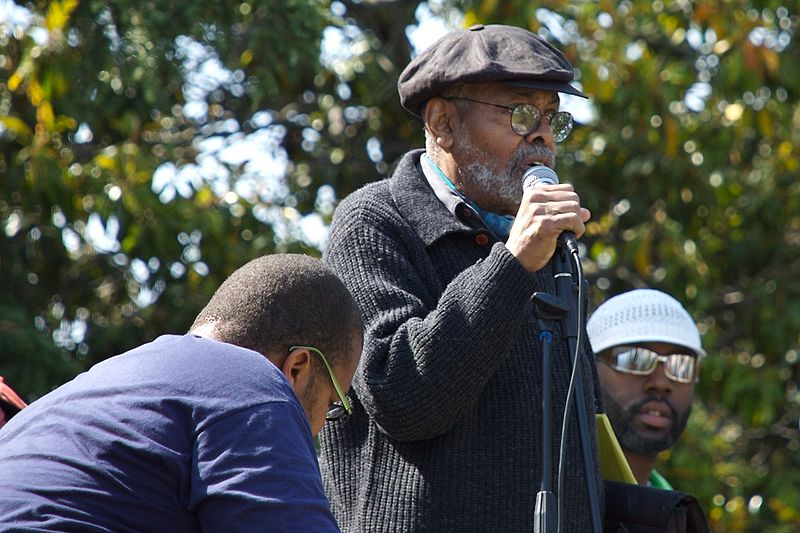
Amiri Baraka addressin Malcolm X memorial Event. Image by David Sasaki from
Top 10 Sensational Facts about Amiri Baraka
Amiri Baraka was one of the major forces in the Black Arts movement of the 1960s and ’70s, which sought to duplicate in fiction, poetry, drama and other mediums the aims of the black power movement in the political arena. Amiri was born Everett LeRoi Jones in Newark, New Jersey, on October 7, 1934. He attended Rutgers University for two years, then transferred to Howard University, where in 1954 he earned his BA in English. He joined the Greenwich Village artists, musicians and writers in Lower East Side of Manhattan. As the racial climate of the ‘60s heated up, Baraka penned a controversial off-Broadway play “Dutchmanâ€� that won an Obie Award for Best Off-Broadway Playâ€� and was later turned into a film.
The assassination of Malcolm X shifted Baraka away from the Bohemian scene and into Black radicalism. He converted to Islam and changed his name to Baraka was a key member of the Black Arts Movement. He was also the secretary-general of the National Black Political Assembly and chairman for the Congress of African People. In 1972, he helped organize the National Black Political Convention in Gary, Indiana.
He published his first volume of poetry, Preface to a Twenty-Volume Suicide Note, in 1961. From 1961 to 1963 he was co-editor, with Diane Di Prima, of The Floating Bear, a literary newsletter. His increasing mistrust of white society was reflected in two plays, The Slave and The Toilet, both written in 1962. The poet’s prolific career went through different stages as politics in his time changed. From a bohemian in NYC to embracing Black Nationalism and later Marxism, Baraka’s political views became the essence of his life. Read on for the Top 10 Sensational facts about Amiri Baraka.
1. Despite Numerous Scholarships he dropped out of College

Students Experiment Station at Howard University in Washington, D.C. Image from
Rutgers University awarded him a full scholarship in 1951, but he left the institution without earning a degree. He also studied philosophy at Columbia University and attended the ‘New School for Social Research’ without obtaining a degree. The renowned African American writer, poet, and playwright did drop out of Rutgers University. Baraka, who was born Everett LeRoi Jones, enrolled at Rutgers University in 1951 but left in 1952 to join the US Air Force during the Korean War. After serving in the military, Baraka returned to the United States and attended Howard University, where he earned a degree in English. He went on to become a prominent figure in the Black Arts Movement of the 1960s and 1970s, using his writing to express political and social commentary on issues affecting Black Americans. Baraka’s decision to drop out of Rutgers University did not hinder his success as a writer and intellectual, as he went on to make significant contributions to the literary and cultural landscape of the United States.
2. Amir Baraka was Dishonourably Discharged from the Military
In 1951, Baraka enlisted into the U.S. Air Force and was promoted to sergeant, but was given a dishonourable discharge for violation of his oath of duty, reportedly for reading communist writings. At the time, Baraka was stationed at a base in Puerto Rico where he became involved in left-wing political activism. He joined the Socialist Workers Party and began writing articles for the party’s newspaper, which were critical of U.S. foreign policy and the military. Baraka’s political activities attracted the attention of his superiors, who viewed him as a potential security risk. He was investigated by military intelligence and eventually discharged from the Air Force under less-than-honourable conditions. Baraka has said that his discharge was related to his refusal to cooperate with military authorities who wanted him to inform on his fellow activists. He has also suggested that his discharge was racially motivated, as he was one of the few African Americans stationed at the base.
Interesting Read; World War II – Actions of USA Presidents.
3. Why Did Amiri Baraka Change his Name?
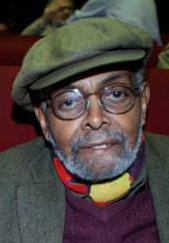
Image by Swing333 from
Amiri Baraka, born Everett LeRoi Jones, changed his name in the 60s as a reflection of his political and cultural beliefs. He adopted the first name Amiri, which means which translates to Blessed Prince who commands with authority in Arabic and Baraka, which means “blessing” in Swahili. The name Imamu Amiri Baraka was part of his move towards embracing black nationalism and rejecting his former identity as a Beat poet associated with the white counterculture. Baraka was a prominent figure in the Black Arts Movement of the 1960s and 1970s, and his name change was symbolic of his commitment to black culture and politics. It’s worth noting that Baraka’s name change was not without controversy, and he faced criticism from some who saw it as a rejection of his African American and African diasporic roots. However, Baraka defended his decision as a way to assert his cultural and political identity and to reject the white-dominated culture of America.
4. Amiri Baraka’s life changed after the Death of Malcolm X

Malcolm X on a stretcher after being shot. Image by United Press International from .
Amiri Baraka’s life was deeply affected by the death of Malcolm X, who was one of his close friends and a fellow activist in the civil rights movement. Baraka, who was then known as LeRoi Jones, had been a follower of Malcolm X and had embraced his teachings of black pride, self-determination, and resistance against oppression. After Malcolm X’s assassination in 1965, Baraka became increasingly radicalized and shifted his focus towards Black Nationalism and Marxist politics. He became more outspoken in his criticism of white supremacy and the capitalist system and his writing reflected this shift in his political ideology.
Baraka’s play “Dutchman,” which was written shortly after Malcolm X’s death, is considered one of his most powerful works and reflects his new political stance. The play deals with issues of race, identity and power; a scathing critique of white America’s treatment of black people. The death of Malcolm X had a profound impact on Amiri Baraka’s life and work, leading him to embrace a more radical political ideology and become a prominent voice in the Black Nationalist movement.
5. Amiri was a Highly Controversial Man!
Amiri Baraka was a highly controversial figure throughout his career as a poet, playwright, and political activist. Baraka’s work often addressed issues of race, politics, and identity. He was known for his outspoken and provocative views. Baraka’s views on race and politics also drew criticism. He was accused of anti-Semitism for some of his statements, and he was criticized for his support of controversial figures such as Louis Farrakhan and Fidel Castro. In The Dutchman, he depicted the distance between whites and blacks and unreservedly came to celebrate black violence against white oppression. He remained driven, after being beaten and arrested during the Newark riot, to write plays and poetry, but they were often undermined by his political agenda, which was connected to the Black Power movement. Baraka incited controversy throughout his career he was praised for speaking out against oppression as well as accused of fostering hate. Despite the controversy surrounding his work his poetry and plays continue to be studied and performed today.
Here are the 10 famous Historical African American events in the US.
6. Amiri was Involved Love Affair with a Fellow Poet
Amiri Baraka had an extended affair in the ’60s with Dominique di Prima who was a radio personality and social activist based in Los Angeles, California. She is best known as the host of “The Front Page,” a morning talk show that airs on KJLH Radio in Los Angeles, which focuses on current events, politics, and social justice issues. DiPrima has been involved in various social and political causes throughout her career, including environmental justice, education reform, and criminal justice reform. She is also a strong advocate for women’s rights and has spoken out against domestic violence and sexual assault. In addition to her work on the radio, DiPrima has also served as a television host and producer, appearing on numerous programs and documentaries. She has received several awards for her work, including the NAACP’s Excellence in Radio award and the Keeper of the Flame award from the Black Business Association.
Who are the Most Famous Black Poets of All Time? CLICK HERE
7. The Poet Laureate Scandal

Image J$S Photography/Videos from
Baraka was New Jersey’s first poet laureate in 2002 and 2003, but after he delivered his poem Somebody Blew Up America? in which he accused the U.S. government and Israel of orchestrating Sept. 11, just ten months after the attacks, calls for his resignation dogged him. Then-Governor Jim McGreevey tried to remove Baraka from the post, but could not legally do so. Instead, the New Jersey state legislature abolished the position, effectively removing Baraka from the post. The poem was widely criticized for its anti-Semitic content, and Baraka faced calls for his resignation as Poet Laureate.
Some critics accused him of promoting conspiracy theories and promoting hate speech. In response, Baraka defended his poem as a critique of American foreign policy and argued that he was exercising his right to free speech. He refused to apologize for the controversial statements in his poem, but did express regret that his words had caused offense to some members of the Jewish community. After the New Jersey legislature abolished the position in 2003, and the state has not had a Poet Laureate since.
8. His Political Stance was Fluid

Image by J&S Photography from
He was known for his radical views on race, politics, and culture. Over the course of his life, Baraka’s political views and affiliations underwent several shifts and transformations, making it difficult to characterize his political stance as strictly “fluid.” In the 1950s and early 1960s, Baraka was associated with the Beat movement and espoused a bohemian, anti-establishment perspective. He was also an advocate for Black Nationalism and cultural separatism, and he rejected the integrationist stance of mainstream civil rights leaders like Martin Luther King Jr. In the mid-1960s, Baraka’s politics became more explicitly Marxist and revolutionary.
Amiri embraced the Black Power movement and founded the Black Arts Movement, which sought to create art that was explicitly political and rooted in the experiences of black people. He also became involved in various leftist political organizations, including the Revolutionary Communist League and the Congress of African People. In the late 1970s and early 1980s, Baraka’s political views underwent another shift, as he became disillusioned with the failures of the revolutionary left and began to explore a more spiritual and nationalist perspective. He converted to Islam and changed his name to Imamu Amiri Baraka, and he began to focus more on cultural and educational work within the black community.
Some Facts about Ralph Ellison.
9. Amiri was an Influential Experimental Fiction Author

With fellow poet Caterina Davinio. Image by Swing333 from
His experimental fiction of the 1960s is considered some of the most significant African-American fiction since that of Jean Toomer. Writers from other ethnic groups have credited Baraka with opening “tightly guarded doors� in the white publishing establishment, noted Maurice Kenney in Amiri Baraka: The Kaleidoscopic Torch, who added: “We’d all still be waiting for the invitation from the New Yorker without him. He taught us how to claim it and take it.�While he is primarily known for his poetry and plays, Baraka also wrote experimental fiction that challenged traditional narrative forms and explored themes of race, class, and identity.
One of his most famous works of experimental fiction is “The System of Dante’s Hell” (1965), a novel that blends elements of science fiction, social commentary, and surrealism. The book tells the story of a young African American man named Dante who is transported to a dystopian future where society is controlled by an oppressive government and racial tensions have reached a boiling point. Through Dante’s journey, Baraka critiques the social and political structures that perpetuate racial inequality and imagines a radical alternative. Baraka’s experimental fiction is characterized by its daring and unconventional approach to storytelling, as well as its unflinching exploration of the social and political issues facing African Americans in the mid-twentieth century.
Read these 30 Famous African American in History.
10. Amiri Baraka’s Son is the Mayor of Newark

Amiri Baraka’s Son. Image by MontClair Film Festival from
Amiri Baraka, who passed away in 2014, had several children, including a son named Ras Baraka. The son with his second wife, Amina, is the current mayor of Newark, New Jersey. Before becoming the Mayor of Newark, Baraka served on the Municipal Council of Newark and as the principal of Central High School in Newark. He also served as the Deputy Mayor of Newark under former Mayor Cory Booker. Baraka is known for his efforts to improve education, reduce crime, and revitalize the economy in Newark. He has also been a vocal advocate for social justice and has spoken out on issues such as police brutality and racism. In addition to his political career, Baraka is also a published author and has written several books, including “Black Girls Learn Love Hard,” “Black Boys Learn to Be Men,” and “In the Tradition: An Anthology of Young Black Writers.”
Despite having faced opposition throughout much of his career due largely to his outspoken views on racism & other social injustices plaguing America’s post-war society he achieved great success & recognition for his remarkable body of work which continues to be celebrated today. During his later years, Baraka was heavily involved with teaching creative writing at colleges throughout America including San Francisco State University, Rutgers University, Columbia University, Stanford University, SUNY Buffalo, George Mason University, Cornell University, Princeton University, Yale University, Brown University and Oberlin College among others.
Planning a trip to Â鶹APP ? Get ready !
These are ´¡³¾²¹³ú´Ç²Ô’²õÌý²ú±ð²õ³Ù-²õ±ð±ô±ô¾±²Ô²µÂ travel products that you may need for coming to Â鶹APP.
Bookstore
- The best travel book : Rick Steves – Â鶹APP 2023 –Ìý
- Fodor’s Â鶹APP 2024 –Ìý
Travel Gear
- Venture Pal Lightweight Backpack –Ìý
- Samsonite Winfield 2 28″ Luggage –Ìý
- Swig Savvy’s Stainless Steel Insulated Water Bottle –Ìý
We sometimes read this list just to find out what new travel products people are buying.


