
 English


And breathe neon sign. Photo by Max van den Oetelaar.
25 Interesting Facts About Oxygen
Breathe in… exhale. Ahh. Hooray for oxygen, the element that powers much of Earth’s life.
Element No. 8 on the Periodic Table of the Elements is a colorless gas that accounts for 21% of the Earth’s atmosphere. Because it’s everywhere, it’s easy to dismiss oxygen as dull and inert; however, it’s the most reactive of the non-metallic elements.
According to a NASA-funded study published in 2007, the Earth has been oxygenated for approximately 2.3 billion to 2.4 billion years, with levels beginning to rise at least 2.5 billion years ago.
According to the study’s researchers, it’s possible that geologic changes on earth caused oxygen produced by photosynthesizing organisms to stick around rather than being consumed in geologic reactions, which is why this lung-friendly gas suddenly became a significant part of the atmosphere.
1. There was controversy regarding its discovery
Although Scheele (a Swedish Pomeranian and German pharmaceutical chemist) independently discovered oxygen, Joseph Priestley received credit in 1774 because Scheele’s work was not published. However, today, Carl Wilhelm Scheele and Joseph Priestley are both credited with discovering oxygen.
Priestley discovered oxygen by heating red mercuric oxide and experimenting with colorless gas. He devised an experiment to see if plants could produce oxygen. When he placed a burning candle in a closed container, all of the oxygen in the container extinguished the candle’s flame quickly. Then he replaces the plant and relights the candle, and this time the flame remains lit. This demonstrated that plants produce oxygen, a gas that allows fuels to burn.
2. Oxygen is formed in the hearts of stars
The fusion of a carbon-12 nucleus and a helium-4 nucleus produces oxygen in the hearts of stars (also known as an alpha particle). However, scientists have only recently been able to peer into the nucleus of oxygen and unravel its structure.
Dean Lee of North Carolina State University and his colleagues reported in March 2014 that they had determined the nuclear structure of oxygen-16, the most common isotope of oxygen, in both its ground state (the state in which all electrons have the lowest possible energy levels) and its first excited state (the next energy level up).
3. Too much oxygen can be harmful
Humans require oxygen to survive, but too much of it can be harmful because oxygen is an oxidant. When there is an excess of oxygen in the body, the body system converts the excess oxygen into a reactive negatively charged ion that can bind to iron; a hydroxyl radical is formed, which can damage lipids in cell membranes. Fortunately, the body stores antioxidants to combat daily oxidative stress.
4. There is an oxygen cycle

Co2 and O2 icons. Photo by piyaset.
Nature circulates oxygen through a process known as the “oxygen cycle.” Aerobic organisms (living things that require oxygen) use the oxygen produced by photosynthesis, and the aerobic organism also produces carbon dioxide, which is required during photosynthesis.
5. The liver consumes the most oxygen
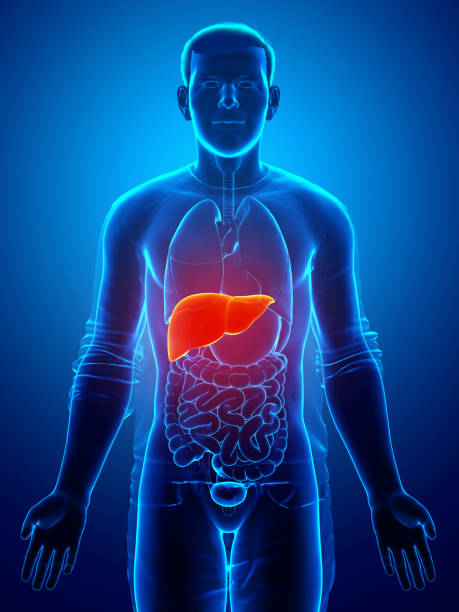
Liver Anatomy. Photo by sankalpmaya.
A human body weighing 60 to 63 kg consumes 250 ml of oxygen per minute, with the liver (20.4%), brain (18.4%), and heart (11.6%) being the major organs that consume oxygen. Oxygen atoms are essential components of DNA and protein in the human body.
6. You can buy oxygen
People can now purchase portable oxygen for $13 per bottle. Most heavily polluted areas and cities, such as China, have their own air/oxygen purifier built into their homes. However, most citizens still consider air/oxygen purifiers to be prohibitively expensive, so they simply wear a flu mask to mitigate the negative effects of pollution on the human body.
According to reports, customers have two options: “pure oxygen,” which contains 97% oxygen and a few other gases, or “fresh clean air,” which contains 78 percent nitrogen, 21% oxygen, and a few other gases.
7. Warm water holds less oxygen than cold water
Warm water holds less oxygen than cold water because the water molecules in cold water are closer together, making it more difficult for oxygen molecules to escape. In addition, oxygen dissolves more readily in warm water than in cold water.
8. The word ‘oxygen’ came from the Greek word Oxys and Genes
The first letter of the word, oxy-, is Greek. The second part, -gen, is derived from a Greek element that means “producing” or “giving birth to.”
9. Cyanobacteria gave the first oxygen on Earth
Cyanobacteria are thought to have produced the first oxygen on Earth by consuming carbon dioxide and exhaling oxygen.
Scientists believe that photosynthesis by green algae and cyanobacteria produces 70% of oxygen, surpassing the contributions of plants and trees.
10. Fish can extract oxygen from water

Single fish in water. Photo by georgeclerk.
Because water has a higher concentration of oxygen than the gills, fish can extract oxygen from the ocean using their gills. The blood vessels in the gills absorb oxygen from the water as it passes through the gills.
11. Oxygen is used to cure illness

A premature newborn in a special incubator. Photo by Sviatlana Lazarenka.
Many hospitals use oxygen to cure or treat illness in a variety of ways. When newborns and infants are born prematurely, the paediatric incubator provides a safe environment for them to develop. Doctors regulate the amount of oxygen in these areas because too much oxygen can harm newborns.
12. Steel companies are the largest user of oxygen

Hot steel on a conveyor. Photo by zhaojiankang.
Because oxygen is so important to steel quality, steel companies are the largest users of oxygen in the industry. Workers use pressurized oxygen to remove undesirable compounds from steel during the forging process.
13. Health of water is determined by oxygen content

Reign Water Company canned drinking spring water. Photo by Sustainabilitymatters.
A scientist can examine the oxygen content of bodies of water to determine how healthy they are. If algae grows rapidly in an area where fertilizer run-off reaches a body of water, the amount of oxygen in the area can become too high, harming the ecosystem. Nonetheless, a certain degree of water is required for life to grow because many species rely on it for survival, and as a result, other species rely on them as well.
14. The oxygen needed by a fetus passes through the umbilical cord

Human Fetus Baby in Womb Anatomy. Photo by magicmine.
The mother breathes for the fetus in the womb, not the fetus. The umbilical cord transports the oxygen required by the fetus. If the umbilical cord is still attached, the fetus will not drown in the womb.
15. 300 years ago, Earth’s oxygen density was 30%
Around 300 years ago, the density of oxygen in the earth’s environment was 30%. It is now only 20% and on the verge of dropping to 19%. Some living creatures have adapted to their new surroundings, but humans have not. Everyone should act now to begin better and more environmentally friendly alternative solutions to this growing problem.
Thank goodness for a 21 percent oxygen atmosphere. When oxygen levels reached 35% about 300 million years ago, insects were able to grow extremely large: Consider dragonflies with hawk-like wingspans.
16. Nitrox used by scuba divers contains 80% oxygen

Scuba diver. Photo by Yu Diving.
Nitrox is commonly used by scuba divers (nitrogen and oxygen). It has up to 40% oxygen content, whereas professional divers use pure oxygen or nitrox, which has up to 80% oxygen content.
To avoid toxicity, scuba divers who use oxygen fractions greater than 21% of air require special training. Nitrox has the following benefits for scuba divers: less fatigue, longer bottom times, and shorter surface intervals.
17. Oxygen exists as the allotrope ozone
Three Oxygen atoms combine to form an Ozone molecule (an allotrope of oxygen). Ozone helps to keep the sun’s harmful rays from entering the earth’s atmosphere.
18. Oxygen is paramagnetic
This is a body or substance that, when placed in a magnetic field, exhibits magnetization in direct proportion to the strength of the field; it is a substance in which the magnetic moments of the atoms are not aligned.
19. It is a highly reactive element

Oxygen on a periodic table. Photo by vchal.
It is, in fact, the least reactive of the non-metallic elements. Non-metals are found in Periodic Table groups 14, 15, and 16.
20. The melting point of oxygen is -218 °C

Liquid oxygen in a beaker. Photo by Staff Sgt. Nika Glover, U.S. Air Force.
Oxygen has an average melting point of -218 °C and a boiling point of -189 °C. At room temperature, oxygen is a gas.
21. Oxygen content on earth is unlike other solar system planets
The Earth’s atmosphere is composed of roughly 78% nitrogen and 21% oxygen, with trace amounts of water, argon, carbon dioxide, and other gases. No other planet in the solar system has an atmosphere rich in free oxygen, which is essential to one of Earth’s other distinguishing features: life.
22. Humans use 550 litres of oxygen daily
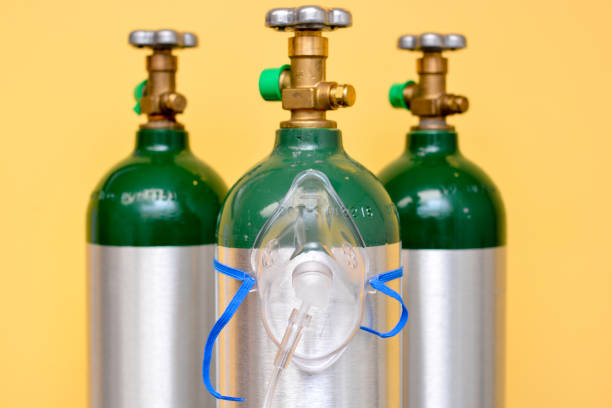
3 Medical Oxygen Tanks with Oxygen Mask. Photo by James Mutter.
Because inhaled air contains about 20% oxygen and exhaled air contains about 15% oxygen, each breath consumes about 5% of the volume of air and converts it to carbon dioxide. As a result, a human uses approximately 550 litres of pure oxygen (19 cubic feet) per day.
23. Oxygen is unreactive with noble gases
Metal oxides, peroxides, and superoxides that dissolve in water react with it to form basic solutions. In addition, oxygen forms covalent oxides with non-metals, which react with water to form acidic solutions. Fluorine and noble gases do not react with oxygen.
24. Oxygen has eight total electrons

Oxygen element formation. Photo by Jonas Reuel.
Two orbit the nucleus in the inner shell of the atom, and six orbit in the outermost shell. The outermost shell can hold up to eight electrons, which explains why oxygen reacts with other elements: Its outer shell is incomplete, allowing electrons to flow freely (and giving).
25. Oxygen is one tough cookie!
According to a 2012 study published in the journal Physical Review Letters, an oxygen molecule (O2) can withstand pressures 19 million times greater than atmospheric pressure.
Planning a trip to Â鶹APP ? Get ready !
These are ´¡³¾²¹³ú´Ç²Ô’²õÌý²ú±ð²õ³Ù-²õ±ð±ô±ô¾±²Ô²µÂ travel products that you may need for coming to Â鶹APP.
Bookstore
- The best travel book : Rick Steves – Â鶹APP 2023 –Ìý
- Fodor’s Â鶹APP 2024 –Ìý
Travel Gear
- Venture Pal Lightweight Backpack –Ìý
- Samsonite Winfield 2 28″ Luggage –Ìý
- Swig Savvy’s Stainless Steel Insulated Water Bottle –Ìý
We sometimes read this list just to find out what new travel products people are buying.


