
 English


Otter cartoon style with a glass of juice. Photo by choirun nazilin.
15 Fun Facts About Otters
Otters nearly became tragically extinct a century ago. It took a concerted conservation effort by environmentalists for them to survive. Otters are usually regarded as cute, lovely, and innocent, but in fact, they belong to the carnivorous Mustelidae family.
The sea otter is North America’s smallest water mammal. Its small size is not a disadvantage, as it has various survival tactics and characteristics.
To stay afloat in the rough seas, sea otters entangle themselves in kelp forests, or giant seaweed, near the water’s surface.
Furthermore, sea otters are not ordinary creatures. They are, however, intelligent and make significant contributions to the environment.
Many interesting facts about sea otters will make you appreciate this tiny animal even more.
1. Not all sea otters are the same
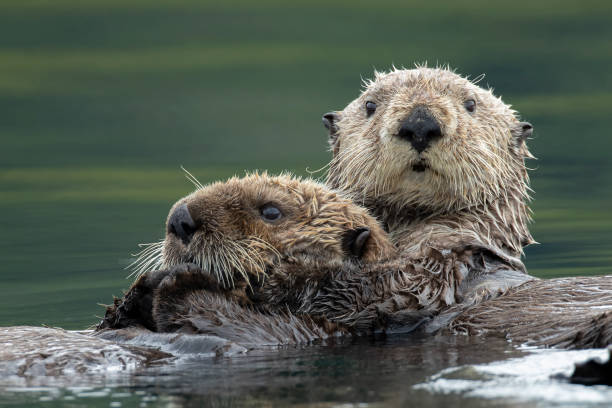
Two sea otters. Photo by Wirestock.
River otters are more often than not confused with sea otters. River otters primarily live in freshwater, but they do swim and hunt in saltwater. They have visible ears, swim belly down, paddle with webbed feet, and move quickly on land and water.
Sea otters are found only along coastlines in the ocean. They move awkwardly on land, paddle with their hind feet and tail, and are much larger than most river otters, with some males weighing up to 100 pounds. In comparison, a male river otter would weigh no more than 30 pounds.
2. Some otters sleep holding hands

Otters sleeping while holding hands. Photo by Sudowoodo.
Mother and pup sea otters sometimes hold hands while floating on their backs. Hand-holding prevents the otters from drifting apart and away from their food source while they sleep. They also sleep with long strands of kelp wrapped around them like a blanket. The kelp acts as an anchor, keeping them from floating away into the open ocean.
3. Otters eat a lot

Close-up shot of Giant otter eating his fish meal. Photo by Wirestock.
Every day, sea otters consume close to 25% of their body weight in food. Sea otters eat:
- sea urchins,
- crabs,
- mussels, and
- clams, which they can crack open with a rock while floating in the water.
Sea otters may dive as deep as 250 feet to find food, using their sensitive whiskers to locate small prey inside crevices or their strong forepaws to dig for clams.
4. They have the thickest fur on the planet
The hair follicles contained on each square inch of their fur are 600,000 to 1,000,000. Otters, unlike most other marine mammals, do not have a blubber layer. Instead, they rely on their dense, water-resistant fur to keep warm. Sea otters spend a large portion of their days grooming and conditioning their fur to keep warm. These traps heat and air near their skin.
5. They are a keystone species
Sea otters help control the sea urchin population along the Pacific coast. Fewer sea urchins help to keep kelp forests from becoming overgrazed. Sea otters have been found to improve seagrass beds in California, and their arrival in Alaska’s Glacier Bay National Park marked the gradual return of a more diverse ecosystem and an exciting moment in colonization efforts.
6. One of the few mammals that uses tools is the otter

An otter holding a stone. Photo by Tom Meaker.
A sea otter’s preferred tool is a rock that can be used as a hammer or anvil to crack open hard-shelled prey. Have you ever wondered where otters keep their tools for safekeeping? They have a loose patch of skin under their armpit where they keep both the food they’ve foraged and the rock they use to crack it open.
7. Otters have a huge lung capacity
Don’t put otters through a breath-holding competition. The lung capacity of an otter is incomparable to any other land mammals. Sea otters have been observed submerged for longer than 5 minutes at a time.
River otters, on the other hand, have the ability to hold their breath for up to eight minutes. The increased time underwater allows otters to detect prey and forage for food.
8. They are fast swimmers

An otter swimming. Photo by belizar73.
Otters speed in water is three times that of the average human swimmer. Otters can hold their breath for 3–4 minutes by closing their nostrils and ears. Their strong tails propel them through the water. River otters also have webbing between their toes to help them navigate.
9. Otters are known by a variety of names
A pup is a baby, otter. They are also known as kittens or kits. Sows are female otters, while boars are male otters.
Otter groups are referred to as a family, bevy, lodge, or romp. The latter is the most commonly used term for a group of land otters. A group of otters in the water is commonly referred to as a raft.
10. Some otters do not have claws
Most otters have sharp claws at the tips of their toes, which aids them in catching prey. However, three otter species have either blunt claws or none at all. The Asian small-clawed otter, African clawless otter, and Congo clawless otter are the three species.
These otters have less webbing between their digits as well. This combination allows them to be more agile when foraging. They use their front paws with dexterity comparable to humans.
11. Otters are expert hunters

Two otters eating fish. Photo by Gerald Corsi.
Otters can eat voraciously because they are skilled hunters. Their powerful and razor-sharp claws allow them to capture their prey. Their forepaws are quite powerful. They have tremendous rubbing, twisting, and pulling power. Furthermore, the tough pads on their palms allow them to grip objects firmly.
12. Otters have a loose skin section for storage
Here’s an otter fact you probably didn’t know! – Otters have small pouches under each forearm to store food gathered after a long day of hunting. They also keep stones in the pouch as hunting tools.
13. Sea otters have multiple sexes

Sea otters nuzzling in the waters. Photo by jtstewartphoto.
The male sea otter practices polygyny, which means he has multiple female partners, according to our list of otter facts.
Male sea otters are aggressive. As a result, they mate with the females in the territory they are defending. When an otter finishes mating with a female, he moves on to his next conquest, ignoring his pup. Male sea otters have also been known to attack and try their luck with baby seals.
14. River otters have a pooping behaviour
Otter poop, according to researchers, has a fishy, pungent odour. The North American river otter poop in the same way that humans do because they have a preferred location for doing so. River otters, like humans, have a specific location near the water where they poop.
Even more intriguing is the fact that North American river otters perform a poop dance. They stomp their hind feet on the ground while lifting their tails. They also expel a substance known to scientists as anal jelly4. It differs from their poop, and the researchers believe it may be bits of an otter’s intestinal lining.
15. Only otter mothers raise their pups
Otter fathers are absent fathers; they do not participate in their offspring’s upbringing. Instead, otter mothers raise their young for the first eight months. Pups are born with their eyes closed. As a result, they cannot swim within the first month of life once they can see where they are going.
Their mother grooms them and blows air into their fur to keep them afloat because the water is too dense for them to swim at first. She also spends 14 hours a day looking for food. She frequently wraps her pup in kelp as an anchor while hunting to keep them together. This experience causes female otters to become ill.
Planning a trip to Â鶹APP ? Get ready !
These are ´¡³¾²¹³ú´Ç²Ô’²õÌý²ú±ð²õ³Ù-²õ±ð±ô±ô¾±²Ô²µÂ travel products that you may need for coming to Â鶹APP.
Bookstore
- The best travel book : Rick Steves – Â鶹APP 2023 –Ìý
- Fodor’s Â鶹APP 2024 –Ìý
Travel Gear
- Venture Pal Lightweight Backpack –Ìý
- Samsonite Winfield 2 28″ Luggage –Ìý
- Swig Savvy’s Stainless Steel Insulated Water Bottle –Ìý
We sometimes read this list just to find out what new travel products people are buying.


