
 English


15 Famous Misanthropes Who Challenged Society
As someone who has always with an optimistic view of humanity, I’ve long been fascinated by famous misanthropes throughout history. These are individuals who distrust, dislike, or outright despise mankind. When I explored the biographies of renowned pessimists, I discovered many complex people who challenged societal norms and assumptions in thought-provoking ways.
For this article, I plan to profile 15 well-known misanthropes who were strongly critical of human nature and behavior. From philosophers like Schopenhauer to authors like Michel de Montaigne to modern-day comedians, I will analyze their unconventional outlooks and how their distaste for humanity manifested in their works and actions.
Some lived as recluses, others used humor or intellectual arguments to convey their dim views of society. Though often depressed, cynical, or disillusioned, these infamous misanthropes contributed powerful perspectives on the darker aspects of human nature that still resonate in today’s world. Read on to discover more.
1. Diogenes (404 BC-323 BC)

, Public domain, via Wikimedia Commons
An influential Ancient Greek philosopher who lived in the 4th century BC. He defied normal societal conventions by living in a large barrel in the marketplace, owning no material possessions. Diogenes‘ philosophy centered around self-control and gaining virtue through willful poverty and simplicity.
He was heavily critical of social norms like wealth, politics, and pride. Diogenes’ unusual lifestyle and blunt, humorous criticism of general human behavior allowed him to challenge and mock social hierarchical structures and superficial values that were widely accepted in Ancient Greek society.
2. Michel de Montaigne (1533-1592)

, Public domain, via Wikimedia Commons
The prominent late 16th-century French philosopher is considered one of the early modern era’s most notable thinkers on humanist skepticism and pessimistic views of human nature. In his highly influential Essays, Montaigne frequently examines the flaws and vanities integral to humanity through an unflinching lens.
He mused extensively on the folly of human emotions, the falseness of societal customs, the inevitability of death and the limitations of human intellect with a sardonic wit. Montaigne’s overarching belief that human judgment was predicated on internal inconsistency and self-contradiction positioned him as a cynical critic of human reasoning and morality.
3. Arthur Schopenhauer (1788-1860)

, CC0, via Wikimedia Commons
The seminal German philosopher was the most influential proponent of philosophical pessimism in the 19th century. In his 1818 work The World as Will and Representation, Schopenhauer described individual human life as characterized by aimless striving and inevitable suffering, an idea he termed, “the will to live.”
Within this pessimistic framework, he viewed humankind’s essential nature as irrational and malign, ever frustrating the achievement of lasting satisfaction. For Schopenhauer, even trivial pleasures and inspirations were fleeting, with true hope or lasting happiness remaining fundamentally illusory and unattainable during our mortal existence.
4. Friedrich Nietzsche (1844-1900)
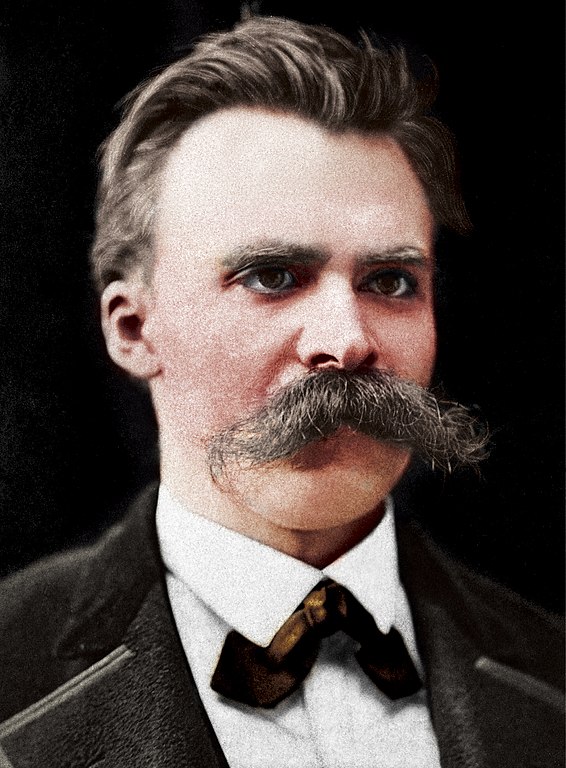
, Public domain, via Wikimedia Commons
The controversial German thinker produced deeply critical theories on religion, morality and modern culture in the late 19th century, often speaking in favor of individual vitality and willpower instead of external ethical systems. In seminal works including Thus Spoke Zarathustra, he outlined his vision of the bermensch, or “overman,” a person who imposes his enlightened values onto society through an uncompromising exertion of creative power – often standing outside the bounds of traditional morality to do so. While not fully misanthropic, Nietzsche‘s elevation of rare great individuals who fundamentally redirect culture reflects an inherent dissatisfaction with wider religious and philosophical trends of the period.
5. Jean-Paul Sartre (1905-1980)

, Public domain, via Wikimedia Commons
The French existentialist philosopher emphasized the centrality of individual human freedom and choice in his mid-20th-century writings. In works like Being and Nothingness and Existentialism is a Humanism, he outlined his belief that lacking an external divine purpose, human existence is ultimately objectively meaningless.
For Sartre, this intrinsically pointless situation paradoxically liberates us to define our own subjective identity and value systems through the cumulative choices we make in life – though taking full responsibility for crafting such an existence can induce profound angst. As such, many famous Sartre quotes grapple with the weight of choosing one’s own nature and moral character without a set external standard to guide the way.
6. Albert Camus (1913-1960)
He was a French-Algerian novelist and philosopher who focused extensively on the apparent meaninglessness and absurdity of life in his essays, novels and plays. As an atheist who rejected religion and belief in God, Camus challenged the idea that life has inherent meaning or purpose and instead argued that individuals must define their meaning and morality in an illogical world.
His ideas influenced the development of absurdist literature and theater in Europe. Major works like The Stranger, The Plague, and The Myth of Sisyphus, captured the isolation and detachment people may feel in response to life’s absurdity. His ideas left a mark on French and European culture and shaped discourse around existential philosophy.
7. Thomas Bernhard (1931-1989)

, , via Wikimedia Commons
An avant-garde Austrian novelist, playwright and poet, regarded for his scathing criticism of Austrian society, culture and politics in the postwar period. Through his controversial literature, which often contained long monologues and rants, he condemned Austria’s refusal to acknowledge its history of anti-semitism and complicity with the Nazis. He scrutinized what he viewed as continuing fascist tendencies among the Austrian establishment.
His confronting works like The Loser, Woodcutters and Wittgenstein’s Nephew, captured his extreme pessimism and negativity towards humanity and society. He is considered a prominent yet controversial voice in German-language literature, impacting the Austrian literary landscape through the provocative questioning of national identity.
8. Michel Houellebecq (born 1956)

, , via Wikimedia Commons
He is a contemporary French author whose fiction frequently expresses misanthropic views and makes sharp criticisms directed at modern society and values. His first novel, Whatever, captured the empty consumerism and cult of youth in contemporary Western culture. Later works like Platform and Submission touch on themes of misogyny, racism, and how radical Islam may prevail over declining secular values.
Houellebecq’s body of work cuts against politically correct discourse and presents controversial dystopian ideas about relationships, death and sexuality in today’s world. He has elicited backlash but also achieved literary fame through his provocative depiction of alienation, disconnection and pessimism with regards to society and humanity in the late 20th and early 21st century.
9. Henry David Thoreau (1817-1862)

, Public domain, via Wikimedia Commons
An American writer, poet, philosopher, abolitionist, naturalist, tax resister, development critic, surveyor, historian, and leading transcendentalist. He is best known for his book Walden, a reflection upon simple living in natural surroundings, and his essay Civil Disobedience, an argument for disobedience to an unjust state.
Thoreau‘s work criticized the materialism and conformity of society, advocating for a simpler, more deliberate way of living that was in harmony with nature. Living for over two years in semi-solitude near Walden Pond, Thoreau wanted to make an individual stand against societal norms and gain a more objective understanding of society.
10. Ambrose Bierce (1842-1914?)

, Public domain, via Wikimedia Commons
He was an American short story writer, journalist, poet, and Civil War veteran known for his satire and wit. He was a critic of hypocrisy, greed, and cruelty in society and for institutions like religion and politics. Bierce gained notoriety as a columnist writing under the pseudonym “Prattle” where his cynical views and vehement attacks earned him the nickname “Bitter Bierce”.
His most famous works include the short story An Occurrence at Owl Creek Bridge and his satirical lexicon The Devil’s Dictionary, which lampooned hypocrisy in the cultural, economic, legal, literary, political, and religious institutions of his day.
11. Samuel Langhorne Clemens AKA Mark Twain (1835-1910)

, Public domain, via Wikimedia Commons
Known by his pen name Mark Twain, was an American writer, humorist, and lecturer. Twain is noted for his novels The Adventures of Tom Sawyer (1876) and The Adventures of Huckleberry Finn (1884), which drew upon his youthful experiences in 1840s Missouri. Though often seen as folksy and nostalgic, Twain’s writing was highly critical of human nature and often satirized societal norms and institutions like religion, politics, and slavery.
Through memorable characters like Huckleberry Finn, Twain challenged the conscience of readers regarding racism, morality, authority and freedom. His incisive wit and insight about the human condition make him one of America’s greatest writers.
12. H.P. Lovecraft (1890–1937)

, Public domain, via Wikimedia Commons
He was an influential American author who pioneered the genre of cosmic horror. Through his fictional works, Lovecraft conveyed a grim, materialist view of a purposeless universe that is oblivious to humanity. His stories describe ancient powerful extraterrestrial beings that are humanity’s remote ancestors, linking the insignificance of humankind to our origins in deep time. Though initially overlooked, Lovecraft’s tales of cosmic indifference and humans’ struggle against forces beyond their comprehension have proven enormously impactful.
Modern horror continues to draw upon Lovecraft’s gloomy materialist themes, and his Cthulhu Mythos fictional universe has become widely recognized in popular culture. Despite his conceptual brilliance, Lovecraft held racist views, even for his time. Nevertheless, his literary legacy continues as new generations discover his works.
13. Yukio Mishima (1925–1970)

, Public domain, via Wikimedia Commons
A prolific Japanese author who became increasingly radical in his right-wing politics during the 1960s. Outraged by the materialism, consumerism and Westernization he saw in post-war Japanese society, Mishima advocated a return to Japan’s samurai traditions and veneration of the Emperor. In 1970, Mishima and a small militant group attempted a coup d’état to inspire a return to such martial values. When this failed, Mishima committed seppuku (ritual suicide by disembowelment) to uphold his principles.
This dramatic final protest shocked Japan and propelled Mishima to international fame. While his politics remain controversial, Mishima is considered one of Japan’s most important 20th-century writers. His works display great range and artistry in chronicling post-war Japanese disillusionment, making him a cultural icon who challenged Japan’s direction.
14. Louis-Ferdinand C̩line (1894 Р1961)

, Public domain, via Wikimedia Commons
A French novelist, pamphleteer, and physician known for literary innovation as well as vitriolic misanthropy and anti-Semitism. His childhood was difficult and he volunteered as a medic during World War I, after which he wrote his first novel Journey to the End of the Night (1932), capturing his generation’s nihilism and mood of desperate revolt through black comedy and the frank, slang-laden language of the Â鶹APPian demimonde.
Though a pioneer of modernist style, his later pamphlets against Jews, Freemasons and parliamentarian democracy reflected an extreme reaction against his war experiences and broader French society. Nevertheless, he is considered one of France’s greatest 20th-century writers for his stylistic achievements and transgressive spirit.
15. Philip Larkin (1922-1985)

, , via Wikimedia Commons
A renowned English poet, novelist and librarian. Though less prolific than some of his contemporaries, he is regarded as one of the best English poets of the latter half of the 20th century. While Larkin experimented with lyrical modernism early on, his later poems exhibit a freelance, parochial style focused on everyday experiences. However, beneath the surface of his verse, there is often a strain of melancholic misanthropy, an acute awareness of life’s disappointments.
Larkin was highly critical of romantic love and increasingly pessimistic regarding modernity’s effects on society in his later years. His published collection The Whitsun Weddings cemented his reputation as a leading voice of what he termed “the post-war generation.”
The misanthropes profiled above held profoundly negative views of human nature that led them to criticize societal norms and assumptions. While their bleak outlooks may seem depressing or even extremist, these individuals had important impacts by bravely voicing opinions that countered mainstream thinking. Though their distaste for humanity led some to become recluses and others to be scorned in their time, their unconventional perspectives on the darker aspects of mankind still resonate strongly today. These infamous misanthropes gave us new lenses to examine our culture, nature, and assumptions about what drives human behavior.
Planning a trip to Â鶹APP ? Get ready !
These are ´¡³¾²¹³ú´Ç²Ô’²õÌý²ú±ð²õ³Ù-²õ±ð±ô±ô¾±²Ô²µÂ travel products that you may need for coming to Â鶹APP.
Bookstore
- The best travel book : Rick Steves – Â鶹APP 2023 –Ìý
- Fodor’s Â鶹APP 2024 –Ìý
Travel Gear
- Venture Pal Lightweight Backpack –Ìý
- Samsonite Winfield 2 28″ Luggage –Ìý
- Swig Savvy’s Stainless Steel Insulated Water Bottle –Ìý
We sometimes read this list just to find out what new travel products people are buying.


