
 English


Image by SPC STEVEN L. PHILLIPS, US Army from
10 Deadliest Natural Disasters of All Time
Earth is a beautiful place but some natural disasters are so terrible; the stuff of nightmares. Even with advancements in science and technology nature has a way of humbling human beings. Although rare Mother Nature will occasionally unleash cataclysmic forces upon unsuspecting communities. From ancient earthquakes, volcanic eruptions and vicious cyclones. Every year nearly 100,000 thousand people perish in natural disasters. While over 150 million are impacted by them worldwide according to WHO. Violent natural disasters are a fact of human life since the beginning of mankind. The death counts of the most ancient of these disasters are lost to history. Survivors are left with permanent scars physical and psychological. So hold on tight as we take a journey through a violent history.
Deadliest Hydrological Disasters
The Yellow River Flood – 1887

Crowd of Chinese refugees of the Yellow River flood who were rescued by Japanese forces. Image by sweeper tamonten from
The Yellow River or Huang He is China’s second-longest river. It was the perpetrator of one of the deadliest natural disasters ever. Its high silt content causes it to overflow its banks, making it susceptible to flooding. In the summer of 1887, the Yellow River burst its banks. Farms, villages and homes were damaged when the river changed its course. The floods killed 900,000 and 2 million people. The catastrophe also had a significant impact on China’s economy because it disrupted trade and transportation and destroyed vast tracts of agricultural land. The floods likewise brought about broad starvation and sickness, with survivors attempting to revamp their lives as a result. In mitigation, the government took steps to reduce to check future floods.
The China Central Floods – 1931
A series of devastating floods struck the central and eastern regions of China. Unusually heavy monsoon rains overwhelmed the Yangtze and Huai river systems and caused widespread flooding. The floods killed an estimated 2 million and affected more than 50 million people. The floodwaters additionally affected yields and domesticated animals, causing far and wide starvation and financial ruin for locals. A massive relief effort to provide flood victims with basic needs and medical care was launched by leader Chiang Kai-shek.
Additionally, the international community contributed resources and aid to alleviate the suffering of flood victims. The 1931 China Central Floods were viewed as a symbol of the weakness of the Chinese government and its inability to protect its people from natural disasters. They had a significant impact on Chinese society and politics. Communist Party of China rose to power by assisting neglected flood victims.
Related Read: 15 Facts about Natural Disasters.
The Deadliest Geographical Disasters Ever
The Shaanxi Earthquake – 1556

Shaangxi 1556 earthquake map of provinces. Image by Roke from
The Shaanxi earthquake, also known as the Great Shaanxi earthquake, struck on January 23, 1556. In human history, is ranked as one of the deadliest earthquakes. It was a magnitude 8 quake on the Richter scale. 830,000 people died while many more were injured. The earthquake caused widespread destruction, including building collapse, landslides, and floods, over an area of approximately 520 miles (840 kilometers). Its effects were felt as far away as Beijing and had a significant impact on both the economy and society. Many buildings collapsed and landslides and aftershocks continued for several months after the initial quake. The Shaanxi earthquake is still a significant event in Chinese history.
10 Things to Know about the Gujarat Earthquake of 2001.
The Tangshan Earthquake – 1976

Image by the National Oceanic and Atmospheric Administration from
The city of Tangshan in China was shaken to the core by an earthquake on July 28, 1976. The death toll stood at between 240,000 to 655,000 people. It was a deadly earthquake. The magnitude is 7.6. The quake was felt by most of northeastern China. It resulted in fires and extensive destruction. The Chinese government initially downplayed the scale of the disaster, but later recognized it and launched large-scale aid measures. Makeshift hospitals were raised to deal with Tens of thousands of people dragged from the rubble. However, many others were trapped and died from their injuries. The Chinese government introduced new building codes after the Tangshan earthquake. Moreover, scientific research on seismology and earthquake prediction in China and around the world was prioritized.
The Indian Ocean Earthquake and Tsunami – 2004
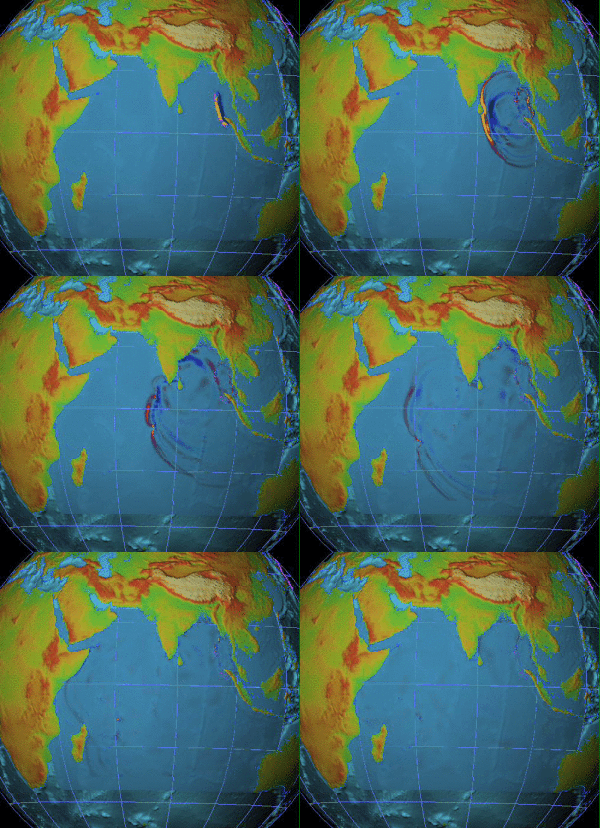
Animation of 2004 Indonesia tsunami by Vasily V Titov from
The Indian Ocean earthquake occurred on December 26, 2004. The earthquake was a magnitude of 9.1-9.3 on the Richter scale. It originated off the west coast of Sumatra, Indonesia. 230,000 people in 14 countries across Asia and Africa were killed by the resultant tsunamis. The earthquake birthed tsunamis with waves that reached heights of up to 100 feet in some areas. Indonesia, Sri Lanka, India, Thailand and several other countries were hit. The destruction and displacement of people were on an epic scale. The international relief effort that was mounted was also massive. The effects of this are still alive in many communities to this day. The destructive power of nature was evident in The Indian Ocean Earthquake. This earthquake and tsunami were one of the books for its deadly force.
The Haiti Earthquake – 2010
On January 12, 2010, Haiti was struck by an earthquake of magnitude 7.0. Port-au-Prince and the surrounding areas were destroyed by the earthquake. 316,000 people died, were injured, or went missing. Homelessness and lack of access to food, water and medical care befell the masses. Humanitarian efforts by the international community massively mobilised for Haiti. Financial assistance, medical supplies and search and rescue teams came from numerous nations. Part of the assistance was to help rebuild Haiti. Notwithstanding aid projects, Haiti’s recuperation has been slow and troublesome, with many difficulties including political precariousness, debasement and unfortunate framework. The earthquake refocused attention on Haiti’s long-term development and recovery efforts.
Deadliest Meteorological Disasters of All-Time
Coringa Cyclone – 1839

The aftermath of the 1839 Coringa cyclone. Image by Monsters and critic from
The cyclone struck Coringa on the evening of November 25th, 1839, and lasted for several hours. in recorded history, this cyclone is estimated to have been one of the deadliest natural disasters. With wind speeds of 120 to 140 miles per hour (193 to 225 kilometres per hour). It was an intense tropical cyclone. The storm surge from the cyclone caused severe flooding in the region. The region was devastated homes and buildings were destroyed and trees and other vegetation were.
The cyclone struck Coringa on the evening of November 25th, 1839 and lasted for several hours. Before the storm, Godavari Delta was a major centre for trade and commerce at the time. Located on the Bay of Bengal, Coringa was once a busy port city the gateway between India and the world at large. 300,000 people, mostly fishermen lost their lives in the disaster. Coringa had sustained massive cyclones in the past, including the Great Coringa Cyclone of 1789 which killed over 20,000 people, but this one was the “MOTHER.�
The Bhola Cyclone – 1970
The devastating tropical cyclone known as the Bhola cyclone made landfall on the coast of East Pakistan—which is now Bangladesh—on November 12, 1970. The number of fatalities was high i.e. 300,000 and 500,000. The cyclone over the Bay of Bengal formed and quickly intensified into a Category 3 cyclone. A storm surge of 10 meters (33 feet) was witnessed. It flooded a lot of Pakistan’s low-lying coastal region. The locale was badly ready for such a calamity, with no early advance notice framework or compelling departure methods set up. The Bhola cyclone had devastating repercussions, causing widespread famine and disease outbreaks. The disaster was a factor in the political upheaval that resulted in Bangladesh’s independence from Pakistan in 1971.
Read These: 15 Alarming Facts about Global Warming.
Galveston Hurricane – 1900
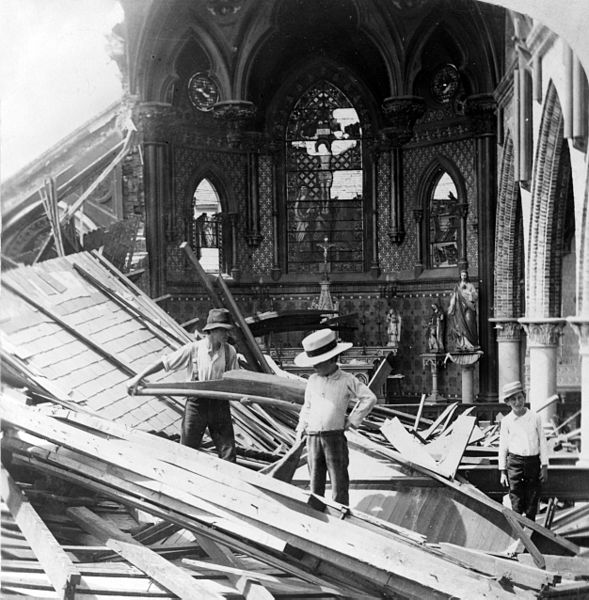
Ruins of church, following a violent hurricane which devastated Galveston. Image by Zahner M H from
The arrival of a hurricane on Sept. 8, 1900, wiped out Galveston; the grandest city in Texas then. The Galveston Hurricane was deadly: the deadliest than any other in United States history. It took with it an estimated 6,000* to 12,000* lives. Its topography as a low-lying island made it vulnerable to storm surges and flooding. The city was ill-prepared for the strength of the hurricane despite weather forecasts and warnings. A 15-foot storm surge caused the floods that destroyed buildings. So devastating was the hurricane of 1900, it’s been estimated that nearly one-fourth of the city’s population died. The inventor Thomas Edison sent a cameraman who arrived several days after the storm had struck. This remarkable record of the disaster is believed to be the first-ever news film. To mitigate the elevation of the island was raised and a seawall was built to protect against future storms.
15 Scary Things about Hurricanes.
Russia Heat Wave – 2010

People cooling off in a public fountain during the abnormal heat wave of 2010. Image by vlsergey from
The Russia heat wave of 2010 was an extreme weather event that occurred in Russia during the summertime. With temperatures reaching as high as 44°C (111°F), it was the h most severe in Russia’s history. 55,000 deaths were attributed to the event as well as widespread forest fires, crop failures and water shortages. Among the victims were thousands of people who drowned during the summer as those with heatstroke – and drunk swimmers – took to pools and rivers to cool down.
A strong high-pressure system and a long-term warming trend caused by climate change. The Russian economy lost $15* billion due to a decrease in industrial output caused by power shortages. The government declared a state of emergency. Relief efforts were launched to provide aid to affected communities. The 2010 Russian heat wave was proof of the dangers of climate change.
Natural disasters destroy and kill a lot of people and the ones mentioned above are some of the deadliest in history. It is impossible to completely avoid them. We can prepare for these disasters by enhancing warning systems and providing assistance and support to affected communities. We should keep on gaining from lessons learnt about these disasters and work towards making a more secure and stronger future.
Planning a trip to Â鶹APP ? Get ready !
These are ´¡³¾²¹³ú´Ç²Ô’²õÌý²ú±ð²õ³Ù-²õ±ð±ô±ô¾±²Ô²µÂ travel products that you may need for coming to Â鶹APP.
Bookstore
- The best travel book : Rick Steves – Â鶹APP 2023 –Ìý
- Fodor’s Â鶹APP 2024 –Ìý
Travel Gear
- Venture Pal Lightweight Backpack –Ìý
- Samsonite Winfield 2 28″ Luggage –Ìý
- Swig Savvy’s Stainless Steel Insulated Water Bottle –Ìý
We sometimes read this list just to find out what new travel products people are buying.


