
 English


Photo by on
Top 10 Sensational Facts about Ansel Adams.
Ansel Adams was born in 1902 in San Francisco, California, he was the most important landscape photographer of the 20th century.
The popularity of his work has only increased since his death. Adams’s most important work brought out the country’s untouched wilderness.
Notably, He was also a vigorous and outspoken leader of the conservation movement.
On receiving his first camera in 1916 Adams proved to be a talented photographer. He created impressive landscape photographs.
He formed a powerful attachment to Yosemite Valley and to the High Sierra that guarded the valley on the east.
Alfred Stieglitz recognized the importance of Adams’s work and gave him the first one-artist show by a photographer in his gallery An American Place.
Adams increasingly used his prominent position in the field to increase the public acceptance of photography as fine art.
Here is a look at top Sensational facts about Ansel Adams.
1. Anselm Adams Consulted for Polaroid and Hasslebad.
 By cquoi –
Adams knew a lot about photography during his era other photographers.
He created ten technical manuals on the discipline and mentored others like Strand and Edward Weston his photographers.
His technical mastery enabled him to react with such immediacy to the quickly changing conditions of the landscape.
Hence the consultation for Polaroid and Hasselblad, to improve their equipment.
Works such as Rocks and Clouds, Sierra Nevada Foothills, California, 1938 needed snap judgments of immense sophistication to capture the momentary effect of sunlight streaming through passing clouds, and establish a balanced tone and focus against the imposing rock formation in the foreground
2. Anselm Adams Became Famous for Photographing a Monolith.
 Half dome by Tuxyso –
He became famous for his photo of a granite summit.
As he became more interested in photographic pursuits got Adams got assistance from Albert Bender an art patron in San Francisco to help him circulate a portfolio of his work.
One of the last images needed to complete the sampler was of the Half Dome, a sheer granite summit in Yosemite that extends 5000 feet above the valley.
to get the shot he wanted Adams climbed to a rock cliff known as the Diving Board. The image, Monolith, the Face of Half Dome, became one of his best-known works.
3. Ansel Adams Broke his Nose During an Earthquake.
He was born in San Francisco to Charles and Olive Adams on February 20, 1902.
The San Francisco great earthquake of 1906 struck when Adams was just 4 years old.
During an aftershock, he lost his balance and fell face-first into a garden wall, breaking his nose. The damage was so severe that it would become a remarkable feature of his face.
His disdain for formal education and his broken nose caused his social anxiety.
Adams chose to be homeschooled by his father and aunt. He then got a “legitimizing diploma� and graduated with an approximate eighth-grade education.
4. He Wanted to Become A Concert Pianist.
 By thaddad55 –
As a student, Adams was hopeless and rebellious but in homeschooling, he was quick to grasp concepts.
He turned out to be a serious and ambitious musician who was considered by qualified judges (including the musicologist and composer Henry Cowell) to be a highly gifted pianist.
Adams taught himself how to read music and play the piano, and it seemed destined to be his career
While photography and the piano shared his attention during his early adulthood, by about 1930 Adams decided to devote his life to photography.
After contributing images to the Sierra Club newsletter and opening a one-man exhibition he decided to make photography his full-time career.
Adams believed that photography could express the same emotions that he felt via music.
As late as 1945, however, he still thought enough of his playing to have a recording made of his interpretations of Beethoven, Chopin, and perhaps others.
5. Adams Photographed the American-Japanese World War II Relocation Camp.
In his writing and speeches, when discussing the Manzanar project and the Owens Valley, Ansel always described the landscape in very emotional and reverential words, “I have believed that the setting of this camp, no matter how desolate the immediate desert surround, was a strengthening inspiration to the people.”
Though Adams is best known for his nature photography, the outbreak of World War II drew his eye to an entirely different topic.
He photographed the Manzanar Internment Camp one of many sites that detained Japanese-Americans.
He captured their poor treatment at the hands of the U.S. government while being forced to exist in war relocation centres.
Adams donated the collection of more than 200 photographs to the Library of Congress in 1965to highlight the suffering the people were undergoing.
The purpose of the photographic record was to show how these people though suffering under a great injustice, had overcome by building for themselves a vital community in an arid environment.
The Manzanar Collection remains an important historical document.
6. Ansel Adams Photo has been to Space.
 Rocket launch by NASA-
In 1941, Adams was commissioned to create photographic murals of national parks and monuments to decorate the halls of the new Department of Interior headquarters.
The most acclaimed work from the commission is The Tetons and the Snake River, Grand Teton National Park, Wyoming which was captured just before the project was discontinued due to financial constraints resulting from America’s entry into World War II.
The image encapsulated the concept of the mysterious, untamed West so well that it was included amongst the pictures electronically placed on the phonograph records that are carried upon the Voyager I and 2 spacecraft.
The contents were selected by NASA and Carl Sagan as a means of articulating to extra-terrestrial life the environment of Earth and the human experience.
7. Ansel Adams Regretted Destroying his Negatives.

Photo by Richard Byrd Photographer –
In order to stir up interest for his Portfolio VI book collection in 1974, Adams purposely limited the number of copies available by advertising that no more reproductions could ever be struck from the original negatives.
He had run the negatives across a check cancelling device destroying them.
Adams later regretted the decision, writing in his autobiography that “negatives should never be intentionally destroyed.�
8. Adams Refused to Take a Photo of a President.
 By liftarn –
Adams was a consummate nature lover.
His political views on environmental conservation were embedded in the fabric of his identity. When politicians didn’t agree, he had no qualms confronting them.
Adams refused to take a presidential portrait of Richard Nixon due to Nixon’s reluctance to support public lands.
After meeting Ronald Reagan in 1983, Adams expressed disinterest in any further communication according to him the president had no fundamental interest or knowledge in the environment.
9. Ansel Adams Didn’t Like Colour Photography.
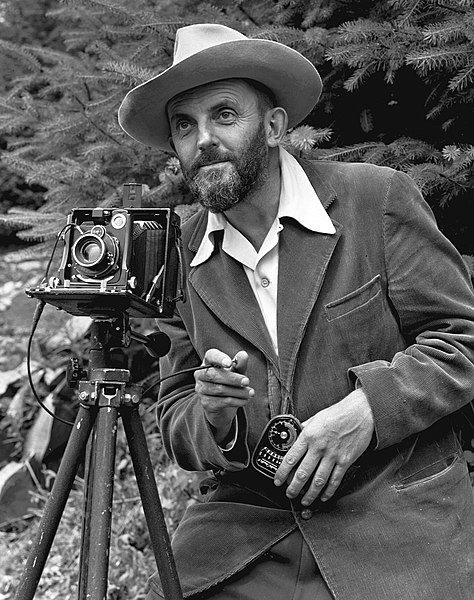 by J Malcom Greany –
Adams mostly used colour photography for commercial assignments, but occasionally for artistic experimentation.
Between 1946 and 1948, in particular, when a Guggenheim Fellowship again allowed him to explore the National Parks, he photographed prolifically on Kodachrome film.
Perhaps his most visible colour images were the 60 feet-wide Coloramas that later appeared in Grand Central Station.
But he was never entirely happy with colour film.
For him, he always got a greater sense of “colour� through a well-planned and executed black and white image than I have ever achieved with colour photography.
10. Medal of honour
 Medals by
All of Adams’s art was intended to reveal the beauty of national parks their value and document conservation efforts.
President Jimmy Carter gave him the Presidential Medal of Freedom in 1980, It is the highest honour awarded to civilians.
The honour was in acknowledging Adams’s years of work as both a photographer and an environmentalist, the president’s citation said, “It is through [Adams’s] foresight and fortitude that so much of America has been saved for future Americans.�
Carter dubbed Adams a “national institution.�
Ansel Adams’ photography puts the American wilderness on display, highlighting its enormity and beauty through dramatic black and white photos.
Adams’ knowledge of cameras and the science behind them allowed him to visualize his photos before he took them. His long career left us with hundreds of remarkable photos
Adams was a professional nature photographer even though it was not considered lucrative.
he was a master and invented the Zone System that customized, precise exposure and development and filters for each scene, then bleaching and toning to extend the tonal range of the paper. He was also a master touch-up artist with a brush
We will long remember the importance of Ansel Adams’ artistry in immortalizing on film our national triumphs and tribulations.
His legacy for telling our national stories through his imagery will live on.
.
Planning a trip to Â鶹APP ? Get ready !
These are ´¡³¾²¹³ú´Ç²Ô’²õÌý²ú±ð²õ³Ù-²õ±ð±ô±ô¾±²Ô²µÂ travel products that you may need for coming to Â鶹APP.
Bookstore
- The best travel book : Rick Steves – Â鶹APP 2023 –Ìý
- Fodor’s Â鶹APP 2024 –Ìý
Travel Gear
- Venture Pal Lightweight Backpack –Ìý
- Samsonite Winfield 2 28″ Luggage –Ìý
- Swig Savvy’s Stainless Steel Insulated Water Bottle –Ìý
We sometimes read this list just to find out what new travel products people are buying.


