
 English


Johnie Ray – Photo by Allan Warren from
Top 10 Interesting Facts about Johnnie Ray
Though barely remembered today, Johnnie Ray was an extremely popular American pop star of the 1950s, considered to be the father of rock and roll. He developed a unique rhythm-based singing style described as alternating between pre-rock rhythm and blues and a more conventional classic pop approach.
Johnnie Ray was born on January 10, 1927, in Dallas, Oregon and started his music career as a pianist at an early age before he broke into international music scene in the 1950s. His dramatic stage performances and melancholic songs have been credited by music historians as precursory to later performers ranging from Leonard Cohen to Morrissey.
Let’s look at the 10 Interesting Facts about him
1. He was Partially Deaf
Johnnie Ray was born healthy and without hearing problem. However, at the of 12 he suffered a devastating accident on a Boy Scout trip, which left him partially deaf in his right ear. This forced him to perform with a hearing aid throughout his career and also had a deep effect on his development as a person and an artist.
Speaking about his emotional style of performing, Johnnie revealed: “The basis is sincerity. My need for sincerity traces back to when I was a child and lost my hearing. I became withdrawn. I had an emotional need to develop a relationship to other people.
2. He was a Bi-Sexual
Throughout his career, Johnnie Ray’s sexual orientations were at the centre of public discussions. Many people believed he was a bi-sexual although he never came forward to deny or accept the allegations in an era when it was against the law to be gay.
Rumours about his sexuality began to spread after he was arrested for accosting and soliciting for sex from an undercover male police officer in the restroom f the Stone Theatre, a burlesque house in Detroit, Michigan.
A few years later, Ray was arrested again for the same offense in a bar that was described as a haven for musicians and gay communities. He went to trial and was found not guilty by a jury that was mainly made of old white women. Two years after his death, several of his friends shared with biographer Jonny Whiteside their knowledge that Ray was bisexual.
3. He was married for one Year

Johnnie Ray and Martha Morrison – Photo Source:
Despite being arrested for same-sex related charges on two occasions, Ray married Marilyn Morrison, daughter of the owner of the Mocambo nightclub in 1952. The wedding ceremony took place in New York and it made headline on The New York Daily News cover story for May 26, 1952.
Morrison was all aware of the singer’s unorthodox sexuality from the start, telling a friend she would “straighten it out.” However, the marriage did not last long and the couple separated in 1953 and were legally divorced in 1954.
In a 1953 newspaper interview with James Bacon, Ray blamed rumours about his sexuality for the breakup of his marriage to Morrison but did not openly admit to it.
4. He struggled with Alcoholism
Johnnie Ray struggled with alcoholism throughout his adult life although the extent of his drinking problem was not publically known at the height of his fame in the1950s.
According to his biographer Jonny Whiteside, Ray drank heavily then and was even arrested on September 2, 1952, in Boston for public intoxication, but was released four hours later. He later quit drinking shortly after he was hospitalized for tuberculosis in 1960.
Ray resumed heavy drinking in 1969, after an American doctor informed him that he was well enough to drink an occasional glass of wine. His health began to decline and he did not fully recover until his death in 1990 as a result of liver failure.
5. He is considered to be the Father of Rock and Roll

Photo Source:
Johnnie Ray has been recognized by many music pundits as the pioneer to what became rock and roll, for his jazz and blues-influenced music, and his animated stage personality.
Inspired by rhythm singers like Kay Starr, LaVern Baker and Ivory Joe Hunter, Ray developed and introduced a unique rhythm-based style, described as alternating between pre-rock R&B and a more conventional classic pop approach.
He also introduced performing style that is today mostly associated with rock and roll, which includes the tearing of hair, falling to the floor, and crying onstage.
6. His Fame didn’t last Long in the United States
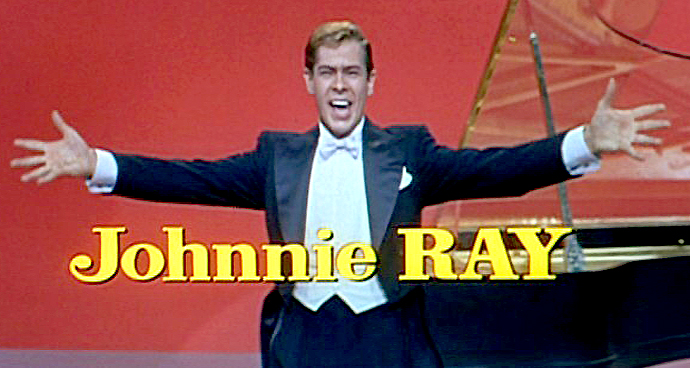
Photo Source:
After scoring a big successes in the early years of his career which quickly saw him rise from obscurity to a superstar, his career in the United States began to decline towards the end of the 1950s. His American record label dropped him in 1960 and he never regained a strong following there and rarely appeared on American television after 1973.
Ray’s decline in popularity is mostly attributed to the entry at the music scene of Elvis Presley and the Beetles, both who took America’s music industry by storm in the late 1950s and early 1960s.
By 1980s Ray was almost forgotten in the United States and some writers suggested that the reason American entertainment bookers and songwriters ignored him in the 1980s was because they simply did not know who he was.
7. He remained Popular in Europe until his Death
Photo Source:
Though Johnnie Ray’s popularity began to decline in the United States as early as 1957, his fan bases overseas remained strong until his death in 1990. Throughout the 1970s and 1980s, Australian, English, and Scottish promoters booked him for large venues as late as 1989, his last year of performing.
Ray had scored a couple of number-one hits in the United Kingdom in the 1950s and had remained popular there even breaking the attendance record at the London Palladium formerly set by fellow Columbia Records artist Frankie Laine.
8. He started singing as a Child
Johnnie Ray was born on January 10, 1927, in Dallas, Oregon to parents Elmer and Hazel Ray. He began playing the piano at the age of three and started singing at the local church choir at the age twelve.
Ray began singing professionally on a Portland, Oregon, radio station at age 15, sharing billing with Jane Powell, then a local young singer. He later performed in comedy shows and theatrical productions in Seattle, Washington before relocating to Detroit, Michigan.
In Detroit, Ray regularly performed at the Flame Showbar, an African-American nightclub, where he developed a local following before he broke in the international music scene in the early the 1950s.
9. He starred in a movie alongside Marilyn Monroe

Johnnie Ray and Mitzi Gaynor – Photo Source
During the highlight of Ray’s career in the 1950s, 20th Century Fox capitalized on his stardom by including him in the ensemble cast of the movie there’s No Business like Show Business. He starred alongside movie stars Dan Dailey, Donald O’Connor, Mitzi Gaynor, and Marilyn Monroe.
This was his first and only motion picture he starred in other than the Rogue’s Gallery, which was never distributed to theatres. Asked why he never had made another widely seen film after There’s No Business Like Show Business, he replied, “I was never asked.
10. He was the “Teens Idol� in the 1950S
Before the arrival of Elvis Presley, The Bee Gees, and The Beetles in the American music scene, Johnnie Ray was the real deal in the rock and roll genre of music.
Although Ray’s first record for the race label Okeh, Whiskey and Gin, did not do well in the bill boards, he was quickly moved to the Columbia label after the executives at Columbia Records realized that he had developed a fan base of Caucasian listeners.
In 1952, he dominated the American popular music charts with the double-sided hit single of “Cry” and “The Little White Cloud That Cried”. Selling over two million copies of the 78 rpm single, Ray’s delivery struck a chord with teenagers and he quickly became a teen idol.
Planning a trip to Â鶹APP ? Get ready !
These are ´¡³¾²¹³ú´Ç²Ô’²õÌý²ú±ð²õ³Ù-²õ±ð±ô±ô¾±²Ô²µÂ travel products that you may need for coming to Â鶹APP.
Bookstore
- The best travel book : Rick Steves – Â鶹APP 2023 –Ìý
- Fodor’s Â鶹APP 2024 –Ìý
Travel Gear
- Venture Pal Lightweight Backpack –Ìý
- Samsonite Winfield 2 28″ Luggage –Ìý
- Swig Savvy’s Stainless Steel Insulated Water Bottle –Ìý
We sometimes read this list just to find out what new travel products people are buying.


