
 English


Top 10 Facts about James Fenimore Cooper
James Fenimore Cooper (September 15, 1789-September 14, 1851) was a Yale-educated 19th century American Novelist.
He was named after his granddad who moved to the USA frontier lands from England.
His father William Cooper was a federalist of repute.
Despite the fact that he received a considerable inheritance he was on the brink of bankruptcy by the age of thirty and that is when he decided to venture into authorship.
His works drew inspiration from the frontier life of early settlers vis-a-vis their interaction with the native Indians.
1. James F Cooper Contributed to the Creation of the American Literature Genre

Image by from
It is a fact that Cooper’s literary creativity was fertile; during his literary life, he produces 32 novels, 12 works of nonfiction, a play and numerous articles.
His most lasting contributions to American literature were his Leatherstocking Tales about Natty Bumppo a fictional character and the protagonist of his novels presented as the child of white parents who grew up among Delaware Indians and was educated by Christians.
The setting draws the reader into an experience of romantic adventure and a realistic narrative.
He penned down several sea stories and the works are well regarded amongst naval historians,
2. Cooper Lived in a Town Bearing his Family’s Name
Born on September 15, 1789, Cooper grew up in Burlington, New Jersey. He was the second last born of twelve children sired by William Cooper and Elizabeth Cooper.
Most of his siblings died during infancy or childhood. His family later moved to New York when he was a year old to a community founded by his father in a place aptly named Cooperstown.
His father had bought the land in a public auction; He constructed a house along Otsego Lake which was known as Otsego Hall where the family resided.
He lived in the town for most of his life.
3. James Cooper was Motivated to Write a Novel by his Wife’s Wager

Image by Dmitry Makeev from
In 1811 at the age of 21 years old Cooper married Susan Augusta de Lancey who came from a wealthy family and was an avid federalist too.
James Cooper had not dabbled in writing but his wife was an avid reader. In 1820 she bet him that he could pen a better book than the one she was skimming.
Cooper took her up on the dare and published Precaution (1820) which was considered a failure.
The following year he released his second work The Spy: A Tale of Neutral Ground. With the newfound success, he moved to New York to further his career.
4. Cooper was a Political Commentator

Image by Dmitry Makeev from
James Fenimore since childhood was exposed to the politics of the period.
His father was a federalist who opposed British imperialistic machinations in the USA.
Cooper moved and lived in Europe for seven years before returning home. It was during this time that he observed how the British elite exploited the masses with a skewed political system.
His aversion to the excesses of those in power was expressed in scathing prose, exposing the oligarchy patronizing it.
His aim was also to awaken American nationalism, if he achieved this goal is a matter of debate.
5. Cooper Created the American Indian Imagery found Present-day in American Consciousness and Literature
In addition to being an important figure in the creation of American literature Cooper is credited with coming up with classical imagery of the American-Indians.
His book The Last of the Mohicans is a fictional work on the dynamics of two opposing communities: the pioneers and the Indians in the struggle to survive and dominate.
It was his inaccurate depictions of Indians as untamed and spontaneous and deserving extermination that stuck in his readers’ minds.
Unfortunately, this bleak view is still ingrained in the American consciousness for centuries now.
6. James Fenimore Cooper Pranks led to his Expulsion from Yale

Image by Yale University from Wikipedia
At the age of 13 years, Fenimore Cooper was admitted to Yale University.
Perhaps as an early peek into his creative imagination he came up with practical jokes that put him in conflict with college management.
Out of his outrageous pranks, two earned him an expulsion from Yale halting his college education.
In one prank he locked a donkey in the recitation room and in a more brazen one he blew the door to another student’s door.
7. James Cooper was a Member of the Inaugural American Navy
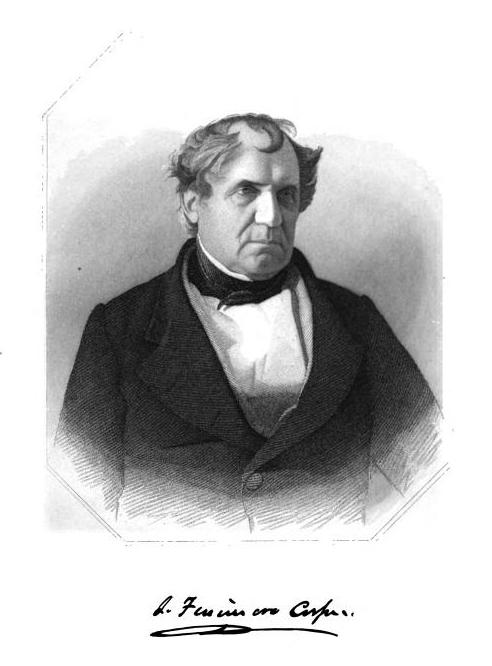
Image courtesy of
A young Cooper photo in the US Navy Midshipman Uniform-Wikimedia
Cooper served in the U.S Navy as a midshipman; the experiences he was exposed to during his commission greatly influenced his novels and papers.
After a disastrous foray into authorship, his first novel being a huge flop, The Spy(1821) a novel on espionage during the American Revolutionary war was a success and cemented his literary prowess.
His early naval experience was as a conscript of the British Royal Navy during Napoleon’s campaign on France.
It was at this point that he vowed to assist in creating an American identity far removed from that of their colonial master
8. James Cooper Advocated for Democracy
James Cooper was a liberal thinker who moved to Europe for seven years to enable his children to get a good education.
While staying in Europe he observed that their politics was fraught with patronage.
Through his writings, he bashed widespread corruption in European regimes.
His conviction on democracy grew he become its vocal champion, however, in America, his sentiments were received with suspicion as he was deemed to have stayed in Europe too long.
Some people thought he had developed aristocratic tendencies.
9. Cooper’s Daughter was an Author too
James Cooper and Susan Augusta de Lancey were blessed with seven children, five of whom lived to adulthood.
Of all the children Susan Augusta Fenimore followed in his father’s literary path.
From the age of 23 years, she served as her father’s literary secretary, thus her induction into publishing.
She was well educated having schooled in France. She did a novel and authored children’s stories but her documentation of nature in the book Rural Hours (1850) put her on the map.
It was a journal of the natural environment of Cooperstown that also established her as a pioneer female naturalist.
10. Mark Twain James Hated Cooper’s Literary Works

Mark Twain pondering over Fenimore Cooper Image by marktwainhouse.blogspot.com from
Mark Twain was an American writer who wore many hats i.e. he was a publisher, a lecturer and an entrepreneur.
He was touted as the father of American literature and was a master satirist.
His most popular works were The Adventures of Tom Sawyer (1876) and Adventures of Huckleberry Finn (1884).
Mark Twain derided James Fenimore’s works by writing a paper detailing all the literary mistakes, omissions and commissions that voided their classification as literary works.
Published in 1895, Fenimore Cooper’s Literary Offenses referred to Cooper’s novels and blatantly declared their content was wanting.
To some observers, it was a declaration that Cooper’s work had no latitude in a post-American civil war literary era.
In the sunset of his career, James Fenimore was respected more in Europe than back home, in fact, his works influenced the iconic Leo Tolstoy amongst others.
Even though mark Twain painstakingly pointed out the weaknesses of his literary choices and works, Cooper’s contribution to establishing American literature is in no doubt.
As proof, his works transcended time some of his novels have been produced as critically acclaimed films.
Planning a trip to Â鶹APP ? Get ready !
These are ´¡³¾²¹³ú´Ç²Ô’²õÌý²ú±ð²õ³Ù-²õ±ð±ô±ô¾±²Ô²µÂ travel products that you may need for coming to Â鶹APP.
Bookstore
- The best travel book : Rick Steves – Â鶹APP 2023 –Ìý
- Fodor’s Â鶹APP 2024 –Ìý
Travel Gear
- Venture Pal Lightweight Backpack –Ìý
- Samsonite Winfield 2 28″ Luggage –Ìý
- Swig Savvy’s Stainless Steel Insulated Water Bottle –Ìý
We sometimes read this list just to find out what new travel products people are buying.


