
 English


Photo by Mike Peel –
Top 10 Astonishing Facts about Jonas Salk
Jonas Edward Salk was born October 28, 1914, in New York City, the eldest of three sons to Russian-Jewish immigrants Daniel and Dora Salk.
The first member of his family to attend college, he earned his medical degree from the New York University School of Medicine in 1939 and became a scientist physician at Mount Sinai Hospital.
In 1942, Salk went to the University of Michigan on a research fellowship to develop an influenza vaccine. He soon advanced to the position of assistant professor of epidemiology.
In 1947, Salk was appointed director of the Virus Research Laboratory at the University Of Pittsburgh School Of Medicine.
With funding from the National Foundation for Infantile Paralysis, he developed a vaccine to wipe out the most frightening scourge of the time: paralytic poliomyelitis.
Hailed as a miracle worker, Salk never patented the vaccine or earned any money from his discovery, preferring it be distributed as widely as possible. Here are 10 astonishing facts about him
1. The March of Dimes Foundation-funded Salk’s Discovery of Polio Vaccine.
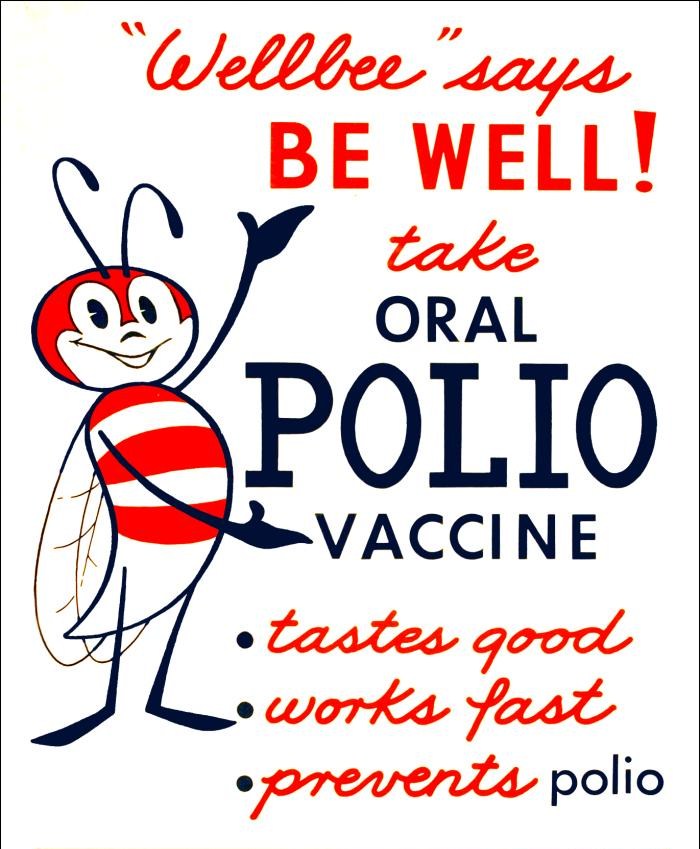
Photo by CDC –
Salk worked on the influenza vaccine at the University of Michigan’s School of Public Health until 1947.
Then he began running a lab at the University of Pittsburgh School of Medicine.
In 1948, he started working on a project for the National Foundation for Infantile Paralysis (later renamed the March of Dimes Foundation) to research the different types of polio.
President Roosevelt created the foundation in 1938 to help other Americans suffering from polio.
The foundation funded many polio research and vaccine trials, including Salk’s.
2. Jonas Salk’s Dad was a Clothes Designer.
Salk’s father, Daniel was the son of Jewish immigrants who came to America from Eastern Europe.
Daniel graduated from elementary school but not high school, and he worked in the garment industry as a designer of women’s blouses.
Salk’s mother, Dora, left Russia for the U.S. in 1901 and had no education.
Because of their limited education, Salk’s parents encouraged him and his two younger brothers to further their schooling and advance in the world.
3. Jonas Salk tested the Polio Vaccine on his Family Members.

Photo by on
Salk tested the polio vaccine he developed on lab monkeys, children in Pittsburgh and himself.
As proof of Strongly believing in the safety and efficacy of his vaccine Salk also injected his wife and their 3 sons in the family’s kitchen, using syringes he had boiled on the stove.
In 1953, Salk published the preliminary results of his human testing in the Journal of the American Medical Association.
By June 1954, 1.8 million polio pioneers were voluntarily injected with Salk’s vaccine (or a placebo) in a double-blind trial.
In 1955, Salk’s vaccine was given the green light. The media reported that Salk’s national trial was a success and the nation was ecstatic.
4. Jonas did not Patent his Polio Vaccine.

Polio vaccination photo by Asap_Kamal –
Salk did not directly profit from his polio vaccine because he didn’t file a patent for it.
When a journalist asked him who owned the patent Salk responded: “The people, I would say. There is no patent.
Salk reportedly objected to owning the patent because millions of Americans had donated money to the March of Dimes, hoping to help eradicate polio.
But according to U.S. patent law, the vaccine wasn’t novel enough to be patentable, so some scholars criticize Salk for presenting himself as a hero when he was probably aware that the vaccine couldn’t be patented.
Forbes estimates that had he owned the patent, Salk could be $7 billion richer.
5. Salk’s Approach to Vaccines was Criticized by some of his Peers.

Dr. Salk fielding questions at CDC in 1955 photo by CDC –
Salk was lauded as a saviour and international hero some of his fellow scientists didn’t agree.
The loudest of the bunch was a Polish-American scientist a kitchen chemist trying to discredit his choice to use a killed poliovirus (rather than live or weakened one) in his vaccine.
Sabin, as well as many of Salk’s contemporaries, incorrectly believed that a killed virus wouldn’t adequately immunize the patient.
Other scientists resented Salk for succeeding outside the medical establishment and for getting all the accolades when he was just one of many researchers working on polio.
In 1962, Sabin introduced an oral (sugar cube) polio vaccine that contained a live virus and the U.S. government adopted Sabin’s vaccine instead of Salk’s because it was cheaper and more effective.
Salk’s vaccine is in use in most parts of the world except for parts of Africa and the Middle East where polio is still a problem.
6. Despite Jonas Salk Nobel Snub his Institute has Produced 5 Laurrettes.

Nobel medal photo by Science Museum London –
Although it may seem foreign to us today, polio was a disease that paralyzed between 13,000-20,000 people per year until Salk developed the vaccine that virtually eradicated it.
Salk brilliantly combined a number of recent discoveries to apply them to creating a poliovirus vaccine and was nominated for the prize in both 1955 and 1956. However, to the Nobel committee, he did not introduce any new thing.
Salk, whose biological institute that has become his legacy, has produced five Nobel laureates in physiology and medicine, but his death in 1995 ensures that he will never himself be awarded one.
Neither Jonas Salk nor Albert Sabin received a Nobel Prize for their work in creating vaccines.
7. Jonas Salk was Step- Father to Pablo Picasso’s Children.

Photo by SAS Airlines –
In 1970, Salk married Françoise Gilot, a French artist who had two children, Claude and Paloma, with Pablo Picasso.
In an interview in 1980, Paloma remembered the fear people had of polio, and that as a child, she didn’t visit her father’s house in the South of France due to a polio outbreak.
She also revealed that she got along well with her stepfather.
After he died in 1995, Gilot continued her late husband’s legacy by working at the Salk Institute for Biological Studies.
8. Salk Continued Research for Cancer and AIDS Cure.

Photo by on
After Salk successfully developed the polio vaccine he tried to develop vaccines for cancer, AIDS and multiple sclerosis (MS).
Although he wasn’t ultimately successful, he patented Remune, a vaccine for AIDS to delay the progression of HIV into AIDS.
In 2001, six years after Salk died Pfizer stopped funding clinical trials for Remune due to a lack of evidence that it worked.
9. Jonas Salk Co-Authored a Book with his Son.
Throughout the 1970s and ’80s, Salk wrote books about science philosophy and mankind.
In The Survival of the Wisest, Salk applied Charles Darwin’s ideas on survival of the fittest to the need for humankind to be educated and knowledgeable.
And in World Population and Human Values: A New Reality, he and his psychiatrist son Dr. Jonathan Salk discussed the interplay between world population growth and human values.
10. Jonas Salk was Rejected by Many Laboratories.

Photo by on
After graduating from medical school at New York University and completing his residency training Salk applied to laboratories to work in medical research.
He opted not to treat patients as a practising physician, Salk hoped to work on the influenza vaccine.
A research area he began studying in medical school.
Although he was rejected from multiple labs, perhaps due to quotas that discriminated against Jewish people he didn’t get discouraged.
In his Academy of Achievement interview, he said “My attitude was always to keep open, to keep scanning. I think that’s how things work in nature. Many people are close-minded, rigid, and that’s not my inclination.”
Although Salk tried many times to share the credit, the public and the media had made him the icon for polio prevention.
With the introduction of the vaccine came a wave of celebrity accorded few scientists in the history of medicine.
Though Salk was undeniably ambitious he had desired to accomplish something great not necessarily to be someone great.
And while other scientists may have blamed him, the attention was not primarily of Salk’s choosing. It cost him a lot personally
Salk spent his last years searching for a vaccine against AIDS. He died on June 23, 1995, at the age of 80 in La Jolla, California. His life’s philosophy is memorialized at the Institute with his now-famous quote, “Hope lies in dreams, in imagination and in the courage of those who dare to make dreams into reality.”
Planning a trip to Â鶹APP ? Get ready !
These are ´¡³¾²¹³ú´Ç²Ô’²õÌý²ú±ð²õ³Ù-²õ±ð±ô±ô¾±²Ô²µÂ travel products that you may need for coming to Â鶹APP.
Bookstore
- The best travel book : Rick Steves – Â鶹APP 2023 –Ìý
- Fodor’s Â鶹APP 2024 –Ìý
Travel Gear
- Venture Pal Lightweight Backpack –Ìý
- Samsonite Winfield 2 28″ Luggage –Ìý
- Swig Savvy’s Stainless Steel Insulated Water Bottle –Ìý
We sometimes read this list just to find out what new travel products people are buying.


