
 English


Sunset at a beach. Photo by Bulaclac Paruparu- Wikimedia Commons
10 Great Facts About Honduras
What do you really know about Honduras, a tiny centrally located American region?
If the response to that query is insufficient, you’re in for a treat! These Honduran interesting tidbits will give you a broad analysis of the nation’s values, population trends, heritage, and geographical features.
Were you aware that Honduras has a Fish Festival? That it was once both a Spanish Honduras and a British Honduras? That Christopher Columbus identified Honduras?
The majority of country’s citizens live in the nation’s mountainous rural area, which may contribute to clarifying the nation’s somewhat more isolated strategy toward Latin and Central American relations. Honduras, just like its neighbors in the area, is a third world country whose residents face numerous socioeconomic obstacles, a scenario exacerbated by difficult terrain and the infrequent extremism of tropical climate changes, such as the widespread destruction caused by Hurricane Mitch in 1998.
Honduras’ actual language is Spanish, and Roman Catholicism is the highest populated faith followed, with roughly two-thirds of the inhabitants practicing it. Protestants make up the majority of the other minorities, with remarkable religious communities in the east and on the Bay Islands. Protestant churches have grown rapidly, particularly since the devastation brought on by Hurricane Mitch in 1998.
Few individuals are acquainted with Honduras. The nation has a horrible image among tourists as it is regarded to be among the state’s most unsafe and rough regions. However, the small amount of visitors who have travelled to Honduras are now obsessed with the large water bodies by the beach and scenic wonders. Below are a few fun facts about Honduras:
1.”Plato Tipico” is Honduras’ native cuisine
Grilled beef, pork sausages, fried plantain, stewed beans, rice, sour cream, fresh white cheese, avocado slices, pickled cabbage, small tortillas, and chismol comprise the plato tipico (pretty standard meal). Undoubtedly, Honduras’ traditional meal is a carbohydrate overabundance.
2.The very first documented foreigner to travel to Honduras was Christopher Columbus
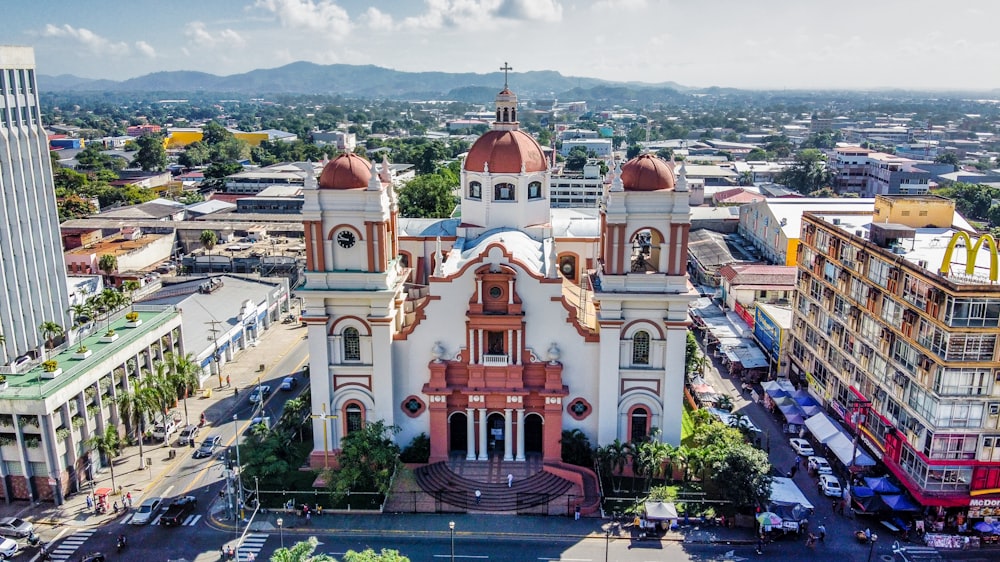
Catedral de San Pedro Sula, Honduras. Photo by Héctor Emilio Gonzalez- Unsplash
During his 4th and last trip to the Americas in 1502, Italian explorer Christopher Columbus initially touched down in Honduras on the island of Guanaja, then on the Honduran territory at the edge of Bay Trujillo.
Despite meeting a few locals, Columbus stopped his adventures in Honduras.
3.You can visit The Mayan Ruins of Copan, which is an unbelievable experience
Copan is the location of the historic Mayan town, in Western Honduras. From AD 426 to 820, it was among the most highly occupied civic regions.
4.Honduran Fish Carnival dropping from the sky
Each year in June or July, Hondurans come together for the Festival de Lluvia de Peces, a one-of-a-kind occasion that’s been successfully held from 1998. Fish literally drop from the sky during the carnival, which is commemorated with tunes, partying, and other celebrations. It’s an extraordinary experience to have and it acts as an example of nature’s splendor and curiosity.
5.Soccer is very prevalent throughout the nation. They even had a war named after it

Cayos Cochinos, Honduras. Photo by Carlos Zacapa- Unsplash
Honduras and El Salvador were facing competition for a place in the 1970 Football World Cup in 1969. El Salvador went through after winning two of three tournaments. The participants exchanged hugs, shook hands, and exited the field.
Both nations were had a military conflict in just a few weeks. The soccer match now was not associated with the fighting. The origins were land distribution concerns in Honduras and border control and population difficulties in El Salvador. The battle started on July 14, 1969, when the Salvadoran army attacked Honduras. On the night of July 18, the Organization of American States (OAS) bargained a desist.
As a result, the identity “100 Hour War” was provided to it.
It’s additionally recognized as the Football War because it took place during soccer tournaments. Several individuals are still convinced that the soccer games served as a trigger, fueling the battle.
6.It is the habitat of a divine bird
Honduras is a birdwatcher’s heaven, with over 700 different breeds. Honduras’ representative bird is the Scarlet Macaw (Aro Macao), which has unique red, blue, and yellow bubbles. It can be discovered in wooded areas throughout northern Central America however, the majority of them reside in the Gracias a Dios pine woodlands. Honduras’ Government decided it the country’s public bird in 1993. Unfortunately because of illegal hunting, its number is rapidly decreasing. They are also common as pets, and are frequently auctioned on the foreign space. One household shields 38 macaw nests among the 600 scarlet macaws that live in the Gracios a Dios. The birds are fed rice, beans, and dried dog food.
7.Belize is another name for British Honduras
Belize was a British protectorate on Central America’s east coast, south of Mexico. When British Honduras attained total independence in June 1973, it was later known as Belize.
8.It was the very first nation to prohibit smoking privately at your residence

Honduras’ national flag. Photo by Héctor Emilio Gonzalez- Unsplash
Honduras implemented an amended rule forbidding cigarettes in public and secluded areas in 2011. It is not prohibited to do so in your own residence however, if a tourist or close relative starts complaining, you could face a visit from the police and a $311 penalty. That is the average of the Central American nation’s total monthly salary. In public places, people who smoke have to be at least 1.8 meters away from non – smokers.
As per Honduran medical experts, approximately 30 out of 100 individuals in Honduras smoke, and 9 out of ten Hondurans who have severe chest infections reside in residences where there is a cigarette smoker.
In accordance with the Department Of health, the government spends $10 to combat smoking-related illnesses, per dollar earned by the cigarette companies in Honduras.
9.Honduras’ remarkable feature, they have two capital cities. Yes TWO!
Honduras’ remarkable capital is an exceptional fusion of 2 towns: Comayagüela and Tegucigalpa. The 2 towns are divided by the Choluteca River and linked by a sequence of piers in the nation’s central region. Honduras’ economic and manufacturing hub is Comayagüela, whereas the electoral and governmental hub is Tegucigalpa. Combined, the 2 towns create Honduras’ thriving capital, a thriving center of movement and heritage.
10.Honduras’ most important international trade is coffee however, they are very big on farming

Dock at dawn in Honduras. Photo by Alex McCarthy- Unsplash
Since the mid-2000s, coffee has since been Honduras’ most important source of foreign exchange. According to reports, the coffee industry generated more than 3.6 million sacks of Arabica coffee in 2019. Honduras also accounts for 4% of the international coffee supply, demonstrating its importance in the coffee production.
Contribution of the agricultural sector is a little more than one-tenth of the nation’s economic output (GDP), before in the twenty-first century, yet it nevertheless hired the largest share (about two-fifths) of the working population. Chiquita (previously United Fruit Company and United Brands) and Dole (previously Standard Fruit and Steamship Company and Castle & Cooke) control a considerable number of the nation’s farm production and generate a significant amount of the country’s revenue by expanding the vast bulk of the nation’s banana plant.
Coffee beans, tobacco, and sugarcane are valuable exported food sources in addition to bananas. Corn is the most common dietary crop. Honduran growers also plant genetically modified maize (which is illegal in the rest of Central America), which has aided in the fight against food scarcity and increasing corn prices. The biggest farm animals exercise is cattle raising, and beef has grown into an industrial powerhouse.
Forest area roughly two-fifths of the nation’s total surface area, creating forest items a possibly massive supplier of economic output. In the 1960s, the comprehensive pine woodlands were hit by devastation, and wood, the substantial wood trading partner, started losing in significance.
The procedure of agricultural production, which involves pervasive wilderness burning and timber trimming for petroleum, has resulted in the exhaustion of natural vegetation. Typical industry woods extortion procedures are ineffective. A major amount of commercially collected wood somehow doesn’t enter the sawmill, and less than half of the wood that does show up at the mill is produced into wood products.
To relief superfluous deforestation methods, the state took over possession of any and all woodlands in 1974, however, woodlands proceed to be exhausted at an astonishing speed.
Fishing is a tiny however, expanding market that takes place primarily off the Caribbean coast. The most vital components of the fishing are shrimp and lobster, the majority of which is exported to the U.S.A.
Planning a trip to Â鶹APP ? Get ready !
These are ´¡³¾²¹³ú´Ç²Ô’²õÌý²ú±ð²õ³Ù-²õ±ð±ô±ô¾±²Ô²µÂ travel products that you may need for coming to Â鶹APP.
Bookstore
- The best travel book : Rick Steves – Â鶹APP 2023 –Ìý
- Fodor’s Â鶹APP 2024 –Ìý
Travel Gear
- Venture Pal Lightweight Backpack –Ìý
- Samsonite Winfield 2 28″ Luggage –Ìý
- Swig Savvy’s Stainless Steel Insulated Water Bottle –Ìý
We sometimes read this list just to find out what new travel products people are buying.


