
 English


Image by Brane Blokar from
Top 10 Incredible Facts about Sinan
Generally considered the greatest of all Ottoman architects, Sinan’s career spanned about 50 years as the chief royal architect. His buildings, mainly his great mosques, are the archetypal image of Turkish Ottoman architecture.
Born in Anatolia, Turkey in 1489, he built hundreds of buildings including mosques, palaces, chapels, tombs, schools, almshouses, schools, caravan serais, granaries, fountains, and hospitals.
The successful career of this great architect and his genius has prompted great interest among historians of architecture and of Islamic civilization in the Ottoman period.
Here are the top 10 incredible facts about him
1. Sinan had a Christian Background
The life story of Sin�n is somewhat complex and full of uncertainties, and some scholars constructed his life story by linking it very much to his Christian origin.
Sin�n was the son of Greek or Armenian Christian parents, and his Christian name was Joseph. He entered his father’s trade as a stone mason and carpenter in his early years.
He was later drafted into the Janissary corps and converted to Islam, and he began a lifelong service to the Ottoman royal house and to the great sultan Süleyman I who reigned between 1520 and 1566.
2. He worked as a military Engineer
After receiving technical education in his early years, Sinan became a military engineer. He rose rapidly through the ranks to become first an officer and finally a Janissary commander, with the honorific title of Sinan.
He refined his architectural and engineering skills while on campaign with the Janissaries, becoming an expert at constructing fortifications of all kinds, as well as military infrastructure projects, such as roads, bridges, and aqueducts.
Sin�n participated in the Persian war and showed great effective skills in the battle of Lake Van when he devised ferries for the crossing of the army through the lake.
3. He was the Chief Royal Architect of Turkish Ottoman

Photo by Moonik from
At about the age of fifty, Sinan was appointed as chief royal architect, applying the technical skills he had acquired in the army to the “creation of fine religious buildings” and civic structures of all kinds.
He headed an extensive governmental department and trained many assistants who, in turn, distinguished themselves, including Sedefkar Mehmed Agha, architect of the Sultan Ahmed Mosque, and Mimar Hayruddin, architect of the Stari Most.
sinan is considered the greatest architect of the classical period of Ottoman architecture and has been compared to Michelangelo, his contemporary in the West. He remained in this post for almost fifty years.
4. Sinan was the architect of at least 374 Structures

Photo by Mostafameraji from
Various sources state that Sinan was the architect of at least 374 structures which included 92 mosques; 52 small mosques, 55 schools of theology 7 schools for Koran reciters, and 3 hospitals.
In geographical terms, his work stretched over most of the regions of the Ottoman Caliphate including, for example, the Mosque of Khorsaw Pasha in Aleppo, and the Mosque of Sultan Suleyman in Damascus.
Others are the dome of the sanctuary of Al-Haram Al-Shareef in al-Quds, the school of Sultan Suleyman in Makkah, the Mosque of Mehmed Pasha in Sofia, and the Palace of Mehmed Pasha in Sarajevo.
5. He constructed the Haseki Complex for Hurrem Sultan
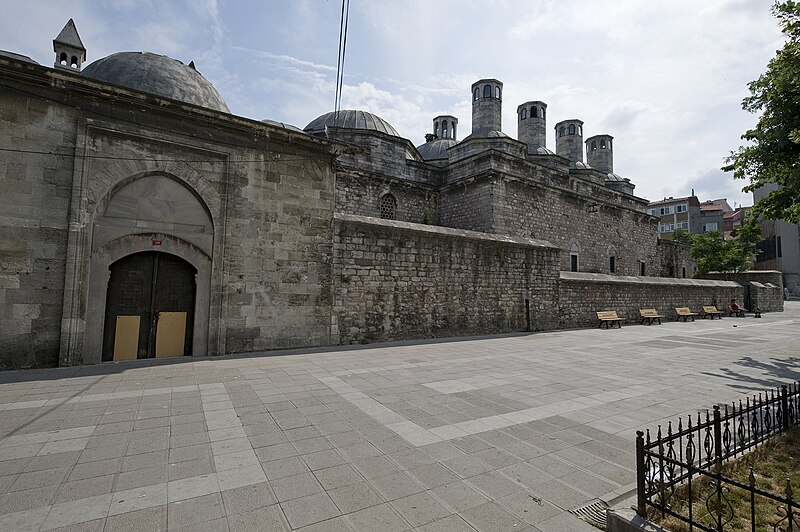
Photo by Dosseman from
Sinan’s first major commission as the royal architect was the construction of the Haseki Sultan Complex for Hurrem Sultan, the wife of the sultan, Suleiman the Magnificent.
During these years he continued the traditional pattern of Ottoman architecture, and he had to follow the plans drawn by his predecessors. He retained the traditional arrangement of the available space without any innovations.
However, he gradually began exploring other possibilities, because during his military career he had had the opportunity to study the architectural monuments in the conquered cities of Europe and the Middle East.
6. Around 196 of his Buildings are still Standing
During his 50 years tenure as the chief royal architect of Turkish Ottoman, Sinan is said to have supervised the construction of 476 buildings. According to the official list of his works, 196 of the buildings are still standing to date.
Although he could not have possibly designed all of them, he relied on the skills of his office, and he took credit and responsibility for their work.
Sinan’s primary responsibility was to the sultan, and only designed buildings for the chief officials in his spare time. He also delegated to his assistants the construction of less important buildings in the provinces.
7. He is buried in a Tomb of his own Design

Photo by Arild VÃ¥gen from
Sinan died in around 1587 and is buried just to the north of the Süleymaniye Mosque in a tomb of his own design in Istanbul. He was buried near the tombs of his greatest patrons: Sultan Süleyman I and Sultana Haseki Hürrem, Suleiman’s wife.
Above the iron-grilled prayer window of his tomb is an epitaph written in Ottoman Turkish by the poet Mustafa Sai. It gives the year of his death and records the works Sinan did in his life.
In 1935, his remains were exhumed by a group of Turkish scholars, who claimed and wanted to prove that he was actually Turkish. Since then the skull is missing and its whereabouts remain unknown.
8. Sinan has been Compared to Michelangelo
Sin�n is considered the greatest architect of the classical period of Ottoman architecture and has been compared to Michelangelo, his contemporary in the West
He was nicknamed Michelangelo of the Ottomans and his works in Suleymaniya Mosque in Istanbul and Selimye Mosque at Edirne are the finest and often compared to Renaissance works of Florence.
Michelangelo and his plans for St. Peter’s Basilica in Rome were well known in Istanbul, and he had been invited to Istanbul twice to submit plans for a bridge spanning the Golden Horn.
9. He First learned his Trade from his Father
From an early age, SinÄ�n followed in his father’s footsteps and learned the skills of his trade. He grew up helping his father in his work, and by the time he was conscripted had a good grounding in the practicalities of building work.
Although his early years are not well documented, there is a brief record dictated by Sinan to his friend and biographer Mustafa Sâi Çelebi. In these manuscripts, Sinan divulges some details of his youth helping his father in his works.
10. He Trained as an Architect in the Military
Sinan was conscripted into Ottoman service under the devshirme system in 1512. He was sent to Constantinople to be trained as an officer of the Janissary Corps and converted to Islam.
Because he was too old to be admitted to the imperial Enderun School in the Topkapı Palace, he was sent instead to an auxiliary school. Some records show that he served the Grand Vizier Pargalı İbrahim Pasha as a novice of the Ibrahim Pasha School.
He initially learned carpentry and mathematics but through his intellectual qualities and ambitions, he soon assisted the leading architects and got his training as an architect.
Planning a trip to Â鶹APP ? Get ready !
These are ´¡³¾²¹³ú´Ç²Ô’²õÌý²ú±ð²õ³Ù-²õ±ð±ô±ô¾±²Ô²µÂ travel products that you may need for coming to Â鶹APP.
Bookstore
- The best travel book : Rick Steves – Â鶹APP 2023 –Ìý
- Fodor’s Â鶹APP 2024 –Ìý
Travel Gear
- Venture Pal Lightweight Backpack –Ìý
- Samsonite Winfield 2 28″ Luggage –Ìý
- Swig Savvy’s Stainless Steel Insulated Water Bottle –Ìý
We sometimes read this list just to find out what new travel products people are buying.


