
 English


Source: http://hdl.handle.net/1887.1/item:731443 from
Top 10 Astonishing Facts about the Arashiyama District
Arashiyama is a pleasant, touristy district on the western outskirts of Kyoto.
The area has been a popular destination since the Heian Period (794-1185) when nobles would enjoy its natural setting. Arashiyama is particularly popular during the cherry blossom and fall colour seasons.
Arashiyama district is located northwest of Kyoto in Japan and is at the base of the beautiful “Storm Mountains.�
It is the second-most important sightseeing district in Kyoto. It’s filled with temples and shrines but the star attraction is the famed Arashiyama Bamboo Grove.
Kyoto is a fair distance away: whether you go by train, bus, bicycle or taxi, you’re generally looking at about a 30-minute trip.
North of central Arashiyama the atmosphere becomes less touristy and more rural, with several small temples scattered along the base of the wooded mountains.
The area north of the Togetsukyo Bridge is also known as Sagano, while the name “Arashiyama” technically just refers to the mountains on the southern bank of the river but is commonly used to name the entire district.
Learn the top 10 astonishing facts about the Arashiyama District.
1. Home to the Iconic Arashiyama Bamboo Grove

Bamboo Forest, Arashiyama, Kyoto, Japan. image by Basile Morin from
The Arashiyama Bamboo Grove is one of Kyoto’s top sights and for good reason: standing amid these soaring stalks of bamboo is like being in another world.
It is one of the most beautiful and serene places where you can hear the sound of nature.
One of the most photographed sights in Kyoto, the bamboo forest in Sagano Arashiyama is a natural gem.
Walking under the shade of the towering bamboo, you can feel somewhat lost in nature despite having been in a bustling open area moments before.
The bamboo forest has entrances accessible from the main shopping street, Nonomiya Shrine, or Tenryū-ji’s gardens and leads you up a slope until you arrive at the Ōk�chi Sans� Villa.
You may take a rickshaw ride through the forest for an added experience.
The walking paths that cut through the bamboo groves make for a nice walk or bicycle ride.
2. Tenryū-ji Temple is the Most important Temple in Arashiyama
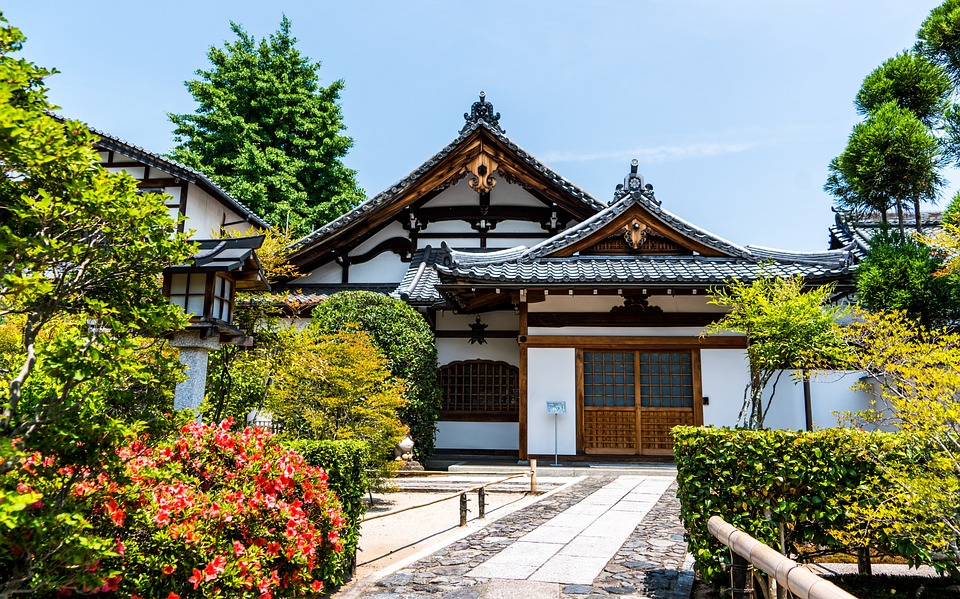
Image by from
Tenryū-ji is the most important temple in Arashiyama. It’s a major temple of the Rinzai Zen sect of Japanese Buddhism and part of the UNESCO World Heritage Site designation for Kyoto’s historic monuments.
Tenryū-ji Temple was built in 1339 by shogun Ashikaga Takauji, a gesture to appease the uneasy spirits of Emperor Go-Daigo, who had just passed away.
Over the years, Tenryū-ji’s buildings were destroyed by fire and rebuilt, so most of the current halls date from about 1900.
This famous Buddhist temple is attached to the bamboo grove, so it is a good idea to kill two birds with one stone in a single visit.
Tenryu-ji has a sublime park, with a dry garden sublimating mosses and rocks, as well as a large pond opening onto the pine forest.
In the springtime, Tenryū-ji Temple is one of many great Cherry blossom viewing spots in Kyoto. The paths are especially pretty when partially covered by fallen pink blossoms.
3. Togetsukyo Bridge is the Signature of Arashiyama

Image by from
A classic symbol of the Arashiyama area, the Togetsuky� Bridge is often the first sight that visitors head to see when they arrive.
The Togetsukyo Bridge (lit. “Moon Crossing Bridge”) is Arashiyama’s most iconic landmark.
It was originally built during the Heian Period (794-1185) and most recently reconstructed in the 1930s.
Spanning the Katsura River (also called the Oi River or Hozu River depending on the area) the bridge offers a splendid view up and down the river which varies dramatically from season to season.
With Mt. Arashi serving as a backdrop, visitors can enjoy cherry blossoms, vibrant summer greens, and colourful autumn leaves on the mountain slope.
On the Oi Riverside, you can watch people in small rental boats paddle about, or take part yourself.
4. Visit the House of Arashimaya’s Celebrity Actor – ÅŒkÅ�chi SansÅ�
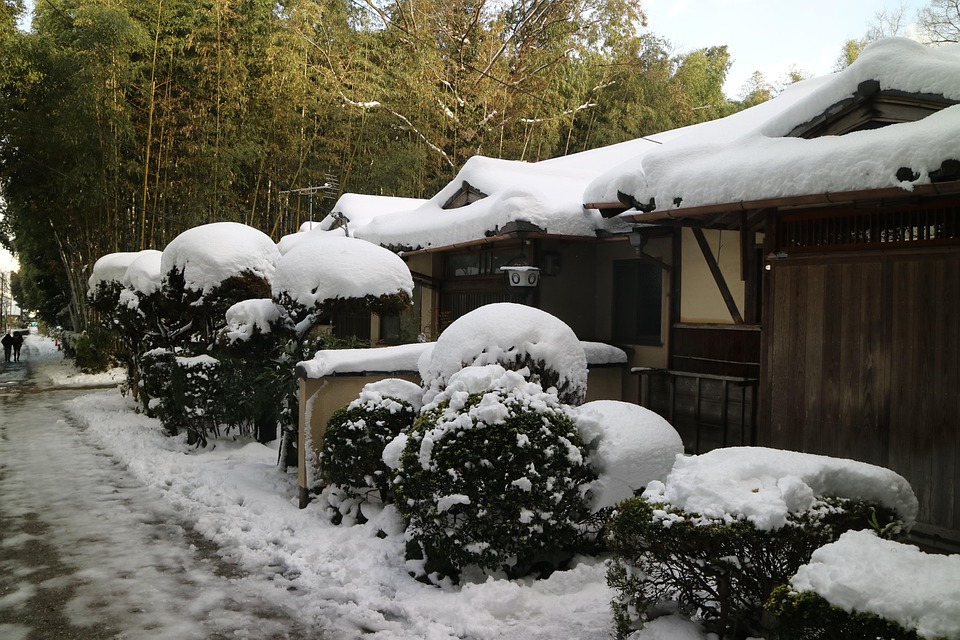
Image by from
Ōk�chi Sans� is not on the radar of most tourists, but we thought it was a real treasure.
This small villa was the private home of Ōk�chi Denjiro (1896-1962), a Japanese actor known for his starring roles in samurai films and other period dramas.
The property has several lovely small gardens and a few buildings that can only be viewed from the outside.
There are also two scenic viewpoints- one overlooking the city, and another offering views of the mountains and Hozu River gorge.
Admission includes a cup of matcha tea and a Japanese cookie. The tea house is a delightful place to rest, looking directly out onto the bamboo grove.
5. In Arashiyama District, Monkeys roam free at Iwatayama Monkey Park

Image by from
Located on Mt. Iwata in Arashiyama, the Iwatayama Monkey Park is home to a 130+ strong troupe of Japanese macaque monkeys.
Though the monkeys are wild and live on the mountain, the research centre/park is a place where tourists can observe and feed the monkeys from an enclosed hut.
After a somewhat sporty climb of about twenty minutes to reach the top of Iwata hill, you will discover a platform offering on the one hand a beautiful view of Kyoto, but also a playground for monkeys.
It is also possible to enter a small hut with netting, to feed the monkeys who remain in their natural habitat.
Scheduled feeding times by staff can be entertaining to watch, and you are free to roam about the park at your leisure.
6. Daikaku-ji, was an Emperor’s Villa in Arashiyama District

Image by Basile Morin from
Intrinsically connected to the history of Imperial rule in Japan, Daikaku-ji was originally the villa of Emperor Saga (786 – 842).
It became a temple after his death on orders from his daughter Empress Masako and later served as a retirement palace.
Though the original buildings inhabited by emperors were destroyed over time, they were replaced by structures transplanted from various locations.
The man-made Osawa Pond on the grounds is one of the oldest surviving Heian Period garden ponds and was designed to look best when seen from a boat, which the temple sometimes provides for guests during festival periods.
The principal objects of worship at Daikaku-ji are the Five Wisdom Kings (Godai My�’�), particularly Fud� My�’�, and the most valuable treasure at the temple is a copy of the Heart Sutra written by Emperor Saga himself.
7. Arashimaya Kimono Forest
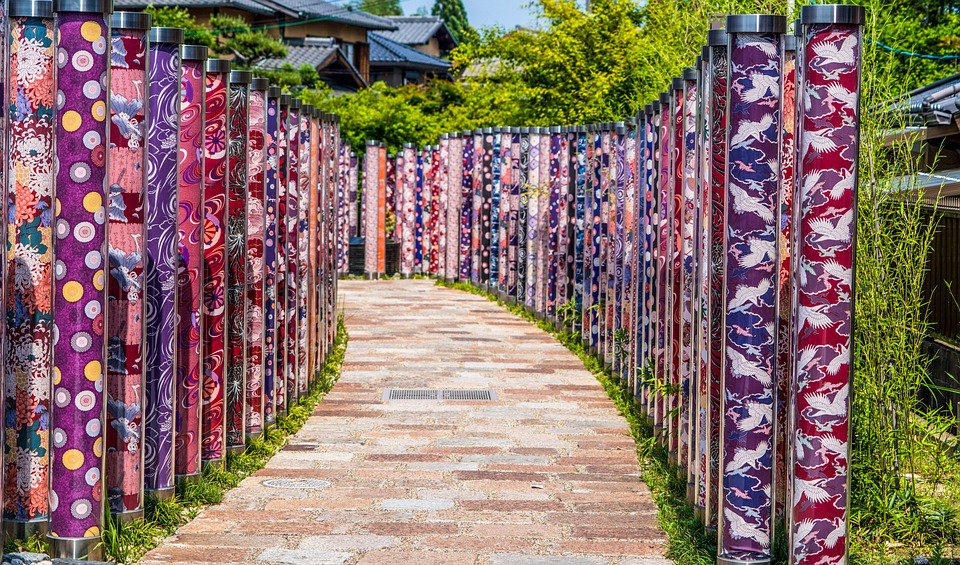
Image by from
The fact is, there is another “forest” in Arashiyama. Although it is not as famous as the bamboo forest, it certainly will be a delight for the eyes.
Kimono Forest is a collection of gorgeous cylinder-shaped pillars framing the laneway to Randen tram station on Kyoto’s Keifuku Arashiyama line, which was installed as part of the renovation in 2013.
It’s not actually a forest but a path in the Randen Station that has 600 kimono cloth draped poles that stand 6.5 feet tall each.
The Kyo-yuzen textile used for this exhibition was created by Kamedatomi, a long-standing textile factory whose history dates back to Taisho period.
The Kimono Forest is FREE and aims to be a small village that can be enjoyed either day or night, with pathways for walking, small parks, kiosks and even a foot spa to rest and soak your tired feet.
If you are looking for something a little less crowded and off-the-beaten-track, then mark down this magical spot in Arashiyama that is Kyoto’s best-kept secret.
8. You can visit the 17th Century Rakushisha Residence
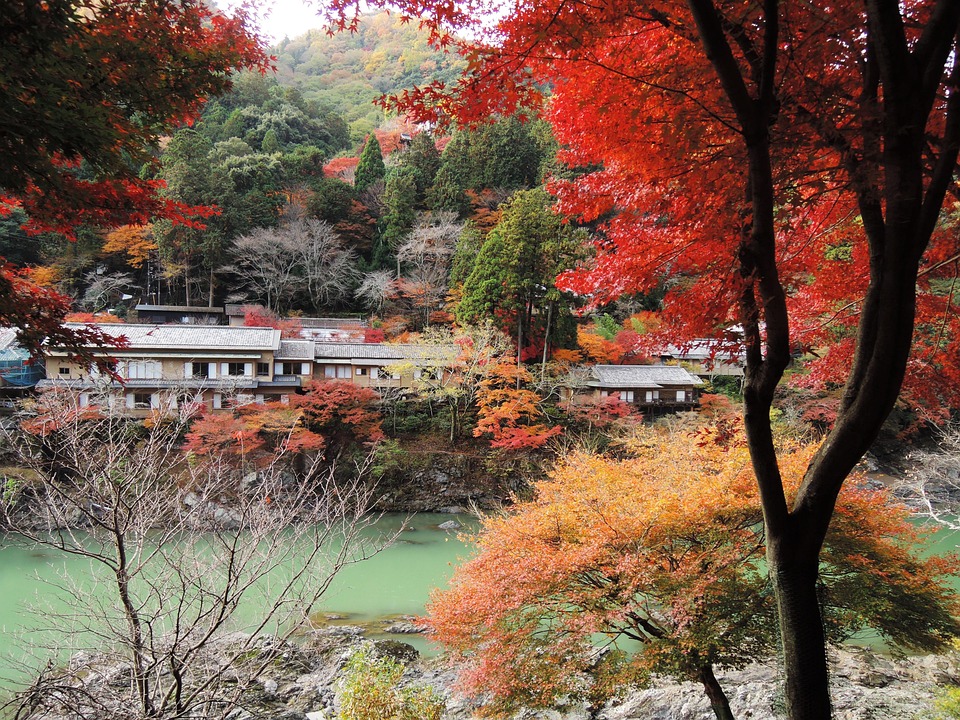
Image by from
The Rakushisha Residence is a thatched hut that belonged to the 17th-century haiku poet Mukai Kyorai. Mukai was a student of Basho Matsuo, one of Japan’s greatest poets.
Basho even composed a few poems here. Mukai named his residence Rakushisha (“fallen persimmon hut”) after a storm had taken down the fruits of the surrounding trees.
Kyorai first trained as a samurai, but at age 23 he gave up martial service and turned to the writing of poetry.
In 1684 he made the acquaintance of Takarai Kikaku, a disciple of Bash�, and shortly thereafter Kyorai also became a disciple.
He built the small retreat on the outskirts of Ky�to, which Bash� often used. Here, Bash� wrote Saga nikki (1691; “Saga Diary�).
9. Senk�-ji in Arashiyama has the Best views in Kyoto
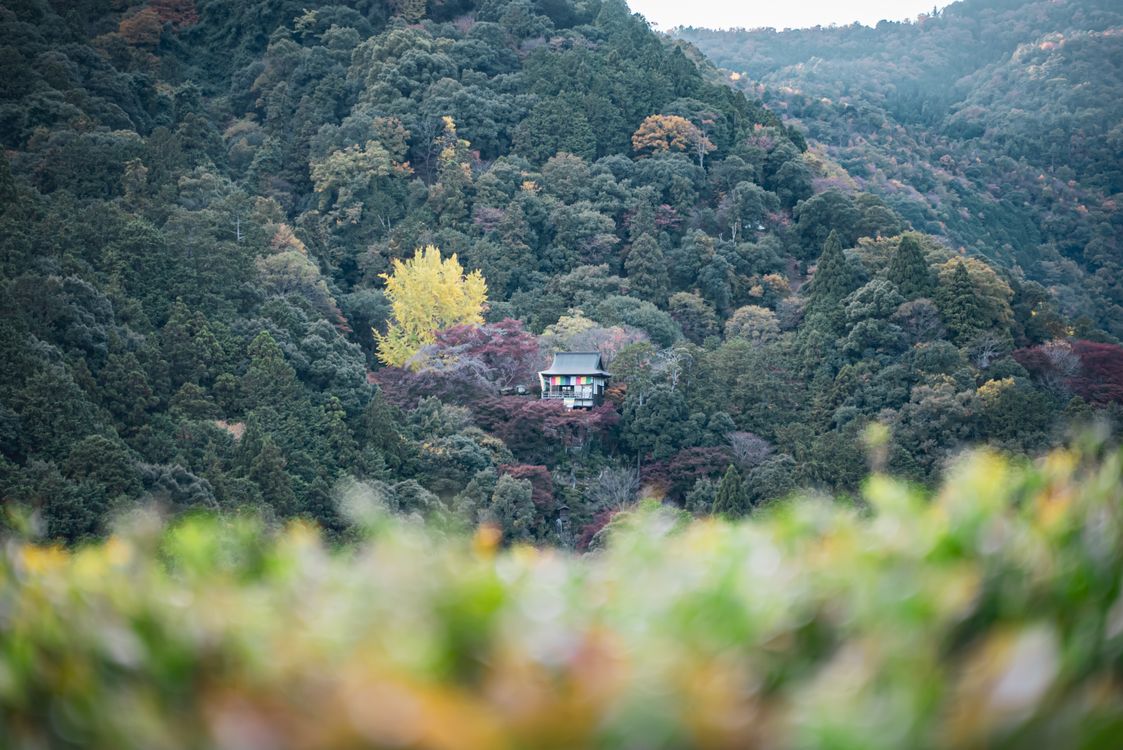
Photo by Satoshi Hirayama from
Touted as “the best view in Kyoto”, SenkÅ�-ji is a Zen temple on an Arashiyama mountainside that does indeed offer a commanding view of the city.
The temple is located halfway up a mountain twenty minutes away on foot from Arashiyama’s famous TogetsukyÅ� Bridge and requires a bit of hiking up winding stone steps.
Despite its somewhat inconvenient location, the site is well worth a visit for those seeking a good look at the surrounding mountains or the city skyline, or even just those who want some peace and quiet or to be surrounded by nature.
SenkÅ�-ji offers a relaxing place to get away from it all and you can spend longer than you’d expect poking around the small grounds, sitting in peace in the viewing hall or using provided binoculars to look for landmarks in the city
10. Take in the Beauty of Arashiyama in a Rickshaw

Image by from
Have you ever ridden a Rickshaw? It’s super fun! If you haven’t, Arashiyama is the perfect place to take a ride on traditional Japanese rickshaws!
You can go on a ride around the district, you could also go on a ride inside the Bamboo Forest. It’s an authentic Japanese experience that no one should miss.
Arashiyama is a beautiful district. Nature has gifted the district with abundance! The sites and activities listed above are only the tip of the iceberg.
If you’re visiting Japan, you should definitely make time to visit Arashiyama and the Bamboo Forest in Kyoto.
Arashiyama is without a doubt a place of beauty that attracts many people from around the world. Here you can explore and experience its charms in so many ways, like the
Mount Arashi itself, the big ÅŒi River, and of course the famous bamboo forest of Arashiyama
Planning a trip to Â鶹APP ? Get ready !
These are ´¡³¾²¹³ú´Ç²Ô’²õÌý²ú±ð²õ³Ù-²õ±ð±ô±ô¾±²Ô²µÂ travel products that you may need for coming to Â鶹APP.
Bookstore
- The best travel book : Rick Steves – Â鶹APP 2023 –Ìý
- Fodor’s Â鶹APP 2024 –Ìý
Travel Gear
- Venture Pal Lightweight Backpack –Ìý
- Samsonite Winfield 2 28″ Luggage –Ìý
- Swig Savvy’s Stainless Steel Insulated Water Bottle –Ìý
We sometimes read this list just to find out what new travel products people are buying.


