
 English


Angela doll-Sophie Taeuber-Arp. Photo by Danielle Jansen.
Top 10 Interesting Facts about Sophie Taeuber-Arp
Sophie Henriette Gertrud Taeuber-Arp was a Swiss painter, sculptor, textile designer, furniture and interior designer, architect, and dancer.
She was born in Davos in 1889 and raised in Trogen, Switzerland. She attended a trade school in St. Gallen and, later, art schools in Germany before returning to Switzerland during World War I.
Sophie met a German-French artist, Hans/Jean Arp, for the first time at an exhibition in 1915 whom she married shortly after. They became associated with the Dada movement, which emerged in 1916, during these years, and Taeuber-most Arp’s famous works – Dada Head (Tête Dada; 1920) – date from these years.
They relocated to France in 1926, where they remained until the invasion of France during World War II, when they returned to Switzerland. She died in an accident with a leaking gas stove in 1943.
1. Sophie was the fifth child
Sophie Henriette Gertrud Taeuber was born in Davos, Switzerland, the fifth child of Prussian pharmacist Emil Taeuber and Swiss Sophie Taeuber-Krüsi from Gais in Appenzell Ausserrhoden, Switzerland.
Her parents ran a pharmacy in Davos until her father died of tuberculosis when she was two years old, at which point the family relocated to Trogen, where her mother established a pension. Her mother taught her how to sew.
2. Sophie Taeuber-Arp studied textile design at St. Gallen’s trade school
She studied textile design at St. Gallen’s trade school (Gewerbeschule, now School of Applied Arts) (1906–1910). She then moved on to Wilhelm von Debschitz’s workshop at his Munich school, where she studied in 1911 and again in 1913; in between, she studied for a year at Hamburg’s School of Arts and Crafts.
Due to World War One, she returned to Switzerland in 1914. The following year, she joined the Schweizerischer Werkbund. She attended the Laban School of Dance in Zurich the same year, and in the summer she joined the artist colony of Monte Verita in Ascona; in 1917, she danced with Suzanne Perrottet, Mary Wigman, and others at Laban’s Sun Festival in Ascona.Taeuber taught embroidery and design classes at Zürich Kunstgewerbeschule in Switzerland from 1916 to 1929.
3. Taeuber-Arp taught weaving and other textile arts at Zurich University

Zurich University. Photo by Khalid Mahmood.
From 1916 to 1929, Taeuber-Arp taught weaving and other textile arts at Zurich University of the Arts. Her textile and graphic works from the early 1920s, along with those of Piet Mondrian and Kasimir Malevich, are among the earliest Constructivist works. These refined geometric abstractions demonstrate a deft understanding of the interplay between color and form.
4. She became involved in the Zürich Dada movement
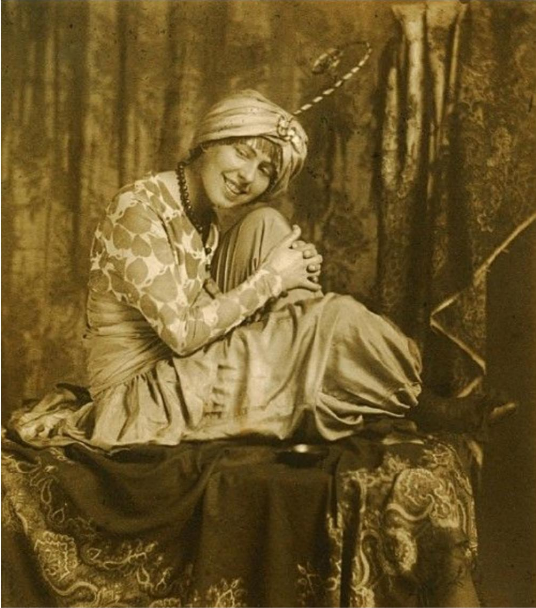
Sophie Taeuber disguised as an odalisque, 1914. Photo by Eduard Wasow.
She was involved in the Zürich Dada movement, which was centered on the Cabaret Voltaire. As a dancer, choreographer, and puppeteer, she participated in Dada-inspired performances, and she designed puppets, costumes, and sets for performances at the Cabaret Voltaire and other Swiss and French theaters.
She danced to poetry by Hugo Ball while wearing a shamanic mask by Marcel Janco at the opening of the Galerie Dada in 1917. A year later, she signed the Zurich Dada Manifesto. Taeuber, who was both a dancer and a painter, was able to incorporate Dada in her dancing movement, which was described as obscure and awkward.
5. She was deemed as a radical artist

Hopi Indian costume by Sophie Taeuber-Arp. Photo by Jean-Pierre Dalbéra.
As Dadaism gained popularity and recognition, Taeuber-Arp found herself at odds with the movement’s growing absurdity and significance. She became furious and wrote to Jean Arp in 1919. ” ‘Radical artist,’ what is this nonsense? It has to be the work; manifesting oneself in this manner is more than stupid.”
During this time, her work began to take on more Constructivist tones, a Russian austere abstract movement that emphasized technical mastery and materials that reflected industry and urbanization. She and Arp married in 1922 and worked together on several projects, including the now-famous interior of Café de l’Aubette in Strasbourg, France, with designer Theo van Doesburg. It was one of the first times that abstraction and architecture were combined in a space.
6. Sophie created a series of turned wood sculptures called “portraits”

Sulpture by Sophie Taeuber-Arp. Photo by Sailko.
Between 1918 and 1920. Their ovoid shapes and painted patterns, on the other hand, evoke mask-like faces that are far from naturalistic. Taeuber most likely created this head as a self-portrait. She adorns herself with playful wire curlicues strung with green and purple beads that spring from her ears like flowers.
Taeuber originally made six to eight heads, including the three that exist today. They are only decorated with the colored geometrics of their painted surfaces.
One of these is almost certainly a portrait of Arp. The combination of a bulbous head atop a long neck and base, however, makes him look like a hatstand in a humorous challenge to ‘pure sculpture.’
7. Sophie was one of the first to use polka dots in fine art

Painting “Animated Circle Picture” by Sophie Taeuber Arp, 1935. Photo by Paradise Chronicle.
Sophie Taeuber-Arp and the husband moved to Â鶹APP in 1929. That move introduced the couple to a new circle of non-figurative artists such as Joan Miro, Wassily Kandinsky, and Marcel Duchamp. She was a member of several abstract and avant-garde arts groups at the time, and she edited the Constructivist art magazine Plastique.
She, like earlier Russian avant-garde artists such as Kazimir Malevich, frequently used circles in her work and was one of the first to use polka dots in fine art.
8. Sophie Taeuber-Arp died at the age of 54
Taeuber-Arp missed the last tram home one night in early 1943 and slept in a snow-covered summer house. She died of accidental carbon monoxide poisoning caused by an incorrectly operated stove at Max Bill’s house.
9. Her portrait was on the 50-franc note
Taeuber-Arp was the only woman featured on the eighth series of Swiss banknotes, with her portrait appearing on the 50-franc note from 1995 to 2016.
10. In 2007, a museum dedicated to Taeuber-Arp and her husband was opened
A museum dedicated to Taeuber-Arp and Jean Arp debuted in 2007 in a section of the redesigned Rolandseck railway station in Germany. The video “Sophie Taeuber-Vanishing Arp’s Lines” (2015) by Swiss new media artist Myriam Thyes is about her “Lignes” drawings, which are segmented circles intersected by lines.
To commemorate Taeuber-127th Arp’s birthday, Google created a Google Doodle for her on January 19, 2016. Mark Holmes created the doodle.
Planning a trip to Â鶹APP ? Get ready !
These are ´¡³¾²¹³ú´Ç²Ô’²õÌý²ú±ð²õ³Ù-²õ±ð±ô±ô¾±²Ô²µÂ travel products that you may need for coming to Â鶹APP.
Bookstore
- The best travel book : Rick Steves – Â鶹APP 2023 –Ìý
- Fodor’s Â鶹APP 2024 –Ìý
Travel Gear
- Venture Pal Lightweight Backpack –Ìý
- Samsonite Winfield 2 28″ Luggage –Ìý
- Swig Savvy’s Stainless Steel Insulated Water Bottle –Ìý
We sometimes read this list just to find out what new travel products people are buying.


