
 English


Textile Museum, Vadianstrasse 2, St. Gallen. Photo by WWHenderson20.
Top 10 Amazing Facts about Textilmuseum St. Gallen
The St. Gallen Textile Museum and the Textile Library are housed in the 1886-built “Palazzo Rosso” in St. Gallen’s old town.
In 1863, the Commercial Directorate created the first sample collections for the regional textile industry, inspired by world exhibitions. Technical and handicraft exhibitions that inspired a large audience from the middle of the nineteenth century. The “Industry and Trade Museum St. Gallen” was established in 1878. The museum first opened its doors in 1886 in a magnificent building on the former Seidenhof site on Vadianstrasse, also known as “Palazzo Rosso” due to its red brick facade. In addition to the commercial directorate’s collections, the building housed the textile library, the drawing school, and, beginning in 1890, the embroidery school.
There were more temporary exhibitions from 1900 onwards, allowing the museum to draw on private collections and company archives that had come to the house over the years. They supplemented the original sample collections with historical textiles that had previously been used as templates for their own production by textile industrialists.
1. The museum was expanded in 1956

Textile Museum in St. Gallen. Photo by albinfo.
The collection has steadily grown over the years. As the need for space grew, the museum was expanded in 1956, resulting in a similarly massive intervention in the appearance of the house as the gray facade painting from 1962.
2. It was originally known as the Museum of Industry and Trade
The “Museum of Industry and Trade” was renamed “Textile Museum” and “Textile Library” in 1982. In 1987/88, the latter was rebuilt and expanded. The Textile Museum and library were given to the «IHK Foundation» in 1991. Since 2012, the Textile Museum Association has sponsored the St. Gallen Textile Museum, which collaborates closely with the Textile Museum Foundation, into which the IHK Foundation was merged in 2019.
3. St. Gallen linen was referred to as white gold
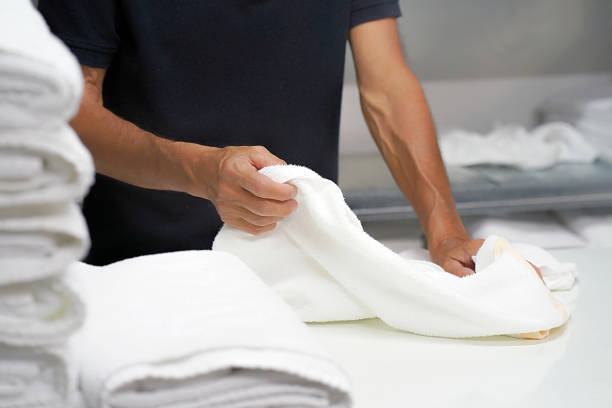
White linen. Photo by Credit:Igor Vershinsky.
St. Gallen can look back on a centuries-long textile history that dates back to the Middle Ages. Its high quality ensures St. Gallen linen’s renown in the past; known as “white gold,” it becomes a myth that endures to the present day.
Linen production has been one of the most important sources of income for the city and region of St. Gallen since the 13th century. Tens of thousands of people are employed with the White Gold. Guilds and city authorities ensure that the linen meets the highest standards at all stages of production.
They bear a “G” (for “St. Gallen”) that attests to the origin of the textile article destined for long-distance trade. In some interpretations, it also refers to the quality (“Good”). When the linen trade suffered a setback in the 18th century, the textile region of St. Gallen begun to refocus, with first cotton processing flourishing, and then wool processing.
3. The Textile Museum’s collections
The collections of the Textile Museum include historical embroidery, hand-made lace, non-European textiles, historical fabrics, and costumes spanning several centuries. The inventory is completed by sample books, fashion photographs, and drawings managed by the textile library.
The Commercial Directorate, a forerunner of today’s St. Gallen-Appenzell Chamber of Commerce and Industry, began acquiring fabric samples from France in 1863 to serve as templates and inspiration for the regional textile industry.
The model collections are supplemented by purchases and donations from important private collections, as well as the acquisition of company archives. The Textile Museum’s depots now house approximately 56,000 objects. Aside from conservation and research of the holdings, another focus is on the collection’s digital development. The objects are cataloged in a database, and a subset of the collection’s objects can be accessed through an online catalog.
4. The Textile Museum houses a library

A library. Photo by Jorge Royan.
Thousands of sample books containing textile samples from Swiss companies are stored in the library room’s cupboards. The over two million originals document machine embroidery in the late nineteenth and early twentieth centuries, during the heyday of the St. Gallen embroidery industry. Numerous examples of fabric printing and weaving are also included. Fashion photographs and illustrations, nature studies, wallpaper patterns, and design drawings are also included.
The Textile Library manages not only selected collections from the Textile Museum, but also stocks of literature on fashion, design, textile history, textile techniques, and so on. A variety of historical and current magazines that can be viewed or borrowed on site.
Special exhibitions are constantly presented in addition to the permanent exhibition. These are dedicated to textile topics in general and place them in art historical, social, and economic historical contexts. National and international issues, as well as historical and contemporary issues, are all taken into account.
5. Entrance is free of charge
Children and teenagers under the age of 18 are admitted free of charge. People with a refugee background currently have free access to the museum upon presentation of a valid ID with F, N, or S status. Unfortunately, the historical museum, is only partially barrier-free.
6. Exclusive textile museum tour
Go on a private tour of the textile museum. These are available in German, English, and French, and can also be scheduled outside of regular business hours. The group size is limited to 25 people, but multiple tours can take place at the same time.
You go to both of the house’s exhibitions. This 1.5-hour tour costs CHF 180 on weekdays and CHF 225 on weekends.
7. The Textile Museum owns approximately 5,000 laces

Lace. Photo by Credit:RossellaApostoli.
The Textile Museum owns approximately 5,000 laces dating from the 16th to the early 20th centuries. Some of which are of exceptional quality. The most important lace inventory comes from the collections of Leopold Iklé and John Jacoby. Laces from Carolina Maraini collection Sommaruga’s are on permanent loan from the federal government to the Textile Museum.
8. St. Gallen museum hosts 2-3 special exhibitions annually
Every year, it hosts two to three special exhibitions that complement the permanent exhibition on the history of textiles in Eastern Switzerland. A diverse event schedule, as well as museum-related educational activities.
9. The museum is split into four sections
Textile Museum, Vadianstrasse 2, St. Gallen. Photo by WWHenderson20.
The museum is split into four sections. The first two sections are about the current textile industry in Sankt Gallen, as well as embroidery and textile art. Then there’s the breathtaking Robes Politiques exhibition. It focuses on the power of fashion as portrayed by strong women throughout history.
Finally, there is an interactive display of the materials and methods used to make clothing, as well as the environmental impact of these practices.
10. Visitors can learn how to embroider at the Textile Museum

A woman embroidering. Photo by Rizly. .
Participate in a collaborative piece of embroidery at the Textile Museum St.Gallen to leave your mark with needle and thread. Embroidering is not difficult to learn. Anyone can participate, whether by embroidering their initials or creating a small, personal piece of art.
Be a part of a larger collective work of art that is expanding by the day. A work that demonstrates the participants’ collaboration in all of its diverse and colorful shapes and forms!
Planning a trip to Â鶹APP ? Get ready !
These are ´¡³¾²¹³ú´Ç²Ô’²õÌý²ú±ð²õ³Ù-²õ±ð±ô±ô¾±²Ô²µÂ travel products that you may need for coming to Â鶹APP.
Bookstore
- The best travel book : Rick Steves – Â鶹APP 2023 –Ìý
- Fodor’s Â鶹APP 2024 –Ìý
Travel Gear
- Venture Pal Lightweight Backpack –Ìý
- Samsonite Winfield 2 28″ Luggage –Ìý
- Swig Savvy’s Stainless Steel Insulated Water Bottle –Ìý
We sometimes read this list just to find out what new travel products people are buying.


