
 English


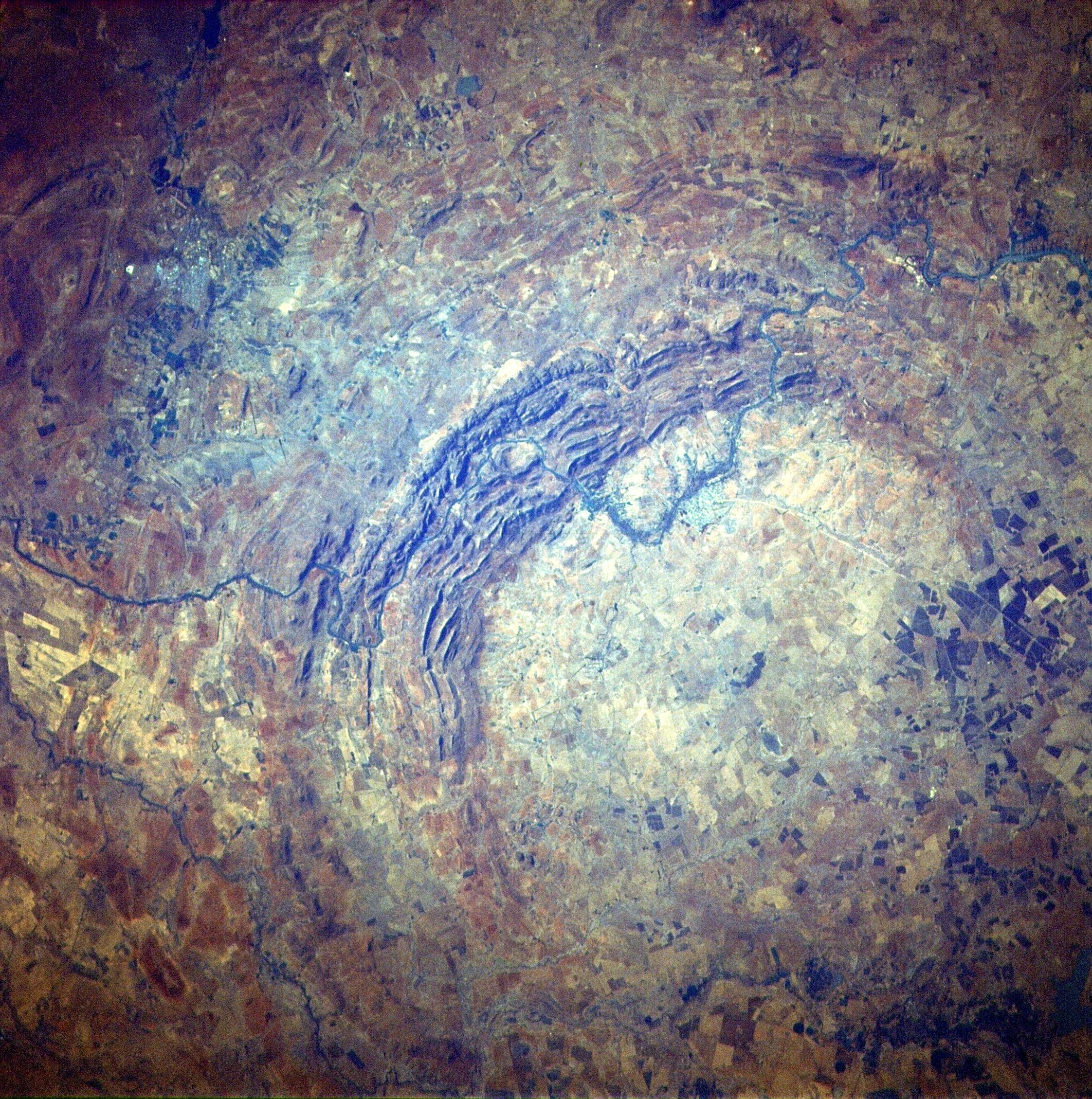
Vredefort Dome. Photo by Júlio Reis.
Top 10 Amazing Facts about Vredefort Dome
The Vredefort impact structure is one of the world’s largest impact structures. The crater, which has since eroded, was approximately 160-300 km across when it formed. The remaining structure, which is made up of deformed underlying bedrock, is found in South Africa’s Free State province.
It takes its name from the town of Vredefort, which is located near its center. The Vredefort Dome is the structure’s central uplift. The impact structure formed 4 million years ago during the Paleoproterozoic Era. After Yarrabubba, it is the Earth’s second-oldest known impact structure.
The Vredefort Dome was added to the list of UNESCO World Heritage Sites in 2005 due to its geologic significance.
1. The development of Vredefort Dome

Vredefort Dome (South Africa). Photo by Francesco Bandarin.
The impactor that formed the meteorite impact structure could have been either a large body, such as an asteroid with a diameter of about 12 km traveling at a velocity of 20 km/sec, or a smaller body, such as the head of a comet, approaching at a much faster speed.
The impact event produced the greatest single energy release known for the earth’s surface. The meteorite impact structure is thought to have formed in less than four hours. The meteorite penetrated approximately 10 kilometers into the Earth’s surface before exploding due to pressure. It sheared through the rocks of the Transvaal, Ventersdorp, Witwatersrand, and Dominion Supergroups to expose the Kaapvaal Continent’s granite basement.
2. The dome has unique vegetation
The Vredefort Dome is brimming with individuality throughout its dome. This geological structure has given birth to a variety of microhabitats, ensuring plant communities that are unique to South Africa. There are at least 99 plant species recorded in the area, and there are valleys between hills that are well wooded and unspoiled, with springs and streams in almost all of them.
Some species found there include typical Bush veld trees such as Bush willow species, as well as Red Ivory, tree fern, and wild olive trees. The dome’s vegetation consists primarily of grass veld, Bankenveld, Riverine bush, and some specialized vegetation found only in valleys and slope areas.
3. Animal species at Vredefort Dome are diverse
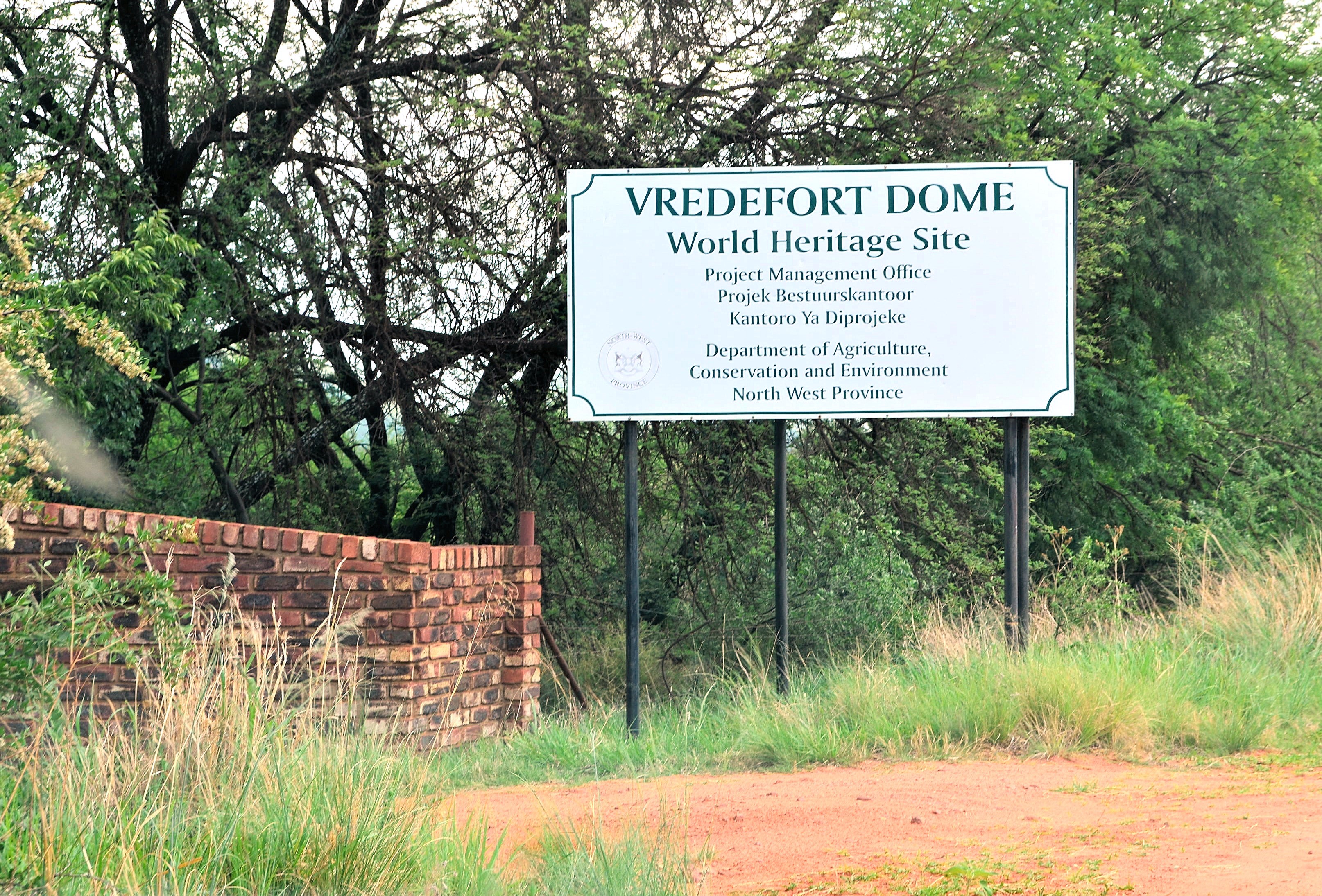
Sign at the Vredefort Dome World Heritage Site, Project Management Office. Photo by Ossewa.
The Vredefort dome is unique for its bird life due to the dome’s diversity of habitat. The dome is home to more than 200 bird species, about 50 small mammal species, and more butterfly species than the entire British Isles.
There have been reports of various animal species in the dome, including the “big five”: the African Elephant, Lion, Leopard, African Buffalo, and White Rhinoceros. Many games and animal species have vanished due to farming activities in the area.
4. The climate at Vredefort Dome
The climate in the area is characterized by significant seasonal and diurnal temperature variation. Summers are hot and humid, with temperatures ranging from 15 °C to 30 °C. Winters are cold and dry, with frosts, with temperatures ranging from -10 °C to 18 °C on average. The average rainfall is 625 mm, with 500 mm falling during the summer, frequently in thunderstorms. The predominant winds are from the north.
5. Gold was discovered there
The area also contains treasures from 19th-century settlements, prompting researchers to conduct additional research. The site contains evidence relating to early white settlers in South Africa as well as the Anglo-Boer War, a war for independence against Britain.
Gold prospecting was popular in the 1880s, but declined in the 1920s due to the low gold content of the ores. It is possible that if the Vredefort impact had not occurred, this gold would have never been discovered.
6. Vredefort dome is home to four towns
The Vredefort dome is home to four towns: Parys, Koppies, Venterskroon, and Vredefort. Among these four towns, Parys is the largest and the center of tourism in the area, while Koppies and Vredefort rely solely on agriculture for economic growth.
The Dome was named after the town of Vredefort. Initially, the people of Vredefort were a part of the hunting economy that stretched across the northwestern Free State.
This area was known as Riemland because of the abundance of leather thongs (rieme) produced as a byproduct of hunting. Agriculture eventually took over as the main commercial activity, and Vredefort has a prominent set of grain silos on the outskirts of town.
7. Visitors and visitor attractions

Vredefort Dome – World Heritage Site. Photo by Leo za1.
The dome’s countryside is beautiful and biodiverse, with archaeological ruins that are easily accessible from Johannesburg. As a focal point, the nearby dome structure to the north is easily identified. The area is already used by youth camps, hiking clubs, and bird-watching clubs. Summer tourism, recreation, education, and research all have high potential: local landowners are developing lodges and campsites as an economic alternative to farming.
Seventeen landowners in the hills have game-fenced their farms and begun reintroducing some large game animals that once roamed the area. On-site activities include canoeing, rafting, and fishing, as well as camping, horseback riding, hiking, mountain biking, and rock climbing.
8. There is a temporary information center

Vredefort Dome Information Centre in Venterskroon. Photo by Ossewa.
There is an interim information center and a state-funded exhibition center near Vredefort town. In the nearby towns of Parys and Potchefstroom, as well as on-site game farms and corporate convention centers, there is hotel, guesthouse, and resort accommodation.
The nominated area was said to have well over 60,000 overnight visitors in 2001. However, there are no visitor or information centers on the property yet. A tourism-focused Strategic Management and Development Plan was submitted along with the nomination.
9. Conservation status and prospects of Vredefort Dome
Although some geologically significant areas have been affected in the past by stone quarrying and other development activities, the site’s geological values remain largely intact. Private land ownership of a natural world heritage site is unusual, and special measures are required to ensure the protection of its world heritage values and long-term sustainable management.
There are some issues with tourism management (particularly visitor access and tourism infrastructure development) and Vaal River pollution.
10. It remains the biggest and oldest crater
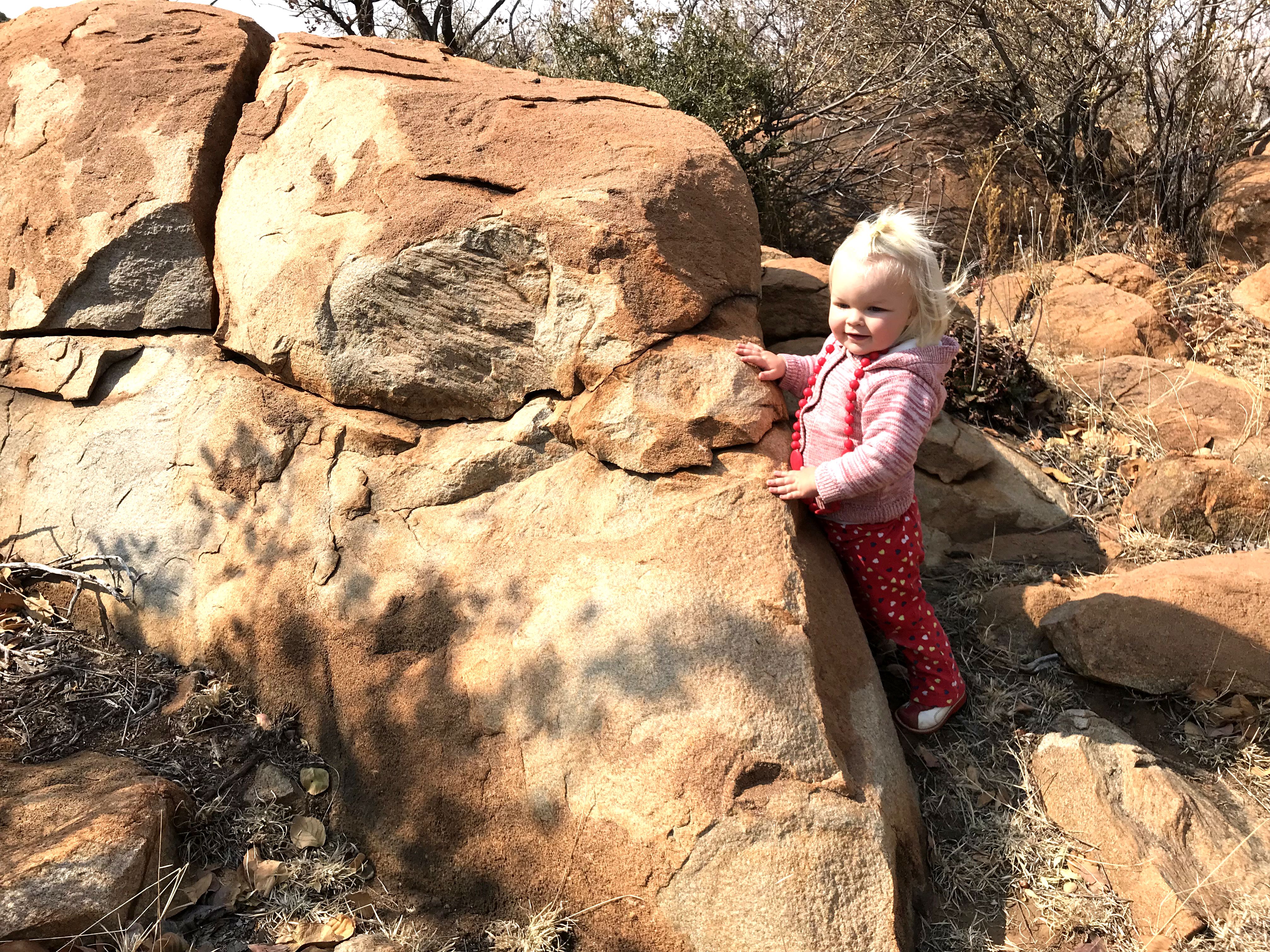
A girl standing at embedded shatter cones at the Vredefort Dome, South Africa. Photo by Liza Kovaleva.
The Vredefort crater was once much larger. A lot. However, centuries of erosion have reduced its radius to 190 kilometers (118 miles). Despite having shrunk to a fraction of its original size, the Vredefort crater is still the world’s oldest and largest impact site. Surprisingly, the erosion caused it to be the deepest.
Planning a trip to Â鶹APP ? Get ready !
These are ´¡³¾²¹³ú´Ç²Ô’²õÌý²ú±ð²õ³Ù-²õ±ð±ô±ô¾±²Ô²µÂ travel products that you may need for coming to Â鶹APP.
Bookstore
- The best travel book : Rick Steves – Â鶹APP 2023 –Ìý
- Fodor’s Â鶹APP 2024 –Ìý
Travel Gear
- Venture Pal Lightweight Backpack –Ìý
- Samsonite Winfield 2 28″ Luggage –Ìý
- Swig Savvy’s Stainless Steel Insulated Water Bottle –Ìý
We sometimes read this list just to find out what new travel products people are buying.


