
 English

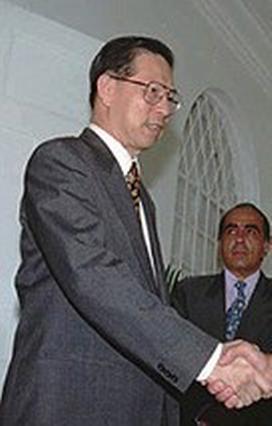
Ong Teng Cheong. Photo by VÃctor Bugge.
Top 10 Facts about Ong Teng Cheong
Ong Teng Cheong was born on 22nd January 1936 – 8th February 2002. He was a Singaporean politician and architect who served as the country’s fifth president between 1993 and 1999. Prior to becoming president, he served as the country’s deputy prime minister. In addition, he is Singapore’s first elected president.
Ong was a member of the ruling People’s Action Party (PAP) and served as the party’s chairman between 1981 and 1993, after Toh Chin Chye stepped down. Between 1972 and 1991, he represented Kim Keat SMC, and between 1991 and 1993, he represented Toa Payoh GRC. Between 1981 and 1983, he was Minister of Manpower, and between 1978 and 1981, he was Minister of Information, Communications, and the Arts. He was also Singapore’s Deputy Prime Minister between 1985- 1993.
Ong resigned from the PAP and his political positions to run as an independent in the 1993 presidential election, which he won and was elected as Singapore’s fifth president. In 1999, Ong decided not to run for a second term as president, owing in part to the death of his wife.
1. Ong was born into a family of five children
Ong was the second of five children born to a middle-class Singaporean family on January 22, 1936. His English-educated father, Ong Keng Wee, believed that learning the Chinese language was essential for success in business at the time and thus sent all of his children to Chinese-medium schools. In 1955, Ong graduated with honors from The Chinese High School (now the High School section of Hwa Chong Institution). With a Chinese-language education, Ong saw few opportunities to advance his studies at the University of Malaya, where English was the medium of instruction.
2. At the University of Adelaide, Ong studied architecture
University of Adelaide. Photo by Ashton 29.
Ong traveled abroad in 1956 with the assistance of his father’s friends. Those years shaped both his beliefs and his passions. Ong attended the University of Adelaide with his childhood sweetheart and future wife, Ling Siew May. Ong and Ling met at a Christmas party while they were still in secondary school.
3. Ong was awarded a scholarship to pursue his master’s degree

Approved scholarship application. Photo by Maybefalse.
Ong was awarded a Colombo Plan scholarship in 1965 to pursue a master’s degree in urban planning at the University of Liverpool, where he graduated in 1967. In the same year, he began working as a town planner for the Ministry of National Development. After four years of government service, Ong resigned and founded his own architectural firm, Ong & Ong Architects, with his wife.
4. Ong advocated for the Mass Rapid Transit System

MRT Station opening plaque being commemorated by Mr Ong Teng Cheong. Photo by GoAheadFan95.
The People’s Action Party (PAP) quickly fielded him as a candidate in the 1972 General Election in Kim Keat. His first political appointment, as Senior Minister of State for Communications, came only three years later. At the time, Ong advocated for the development of the Mass Rapid Transit System (MRT), Singapore’s largest construction project. During his time as Communications Minister, Ong was a strong supporter and advocate of the Mass Rapid Transit system.
5. Ong succeeded Lim Chee Onn as Secretary General of the National Trades Union Congress (NTUC)
Non-communist trade unions, led by the NTUC, have historically had a “uniquely cozy relationship” with the Singaporean government and the PAP in a “tripartite system,” and were key political allies in the PAP’s 1960s victory. Despite the fact that Lim Chee Onn, the NTUC’s secretary general at the time, “proclaimed effusively” that the “PAP and the NTUC came from the same mother – the struggle with the communists and the colonialists,” relations between the unions and the government had become more strained by the 1980s.
Older grassroots union leaders had been barred from voting in the top NTUC leadership, which, according to Michael Barr’s analysis, had come to be dominated by de facto appointed PAP technocrats unfamiliar with the grassroots labor movement. Lee Kuan Yew believed that Lim, despite being his “protégé,” was not “progressing well” in the NTUC’s “process of meshing [elite] scholars and professionals with rank-and-file union leaders,” causing “increasing disquiet” among grassroots union leaders. Lim was preceded by Devan Nair, the NTUC’s founder and a popular member of the PAP democratic socialist old guard, and Phey Yew Kok, a powerful union leader who played a key role in convincing Chinese unions to join the NTUC in the 1970s. However, he was forced to resign in 1980 and fled the country due to a corruption scandal.
6. Ong restored trust between the unions and the government
Where Lim had failed, Ong made numerous arguments for repairing the strained relationship between unions and the government. After only a few months as secretary general, “he confronted the rebellious leadership of the UWPI,” where “they quickly reversed their opposition to house unions,” and the Triennial Delegates Conference backed the government’s push for house unions in 1985. “Ong had a mastery of institutional power,” writes Barr.
Ong was also a ferocious union activist, “working actively and forcefully in the interests of the unions in a way that Lim had never seen” and “stretching union activism to the very limits of what the government would tolerate”; Barr contends that this activism would have been impossible to tolerate if anyone less trusted than Ong had been in charge of the NTUC. In exchange, the unions agreed to cooperate with the “government’s core industrial relations strategies.”
7. Ong authorized a strike in Singapore’s shipping industry

Group of people on strike. Photo by Boonsom.
In January 1986, Ong authorized a strike in Singapore’s shipping industry. The first in nearly a decade, believing it was necessary because “management was taking advantage of the workers.” He did not, however, notify the Cabinet in advance. He feared that the Cabinet would prevent him from carrying out the strike.
8. Ong organized a 4,000-person demonstration at the US Embassy

US Embassy. Photo by AmandaLewis.
As NTUC Secretary General, Ong also organized a 4,000-strong protest at the US Embassy in response to US First Secretary E. Mason Hendrikson’s encouragement of dissident lawyers to run for election against the PAP.
9. Ong Teng Cheong, was Singapore’s first elected president

Flag of Singapore. Photo by Seungyeon kim.
He was elected Singapore’s first President and Commander-in-Chief in 1993. It was a presidency marked by numerous charitable projects. The most notable of which is the President’s Star Charity, an annual event initiated by Ong and benefited numerous charities, arts organizations, and youth organizations.
Ong became embroiled in a dispute over access to information about Singapore’s financial reserves. The government estimated that it would take 56 man-years to value the immovable assets in dollars and cents. He discussed this with the accountant general and the auditor general, eventually admitting that the government could easily declare all of its properties, a list that took several months to produce. Even then, the list was incomplete; it took the government three years to produce the information requested by Ong.
10. Ong was a one – term president

President Menem greets the President of Singapore Mr. Ong (in a black suit). Photo by VÃctor Bugge.
At the age of 63, Ong resigned as President. In 1999, Ong decided not to run for a second term as president. This was due to the death of his wife. S. R. Nathan succeeded him.
Planning a trip to Â鶹APP ? Get ready !
These are ´¡³¾²¹³ú´Ç²Ô’²õÌý²ú±ð²õ³Ù-²õ±ð±ô±ô¾±²Ô²µÂ travel products that you may need for coming to Â鶹APP.
Bookstore
- The best travel book : Rick Steves – Â鶹APP 2023 –Ìý
- Fodor’s Â鶹APP 2024 –Ìý
Travel Gear
- Venture Pal Lightweight Backpack –Ìý
- Samsonite Winfield 2 28″ Luggage –Ìý
- Swig Savvy’s Stainless Steel Insulated Water Bottle –Ìý
We sometimes read this list just to find out what new travel products people are buying.


