
 English


Photo Source:
Top 10 Interesting Facts about Boris Pasternak
Boris Pasternak was born in Moscow to a cosmopolitan Russian Jewish family on February 10, 1890; He grew up in an atmosphere that fostered an appreciation of the arts and literature.
His father, Leonid Pasternak, was a professor at the Moscow School of Painting, Sculpture, and Architecture, His mother, Rozaliya Kaufman, was a talented concert pianist
He was a Russian poet, novelist, and literary translator. His book entitled Doctor Zhivago earned him international recognition and the 1958 Nobel Prize in Literature.
Here are the top 10 interesting facts about Boris Pasterkan
1. Boris Pasternak Won Nobel Prize in Literature

Photo Source:
On 23 October 1958, Boris Pasternak was announced as the winner of the Nobel Prize in literature, the citation credited his contribution to Russian lyric poetry.
The Nobel Prize in Literature is a Swedish literature prize that is awarded annually, since 1901, to an author from any country who has, produced the most outstanding work in an idealist direction.
The prize is one of the five Nobel Prizes established by the will of Alfred Nobel in 1895. The Literature Prize is traditionally the final award presented at the Nobel Prize ceremony.
Members of the Nobel Prize committee vote and the candidate who receives more than half of the votes is named the Nobel Prize winner.
A Literature Nobel Prize laureate earns a gold medal, a diploma bearing a citation, and a substantial sum of money.
2. Boris Declined the Nobel Prize in Literature
Boris Pasternak was a Great Russian poet, novelist, and literary translator. His first book of poems was published in 1922.
In 1957, his most famous book titled “Doctor Zhivago” was published in Italy. The book became very popular with western countries scholars but was outright rejected in his home country.
Following the popularity of the book after it was published; Boris Pasternak was nominated for the Nobel Prize in literature. On 23 October 1958, Boris Pasternak was announced as the winner of the Nobel Prize in Literature.
In the days following the announcement, Pasternak was forced to write to the Nobel Prize committee informing them of his decision to decline the Nobel Prize award.
This was due to great pressure from soviet authorities who viewed the award as a humiliation of the Soviet Union by the Western Countries. His son later accepted the award on behalf of his father in 1984.
3. Boris Pasternak’s Novel was Banned in his Homeland

Photo source: C.I.A from
Boris Pasternak completed writing his famous book ‘Doctor Zhivago’ in 1955. He took it for publication but was rejected by Russian publishers for being anti-socialism.
The book was smuggled out of Russia and was published by an Italian publisher in 1957. It was later published into the Russian language by western intelligence agencies who hoped to use its anti-socialism writing to destabilize the Soviet Union.
In the Soviet Union, the book was banned, and anybody found with it faced a long prison sentence.
In the mid-1980s the book was finally accepted into soviet society, and it is now part of the Russian school curriculum since 2003.
4 Boris Pasternak Translated Great Western Writings into the Russian language
Due to his criticism of communism and refusal to conform to socialist ideas, Pasternak was shunned and was unable to publish any of his writing in Russia.
He turned to translations, making his living by translating great works of English, German, and French poetry writers into the Russian language.
The most famous works that he translated are theatrical translations of Johann Wolfgang von Goethe, Friedrich Schiller, Pedro Calderón de la Barca, and William Shakespeare.
5. Boris Pasternak Participated in the World War two
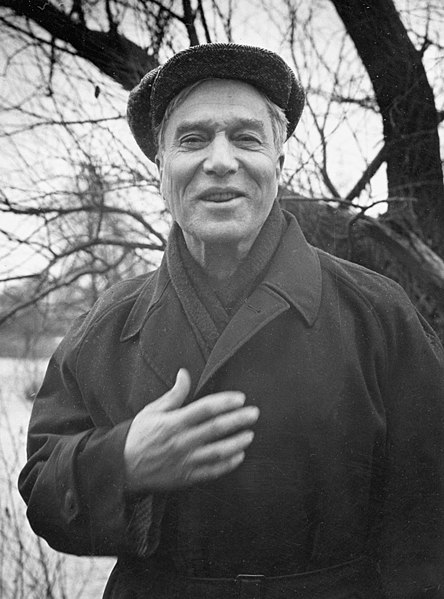
Photo by Monozigote from Wikimedia
In 1941 Germany invaded the Soviet Union in a surprise attack code-named operation Barbarossa. Pasternak immediately began to serve as a fire warden in Moscow, the capital city of Russia.
He actively helped in putting out fires caused by German’s extensive bombing of the city; he also helped to dispose of the German bombs that fell into the city undetonated.
In 1943 Pasternak visited the soldiers at the battle fronts, where he encouraged wounded soldiers by reading them his poetry works.
The war went on for four years until the Germans were finally defeated by the Russian in April 1945. Pasternak went back into writing after the war.
6. Boris Pasternak had an Extra-marital Affair
Although Boris Pasternak was still married to his second wife Zinaida, he started an extra-marital relationship with Olga Ivinskaya which lasted for the remainder of his life.
Pasternak met Olga Ivinskaya in 1946 at a printing press of Noug Mir, a Soviet literary magazine where she was working.
Olga was widowed at that time and she was living with her daughter, her son, her mother, and her stepfather.
Her mother was strongly opposed to their relationship, for she didn’t like the idea of 56 years old married man dating her 34 years old daughter.
7. Boris Pasternak tried a career in Music
After attending a music concert by celebrated Russian composer Alexander Scriabin in 1903. The fourteen years old Pasternak decided to devote his life to music composition.
He seriously engaged himself in the study of music at the Moscow Conservatory, under the guidance of another great composer Reinhold.
Pasternak surprised everyone when he abandoned his chosen career six years later. He attributed his failure to a lack of natural talent in music composition.
8. Boris Pasternak Died of Cancer
Boris Pasternak died of lung cancer in Peredelkino on the evening of 30 May 1960, he was 70 years old.
Lung cancer is when abnormal cells divide in an uncontrolled way to form a tumor in the lung. its treatments include surgery, chemotherapy, and radiotherapy.
Before he died, Pasternak was given the last rites by the priest of the Russian Orthodox Church.
9. Pasternak had a Lover in exile

Photo source:
Pasternak had a romantic affair conducted entirely through letters with Marina Tsvetaeva, another famous 20th-century Russian poet.
Their correspondence began in 1922 when Tsvetaeva was living in exile and continued until 1935. In total, they wrote about 200 letters to each other, some of which have been published.
The correspondence ended after they finally met in person in Â鶹APP in 1935 and failed to find common ground. At some point, Pasternak excused himself to go for some cigarettes and he did not return.
10. Boris Pasternak’s novel inspired an Award-winning movie
The movie version of Boris Pasternak’s novel “Doctor Zhivago,â€� directed by David Lean and distributed by Metro-Goldwyn-Mayer was released in 1965.
It was a big success in the movie theatres around the world, and it was ranked the second highest-grossing movie in 1965.
The movie received five Golden Globes and five Oscars. It is ranked as the 39th greatest American film of all time.
Planning a trip to Â鶹APP ? Get ready !
These are ´¡³¾²¹³ú´Ç²Ô’²õÌý²ú±ð²õ³Ù-²õ±ð±ô±ô¾±²Ô²µÂ travel products that you may need for coming to Â鶹APP.
Bookstore
- The best travel book : Rick Steves – Â鶹APP 2023 –Ìý
- Fodor’s Â鶹APP 2024 –Ìý
Travel Gear
- Venture Pal Lightweight Backpack –Ìý
- Samsonite Winfield 2 28″ Luggage –Ìý
- Swig Savvy’s Stainless Steel Insulated Water Bottle –Ìý
We sometimes read this list just to find out what new travel products people are buying.


