
 English


The Whole Trinity. Photo by Wilfredor.
Top 10 Amazing Facts about Andrei Rublev
Andrei Rublev also transliterated Andrey Rublyov was born in the 1360s, died 1427 or January 29, 1430. He is regarded as the greatest medieval Russian icon and fresco painter. The Andrei Rublev Museum has been open at the Andronnikov Monastery since 1959, displaying the art of his works and epoch.
Rublev’s name appears in early chronicles in connection with the construction of various churches. He was a member of the Prince’s cartel of craftsmen and artists who traveled from town to town building and decorating churches in the 1380s.
Following the Battle of Kulikovo in 1380 between Tatar-Mongols and Russians near the Don River, many new churches were built in Russia, and each was decorated by Russian iconographers. This served as an inspiration for Rublev.
There is very little information available about his life. He was born somewhere unknown. Andrei Rublev most likely lived at the Trinity-St. Sergius Lavra near Moscow under Nikon of Radonezh, who took over as hegumen after Sergii Radonezhsky died.
1. Andrei Rublev built his legacy from a very young age
Rublev is first mentioned in 1405 when he decorated icons and frescoes for the Moscow Kremlin’s Cathedral of the Annunciation with Theophanes. His name was at the bottom of the list of masters, as he was the youngest both in rank and age.
2. The Holy Trinity icon is entirely Andrei Rublev’s work
The Whole Trinity. Photo by Wilfredor.
Rublev’s Old Testament Holy Trinity is his religious art masterpiece. It is unquestionably one of the finest Russian religious paintings in existence. Rublev based it on an earlier icon painting the Hospitality of Abraham, and through a subtle use of composition and symbolism changed the subject to focus on the Mystery of the Holy Trinity.
2. Virgin of Vladimir was done by Andrei Rublev

Virgin of Vladimir. Photo by Joe Mabel.
Another icon that is almost certainly by Rublev is a Virgin, modeled after the Virgin of Vladimir. It is masterful in its delicacy and flawless in its incorporation of Italian tenderness. It has the same integrity and exquisite sensibility as the Trinity, and is just as successful at balancing grace and severity, or blending Italian naturalism with the formal idiom of icon painting.
3. Rublev did mural decorations

Inside the Dormition Orthodox Cathedral. Photo by Loraine.
Rublev is known to have painted numerous icons, as well as mural decorations for Moscow’s Cathedral of the Dormition and the Spas Andronievski Monastery, his wall-paintings have yet to be cleaned, and more of his icons are no doubt to be discovered.
When they are revealed, Rublev will be recognized as one of the greatest religious painters of all time. It will then be possible to determine, among other things, whether the stylized cloud or tendril design that appears on some of his icons is as characteristic of his work as the single branch or flower is of Holbein’s portraits.
4. Andrei Rublev’s Khitrovo Gospels is in the Russian State Library
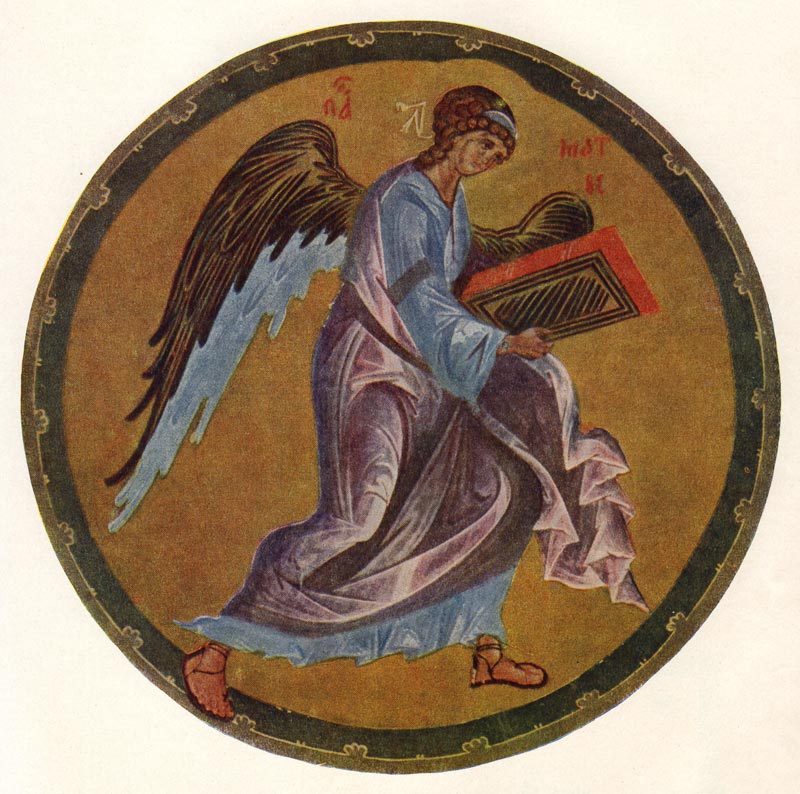
Angel of Matthew from the: Khitrovo Gospel. Photo from
The Khitrovo is an eight-page miniature Russian gospel book from the late 14th or early 15th century. The miniatures include four Evangelistic portraits as well as four images of their symbols: an angel, a bull, a lion, and an eagle.
Though some historians believe he created all the miniatures, the angel, a symbol for the evangelist Matthew. A young winged boy is surrounded by a circle.
The figure’s elegant line and contours, soft coloring of azure blue and fresh green, and the boy’s expressive facial features give the image a lightness and gayety that was characteristic of Rublev’s style.
5. Rublev’s paintings had both an element of asceticism and byzantine mannerism
Rublev’s painting combined two important elements: asceticism and Byzantine mannerism harmony. The figures in his paintings are always serene.
Perhaps it was for these reasons that his art became known as the pinnacle of religious orthodoxy and iconography. Rublev’s icon art style was declared a model for church painting at the Stoglavi Sobor.
6. Rublev was a master of different styles of painting
Rublev, like his master Theophanes the Greek, was a master of tempera, fresco, and encaustic painting. Aside from icon and mural painting, he also created devotional panel paintings, miniatures, and various forms of biblical illustration, such as the Khitrovo Gospels.
7. A film was made to celebrate Andrei Rublev
In 1966, Andrei Tarkovsky made his celebrated film, Andrei Rublev from a screenplay written by Andrei Konchalovsky and Tarkovsky. The story of Andrei Rublev is set in fifteenth-century Russia.
Tarkovsky made a film in which he portrays himself as a “world-historic figure” and “Christianity as an axiom of Russia’s historical identity.” Because of the film’s religious themes and political ambiguity, it remained unreleased for years in the atheistic and authoritarian Soviet Union, except for a single screening in Moscow.
In 1969, a shortened version of the film was shown at the Cannes Film Festival. A censored version of the film was released in the Soviet Union in 1971.
When it was released in the United States in 1973, the film was cut again for commercial reasons. As a result, several versions of the film exist. Rublev is widely considered a masterpiece and one of Tarkovsky’s best works.
8. Andrei Rublev left a legacy
Rublev was not (re)discovered until the twentieth century, when The Trinity was cleaned in 1904. His fame grew to the point where the Andronikov Monastery opened The Andrei Rublev Museum in 1959.
9. Andrei Rublev has 16 selected works

Holy Trinity. Photo by Andrei Rublev.
Some of Andrei Rublev’s works include: Nativity of Jesus, 1405 (Cathedral of the Annunciation, Moscow Kremlin), Baptism of Jesus, 1405 (Cathedral of the Annunciation, Moscow), Annunciation, 1405 (Cathedral of the Annunciation, Moscow), Version of the Theotokos of Vladimir, ca. 1405 St. Michael, 1408 (Iconostasis at Dormition Cathedral, Vladimir), St. Gabriel, 1408 (Dormition Cathedral, Vladimir), St. Andrew the First-called, 1408 (Dormition Cathedral, Vladimir), St. Gregory the Theologian, 1408 (Dormition Cathedral, Vladimir)
10. Andrei Rublev is a saint
Andrei Rublev was declared a saint by the Russian Orthodox Church in 1988. His feast days are January 29th and July 4th.
Planning a trip to Â鶹APP ? Get ready !
These are ´¡³¾²¹³ú´Ç²Ô’²õÌý²ú±ð²õ³Ù-²õ±ð±ô±ô¾±²Ô²µÂ travel products that you may need for coming to Â鶹APP.
Bookstore
- The best travel book : Rick Steves – Â鶹APP 2023 –Ìý
- Fodor’s Â鶹APP 2024 –Ìý
Travel Gear
- Venture Pal Lightweight Backpack –Ìý
- Samsonite Winfield 2 28″ Luggage –Ìý
- Swig Savvy’s Stainless Steel Insulated Water Bottle –Ìý
We sometimes read this list just to find out what new travel products people are buying.


