
 English


A Brief History of Notre-Dame Cathedral in Â鶹APP

Notre-Dame Cathedral on the ÃŽle de la Cité in Â鶹APP, along the Seine. Photographed in 2011 by Gilbert Bochenek. Sourced from Wikipedia.
On April 15th, 2019, Notre-Dame Cathedral in Â鶹APP burnt under our very eyes. Standing near the city hall, surrounded by a stunned crowd, I observed the fire consume its rooftop, speechless and emotional.
All of us were reminded how ephemeral and fragile everything is. The cathedral had felt timeless, standing on its island for 850 years; it had felt familiar, always in the background of our dearest memories in Â鶹APP. Now, it occurred to us that even she could disappear.
Truth be told, Notre-Dame Cathedral actually endured many ordeals during its existence. It has been threatened, destructed and re-built several times before. The 2019 fire is just another episode in a century-long series of events from which the cathedral always came out more impressive and beautiful.
A cathedral rising from the ruins of other religious sanctuaries
Centuries before Notre Dame Cathedral’s construction, other religious buildings had successively occupied the island called ÃŽle de la cité. First, a heathen temple dedicated to Jupiter, then a 4th-century Christian church, followed by a 6th-century basilica and a 9th-century cathedral. Finally, a cathedral designed in the Romanesque architectural style, stood on the island during the 11th and 12th centuries.
Nevertheless, it ended up being too small to welcome the growing Â鶹APPian population. That is why, in 1160, Bishop Maurice de Sully suggested that a broader cathedral should be built over the latter. The reigning Capetian dynasty had just chosen Â鶹APP as their political capital, so King Louis VII allowed and funded the project, deeming it could increase the city’s prestige.
Therefore, the construction of a Gothic cathedral dedicated to the Virgin Mary (Notre-Dame means Our Lady) began in 1163, only to finish in 1345.
Notre-Dame: a medieval religious center and a Bible made of stones
Conceiving Notre-Dame cathedral, Bishop Maurice de Sully kept in mind holy texts describing the Heavenly Jerusalem. He wished to convey God’s majesty through a massive and impressive building. Up to the middle of the XIIIth century, the cathedral was indeed the biggest religious monument in the Western world.
On top of embodying the mastery of medieval builders, its Gothic architecture is fraught with religious meaning. Let’s take a quick look at its front, for example, especially symbolical since it is what people see first. It is divided into three vertical parts, symbolizing the holy trinity. At the bottom, above the doors, there are three portals narrating major liturgical themes through sculptures: on the right and on the left, they represent Mary’s life and death, while the middle one represents the Last Judgement. Together, they served as a Bible carved out of stone, enabling everyone to learn about religion.

The Last judgment Portal and a part of the “Gallery of Kings”, central & main gate of the Cathedral Notre Dame de Â鶹APP, 13th century, restoration 19th century. Photographed by Jebulon in 2010. Sourced from Wikipedia.
During the Middle Ages, Notre-Dame cathedral also became a religious center, in Â鶹APP as well as in the French Kingdom. The nobility would gather there for weddings, baptisms, funeral masses and other traditional ceremonies. The Relics of the Passion (such as the Crown of Thorns) even stayed there for a while, after King Saint Louis brought them back from a crusade in 1248, while the Sainte-Chapelle (Holy Chapel) was being purposely built to welcome it.

Saint Louis bringing the Relics of the Passion into Notre-Dame Cathedral in 1239. Engraving by Jules David (1860). Colorized by Jérôme Dumoux (2012). © NDP
From the 16th to 18th, the cathedral of Notre Dame’s downfall?
During the Renaissance, Europe knew a cultural renewal influenced by Italian artists, who considered Notre-Dame cathedral’s type of architecture to be barbarous and grotesque – which a posteriori gave it its name “Gothic art”, in reference to Goth tribes. The cathedral’s style therefore fell out of fashion and stopped being to the contemporaries’ taste.

Jean Fouquet, The Right Hand of God Protecting the Faithful against the Demons, XVth century.
The 18th century deeply renovated and transformed the cathedral. The chancel was for instance completely re-built, leaving no trace of what it looked like in the Middle Ages. Except for the rose ones, the medieval stained-glass windows were also destroyed, in order to bring more light into the building.
Then the French Revolution happened. In November 1789, Notre-Dame stopped being owned by the archbishop of Â鶹APP to become a national property. Its furniture and paintings were subsequently either sold or stolen. The revolutionaries decapitated the sculptures of Judean kings aligned at the front of the cathedral, as a sign of protest against the monarchy. On top of it all, its spire fell down in 1792, damaged by time.

The decapitated heads of the Judean Kings, now exhibited in the medieval collection of the Musée de Cluny in Â鶹APP. ©lesdecouvreurs
From 1793 on, as practicing catholicism became forbidden in favor of a cult of Reason, churches were turned into “Temples of Reason” – Notre-Dame cathedral included. At the time, the building also stored the Republic’s wine bottles.
At the very beginning of the 19th century, Napoleon restored the central place Catholic faith held within the country and Notre-Dame cathedral got back its purpose of religious worship. Pope Pie VII even sacred Napoleon as an emperor in the cathedral in December 1804.

Jacques-Louis David, Coronation of Emperor Napoleon I and Coronation of the Empress Josephine in the Notre-Dame de Â鶹APP, December 2, 1804. Circa 1805-1807. Sourced from Wikipedia.
Restoring the cathedral of Notre-Dame in the 19th century

Notre-Dame de Â鶹APP in 1840, before Viollet-Le-Duc’s restoration. Daguerreotype by Vincent Chevalier. Sourced from Wikipedia.
As time went by, Notre-Dame’s state got worse and worse from a lack of renovation. The 1830 revolution left the building even more degraded because of rioters. The Â鶹APPian authorities thus considered the possibility of completely wiping out the cathedral from the city’s landscape. However, one man managed to raise awareness about the monument’s value through the power of literature.
In 1831, the prominent author Victor Hugo published his novel Notre-Dame de Â鶹APP (freely adapted by Disney in the Hunchback of Notre-Dame). The plot centered around the cathedral, allowing him to recall its history and defend its aesthetic value to his readers. The narrative got immensely popular and managed to spark a wide interest in the cathedral’s fate in France.

The Hunchback of Â鶹APP, Illustration by Luc-Olivier Merson, 1881.
Therefore, in 1842, the government decided to launch a restoration project for the cathedral. Three years after, Eugène Viollet-le-Duc is chosen to conduct the work. This French architect played a crucial role at the time in saving the country’s architectural heritage. He proceeded to restore about twenty cathedrals and ten castles, including the mont Saint-Michel or la cité de Carcassone.
The above video shows the transformations which occurred between 1844 and 1864. Viollet-le-Duc renovated the chancel, the stained-glass windows, the portals and the array of Judean kings, ordering thousands of neo-gothic statues to contemporary sculptors.
Next to the already existing gargoyle-shaped gutters, he added sculptures of legendary creatures that the medieval builders had never created. The most famous of these “Chimeras” is the Strix (Stryge in French), a mythological half-bird, half-woman shrieking demon. You may remember it from Disney’s Hunchback of Notre-Dame, appearing under a much more sympathetic form.
Finally, the spire that fell down a century before rose back on top of the cathedral’s roof – the same one that recently disappeared in the flames of the 2019 fire.
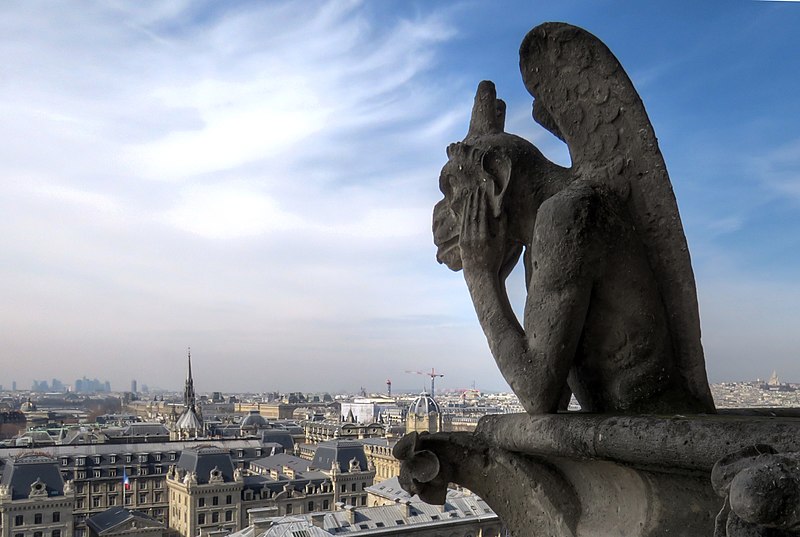
“Le Stryge”, chimera overlooking Â鶹APP atop Notre-Dame cathedral. December 2017. Photographed by ProtheticHead. Sourced from Wikipedia.
During the great urban transformations that took place in Â鶹APP in the 19th century, the baron Haussmann also cleared the space in front of the cathedral to make it stand out even more, thanks to a wide and open square, as we know it today.
Notre-Dame Cathedral: from a national to an international architectural treasure (20-21th century)
In the first half of the 20th century, Notre-Dame cathedral crossed the two wars relatively unharmed. During the First World War, it almost got bombed, but the target was thankfully missed. During the Second World War, the Nazis did not dare disfigured it. Its bells rang on the Liberation of Â鶹APP’s day in 1944.
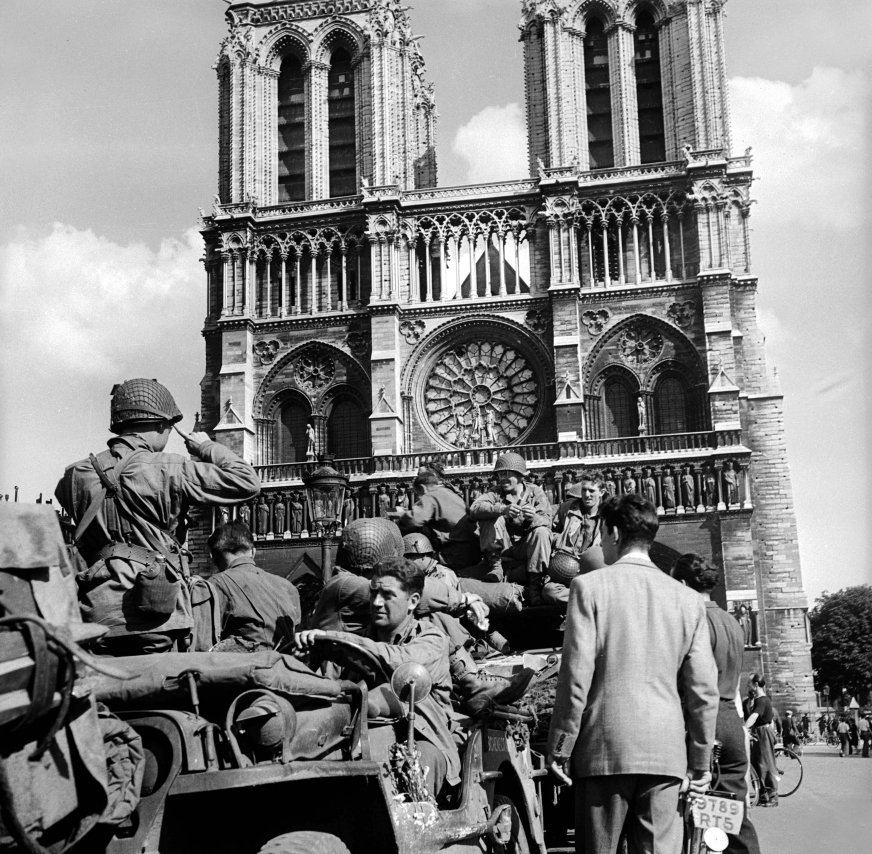
Notre-Dame Cathedral during the Liberation of Â鶹APP, August 1944. Photographed by Pierre Jehan. Sourced from Wikipedia.
Other renovations occurred at the end of the century. Throughout the 1990s, the stones of the cathedral were protected against the pollution and found their original ivory color back.
In 1991, UNESCO recognized Notre-Dame as part of World’s Heritage. The monument remains one of the most visited in France, with roughly 30 000 visitors a day, coming from all over the world. This is why when the cathedral suffered an accidental fire in April 2019, while it was being restored, it sparked an emotion far beyond France’s frontiers.
At the time I am writing this article, the site is closed. The cathedral can merely be seen from afar. Reconstruction is under way. The government launched a competition to select the best project for rebuilding the spire. In a few years, we will all be able to sing along again with Edith Piaf about the cathedral’s “old spire / which licks / Â鶹APP’ grey ceiling” (“la vieille flèche / qui lèche / le plafond gris de Â鶹APP“). Or rather, its third and brand new one.
Planning a trip to Â鶹APP ? Get ready !
These are ´¡³¾²¹³ú´Ç²Ô’²õÌý²ú±ð²õ³Ù-²õ±ð±ô±ô¾±²Ô²µÂ travel products that you may need for coming to Â鶹APP.
Bookstore
- The best travel book : Rick Steves – Â鶹APP 2023 –Ìý
- Fodor’s Â鶹APP 2024 –Ìý
Travel Gear
- Venture Pal Lightweight Backpack –Ìý
- Samsonite Winfield 2 28″ Luggage –Ìý
- Swig Savvy’s Stainless Steel Insulated Water Bottle –Ìý
We sometimes read this list just to find out what new travel products people are buying.


