
 English


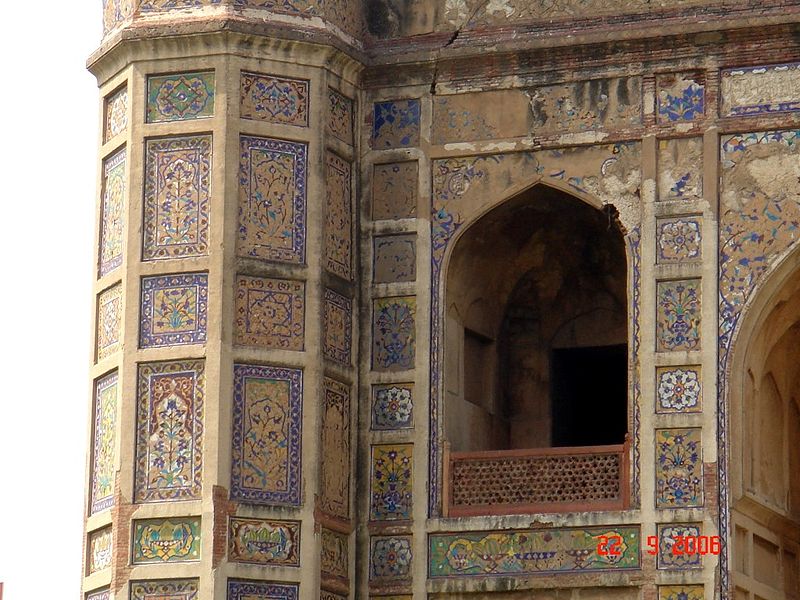
Image by Airknight (talk) (Uploads) from
Top 10 Amazing Facts about Chauburji
Chauburji is a relatively small Mughal-era building in the city of Lahore. It is located at the intersection point of Bahawalpur road and Multan road. The building was raised in 1646 C.E during the era of Emperor Shah Jahan.
The building originally served as a doorway to a large garden, which was later destroyed by the flooding of River Ravi. There are no remnants today from the ancient garden save for the Chauburji Gate.
Chauburji (four towers) embodies elements from both Mughal and Arab-Persian architecture. Perhaps the most unique feature of the monument is the four minarets, which grow wider towards the top. Some historians have speculated that the four minarets were originally capped with cupolas which must’ve eroded with time.
Here are the top 10 facts about Chauburji.
1. Chauburji means Four Towers

Image by Ms.usmanasif from
Chauburji, literally meaning ‘Four Towers’, is perhaps best recognized by its four sturdy octagonal towers that stand against the thick walls of the building. Built-in 1646, it once served as the entrance to a remarkable garden compound.
In the present times, Chauburji is located at a busy intersection, marking the roads which lead to Multan and Bahawalpur.
Though it seems to have vanished as the city has expanded, what remains is still a magnificent structure with azure blue, vivid lemons and sea-green mosaics with holy verses engraved inside.
2. Chauburji is a Vestige of Mughal Architecture

Mughal Architecture Photo by on
Chauburji Gateway is among the famous monuments of structures and buildings of the Mughal era in Lahore, Pakistan. It’s called Chauburji in the local language because of its four minarets (towers). It was constructed in 1646, a typical Mughal architecture.
The gateway comprises dazzling tiles and is magnificently festooned with rich mosaic work. Red brickwork typically represents the Mughals-style architecture of the sub-continent like the Badshahi Mosque and Lahore fort.
Moreover, the distinctive features of this building are its minarets which were said to have cupolas on minarets toppled as time advanced. Arches are just like the Tudor architectural style of England later adopted by Mughals which could be seen in their Masjids and mausoleums.
3. It was once the Entrance to the Large Pleasure Gardens of Lahore

Image by Mahanoor rasheed from
The view of the 400 years old majestic Chauburji pleasure gardens was once a relief for sore eyes. Today, the priority needs of a growing city take precedence but the old relic stands intact with glory.
An inscription on the monument gives the date 1056 AH (1646) and attributes it to “Sahib-e-Zebinda Begam-e-Dauran�. According to the 19th-century historian Syad Muhammad Latif, the full inscription reads:
“This garden, in the pattern of the garden of paradise, has been founded…
(the second line has been effaced)
The garden has been bestowed on Mian Bai
By the bounty of Zebinda Begam, the lady of the age�.
4. Chauburji is a Clash of Modern and History

Image by Shahzaib Damn Cruze from
The gate is basically in the middle of what is now an involuntary roundabout. The entire area in which the tomb is has been encroached on. To imagine that Lahore city planners put a historic structure in the center of a roundabout is baffling.
The location is an inconvenience to tourists especially crossing the streets to the tomb is tricky owing to the busy traffic. Nevertheless, the structure is still amazing on its own merits.
5. The Lahore Orange Line Metro Train Project’s effect on Historical Buildings
The Lahore Orange Line Metro Train Project affected the view of two major monuments of the city — Chauburji and Shalamar Gardens.
The 27.1km orange line comprises an almost 25km elevated track with train stations — Dera Gujran to the intersection before General Post Office (GPO) Chowk and Jain Mandir to Ali Town — and a 2km underground portion from Jain Mandir to the intersection next to GPO Chowk. The underground portion also includes some part of the historical GPO building.
6. The Tomb is a Haven for Drifters
Walking across the courtyard of the monument one will observe it strewn with rubble, heaps of sand, and trash. A horde of junkies lay beneath the sparse trees that dot the grounds.
It looks like the authorities have forgotten the tomb though they have made a halfhearted attempt to renovate it. The outer walls seemed waterlogged and drifters occupy the alcoves.
It is a far cry from the glory days of the Mughals who constructed the monument. How far-sighted were the kings of old days? The city authorities should plan for the maintenance of the tomb.
7. Swallows have nested in the Tomb

image by Kumail Hasan from
The common swallow, also referred to as the Ababil, has many species of Genus Hirundo. It is so named because of its typical deeply forked “swallow� tail. It builds clay nests on the lower portions of old and dilapidated buildings as well as old bridges.
It collects moist soil from banks of streams and rivers etc. and makes the shape of a nest with one hole-like opening. Their colony consists of numerous nests. It is really a wonder, how every individual bird identifies its nest, as well as the young, to which the bird feeds very frequently throughout the day. Looking at the ceiling of the tomb you will notice colonies of swallows.
8. The Main Purpose of the Building was Ornamental

Image Hhaarroonn from
The red brickwork is typical of the Muslim buildings of the sub-continent; the doorways and windows running through the interior corridors are examples of the living style that characterised the Mughal buildings.
However, the main purpose of building Chauburji appears to be strictly monumental. The decrepit building, which has not lost its elegance, stands alone surrounded by hoardings and bustling traffic on the busy Multan Road.
9. Chauburji was Affected by the 1843 Earthquake
During a severe earthquake in 1843, the north-western minaret collapsed and cracks appeared in the central arch. This has however been restored as much as was reasonably possible and the gateway now looks quite as it might have been during the time of its Mughal patroness. The restoration was carried out by the Department of Archeology in the late 1960s.
10. The Chauburji Gateway was Created for Princess Zeb-un-Nisa Gardens

Image by Unknown Author from
In the historic city of Lahore, on the road that led southwards to Multan, the Chauburji gateway remains an extensive garden known to have existed in Mughal times. The establishment of this garden is attributed to Mughal, 1646 AD, which appears in one of the inscriptions on the gateway. The gateway consists of four towers and contains much of the brilliant tile work with which the entire entrance was once covered.
Planning a trip to Â鶹APP ? Get ready !
These are ´¡³¾²¹³ú´Ç²Ô’²õÌý²ú±ð²õ³Ù-²õ±ð±ô±ô¾±²Ô²µÂ travel products that you may need for coming to Â鶹APP.
Bookstore
- The best travel book : Rick Steves – Â鶹APP 2023 –Ìý
- Fodor’s Â鶹APP 2024 –Ìý
Travel Gear
- Venture Pal Lightweight Backpack –Ìý
- Samsonite Winfield 2 28″ Luggage –Ìý
- Swig Savvy’s Stainless Steel Insulated Water Bottle –Ìý
We sometimes read this list just to find out what new travel products people are buying.


