
 English


David van Dantzig in 1915. Photo by
Top 10 Unknown Facts about David van Dantzig
Van Dantzig, who was born in Amsterdam to a Jewish family in 1900, began studying Chemistry at the University of Amsterdam in 1917, where Gerrit Mannoury lectured. In 1931, he received his PhD from the University of Groningen for his thesis “Studien over topologische algebra” under the supervision of Bartel Leendert van der Waerden.
In 1938, he was appointed professor at Delft University of Technology, and in 1946, he was appointed professor at the University of Amsterdam. Jan Hemelrijk (1950), Johan Kemperman (1950), David Johannes Stoker (1955), and Constance van Eeden (1955) were among his doctoral students (1958). He was a co-founder of the Mathematics Centrum in Amsterdam. Jan Hemelrijk succeeded him at the University of Amsterdam.
1. He was appointed professor at the University of Amsterdam and the Delft University of Technology
In 1938, David Van Dantzig was appointed professor at Delft University of Technology, and in 1946, he was appointed professor at the University of Amsterdam. Jan Hemelrijk, in 1950, and David Johannes Stoker, in 1955, were among his doctoral students. He was a co-founder of the Mathematics Centrum in Amsterdam. Jan Hemelrijk succeeded him at the University of Amsterdam.
2. The government appointed David van Dantzig to resolve delta works

David van Dantzig. Photo by
In response to the 1953 North Sea flood, the Dutch government formed the Delta Committee and tasked Van Dantzig with developing a mathematical approach to formulating and solving the economic cost-benefit decision model concerning optimal dike height problems in connection with the Delta Works. The Delta Committee’s efforts, including Van Dantzig’s, resulted in statutory minimum safety standards.
3. At the age of 13, he wrote his first mathematics paper

Mathematics computation. Photo by Antoine Dautry.
David van Dantzig was in secondary school when he wrote his first mathematics paper, and he was only thirteen years old. His main interest in secondary school, however, was not mathematics, but chemistry. He continued his studies of chemistry at the University of Amsterdam after leaving school, but he did not enjoy chemistry, and when he was forced to give up his academic studies to help support his family, van Dantzig took on a number of jobs purely for money.
However, his brief time at the University of Amsterdam would have a lasting impact on his career because, while a chemistry student, he began attending Gerrit Mannoury’s analytic geometry course at the university in October 1917. Following the second lecture, he wrote a lengthy letter to Mannoury, beginning a life-long master-pupil relationship.
4. David was a co-founder of the Amsterdam University Mathematics Center, a research and service institution
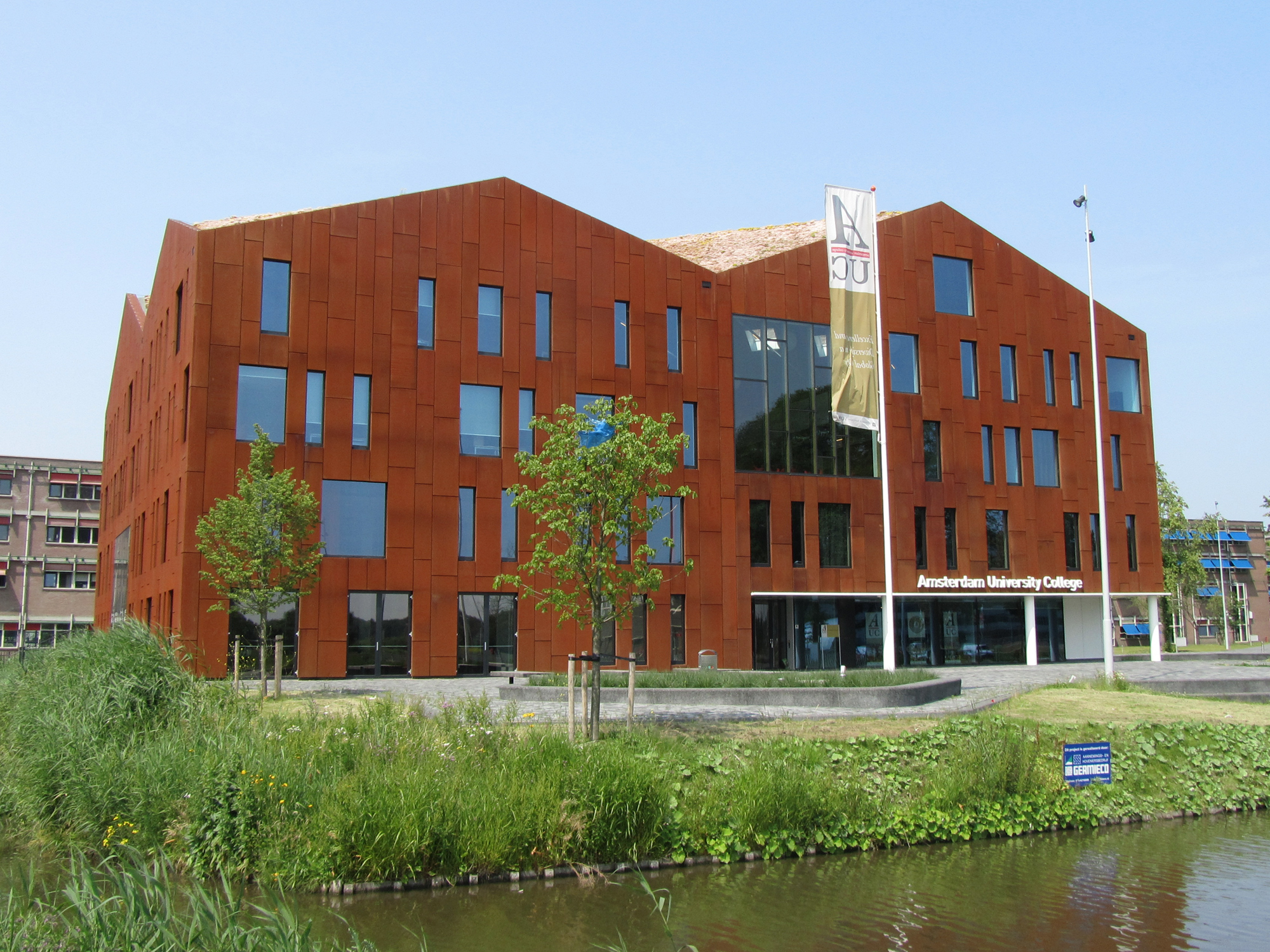
Amsterdam University. Photo by Jvhertum.
In February 1946, he cofounded, with J G van der Corput and J F Koksma, the research and service institution Mathematisch Centrum in Amsterdam. He was a key figure at both the Mathematical Center and the University of Amsterdam, where he held a chair until his death. He was the head of the Department of Mathematical Statistics at the Center and the Theory of Collective Phenomena at the University. This chair was made especially for van Dantzig.
He was extremely busy in these two roles, both academically (delivering courses, attending congresses, and supervising student work) and administratively (sitting on numerous committees and boards).
5. David began working on probability during WWII
David van Dantzig in 1915. Photo by
Van Dantzig’s research topics and approach to research would change as a result of World War II. When World War II broke out in 1939, the Dutch tried to remain neutral, but in the spring of 1940, German troops entered Holland in a strategic move on their way to attack France, and the Dutch were defeated in a week.
When the Germans occupied Holland, van Dantzig was fired from his chair in Delft and forced to relocate with his family from The Hague to Amsterdam. During the war, he began to work on probability, and in 1941, he published Mathematical and empirical foundations of probability theory (Dutch).
6. His doctoral thesis topic came from a seminar he attended at the University of Amsterdam in 1925
In 1925, Van Dantzig attended a seminar at the University of Amsterdam led by L E J Brouwer, which also included Pavel Sergeevich Aleksandrov, Karl Menger, Leopold Vietoris, and Witold Hurewicz. He decided to try to unify these concepts after hearing these outstanding mathematicians discuss their work on topological groups, rings, and fields at this seminar.
This became the subject of his doctoral dissertation. Van Dantzig began working as an assistant to Jan Schouten at Delft Technical University in 1927. He married Elisabeth Mathilde Stumpfrock two years later, and they had three children. Beginning in 1929, he taught at the Kweekschool voor Onderwijzers in Rotterdam, a teacher training institution.
7. He has made two significant contributions to mathematics

Mathematical figures on a chalkboard. Photo by Thomas T.
His theory of collective marks is the first. On arbitrary hereditary time-discrete stochastic processes, viewed as stationary Markov chains, and the corresponding general form of Wald’s fundamental identity, he describes it (1954). Application to rank correlation is his second. The mimeographed notes contain this information.
The generator functions are linked to some non-parametric tests.
8. Van Dantzig addressed the issue of Mathematical Issues Raised by the 1953 Flood Disaster
Van Dantzig had already given the plenary address Mathematical Problems Raised by the Flood Disaster of 1953 at the International Congress of Mathematicians in Amsterdam in September 1954. The report produced by the Mathematical Center looked at all three categories of problems mentioned by van Dantzig in the preceding quote, and it was still being reviewed by van Dantzig at the time of his death. The North Sea problem was a series of papers published after his death by van Dantzig and H a Lauwerier as a result of this major investigation.
9. He wrote papers on differential geometry and its applications to physics with Jan a Schouten
David van Dantzig. Photo by
“In three previous papers, we have given a brief account of a new physical theory, the “general field theory,” which intends to unify general relativity not only with Maxwell’s electromagnetic theory, but also with Schrödinger’s and Dirac’s theory of material waves.” The main point of this theory is that it is based on a projective connection rather than a metrical or affine one. As a result, it is closely related to the theory of Veblen and Hoffmann, which also relies on a projective connection, and to the theory of Einstein and Mayer, which can be converted into a projective form, as we demonstrated in a previous paper.
In contrast to these theories, the geometrical conditions in our theory are reduced to a smaller number in order to obtain the possibility of adapting the projective connection most closely to physical considerations. The method developed by D van Dantzig to handle the projective connection in this paper is based on the introduction of homogeneous coordinates. J A Schouten developed the method used to handle spin quantities.”
10. There’s an article that looks at Van Dantzig’s contributions to significs
David van Dantzig in 1915. Photo by
When David van Dantzig was in his early twenties and studying mathematics at the University of Amsterdam under Mannoury and Brouwer, he became acquainted with significs; especially to Gerrit Mannoury, the study of the foundations of mathematics was a signific study of those foundations themselves, which he incorrectly called the philosophy of mathematics.
Planning a trip to Â鶹APP ? Get ready !
These are ´¡³¾²¹³ú´Ç²Ô’²õÌý²ú±ð²õ³Ù-²õ±ð±ô±ô¾±²Ô²µÂ travel products that you may need for coming to Â鶹APP.
Bookstore
- The best travel book : Rick Steves – Â鶹APP 2023 –Ìý
- Fodor’s Â鶹APP 2024 –Ìý
Travel Gear
- Venture Pal Lightweight Backpack –Ìý
- Samsonite Winfield 2 28″ Luggage –Ìý
- Swig Savvy’s Stainless Steel Insulated Water Bottle –Ìý
We sometimes read this list just to find out what new travel products people are buying.


