
 English


Samuel Iperusz. Wiselius. Photo by Hendrik Willem Caspari/P. Velyn.
Top 10 Sensational Facts about Samuel Iperusz. Wiselius
Knight Samuel Iperuszoon Wiselius was a successful Dutch lawyer and a prominent Patriot and democrat who was involved in the demise of the Dutch East India Company (VOC) and the Cape negotiations. Wiselius was a witty Voltairian spirit with far-sighted political views who would end his days writing dramas on Classical themes. Wiselius corresponded with nearly all the major players during the Batavian Republic, and understanding the period would be impossible without his meticulously kept and neatly written correspondence. He was also a poet, historian, and police superintendent.
1. On the Athenaeum Illustre, Samuel studied law and classics
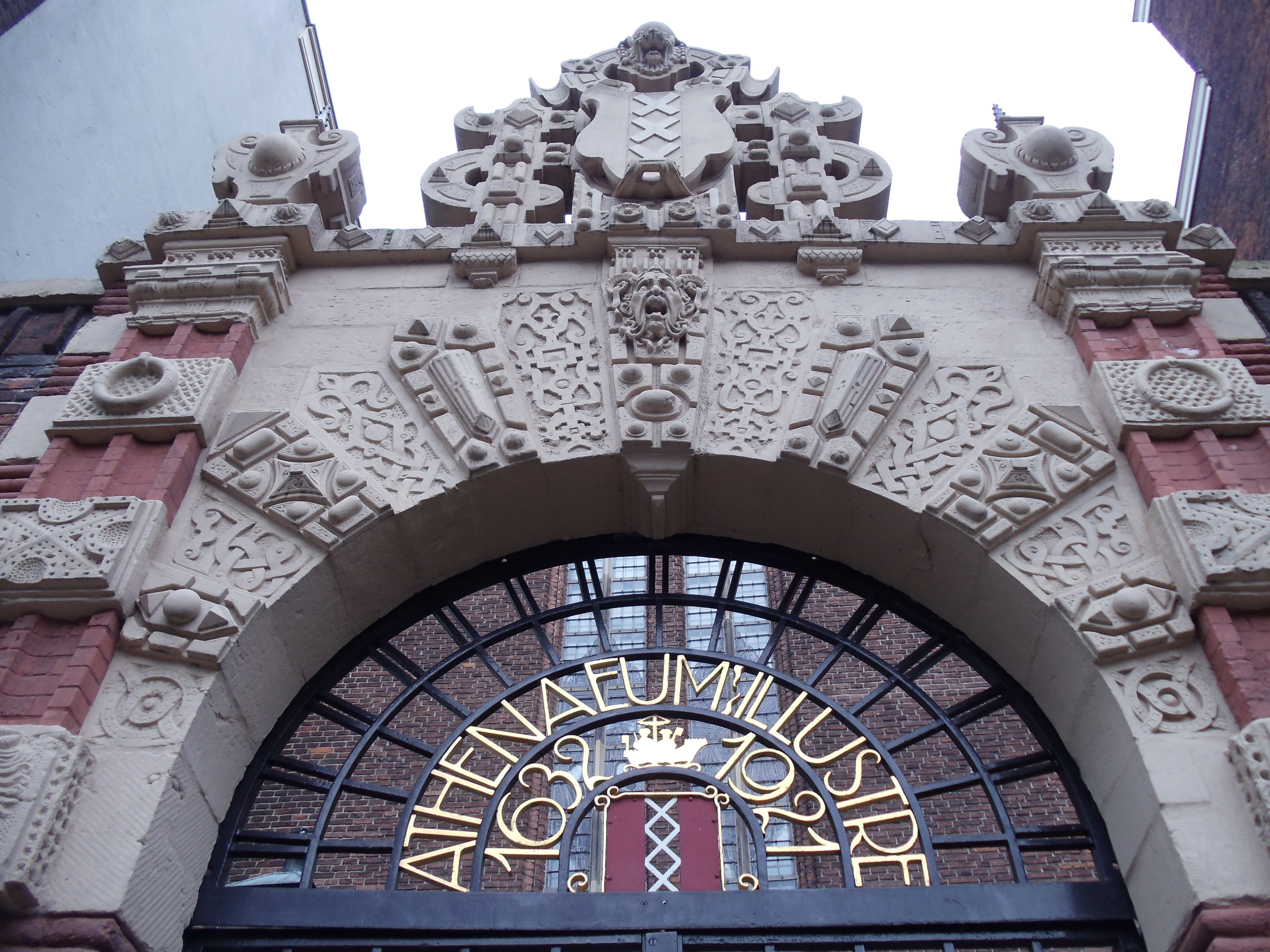
The gate to the Agnietenkapel, where the University of Amsterdam was founded as the Athenaeum Illustre in 1632. Photo by Swimmerguy269.
In 1786, he visited Franeker and showed Johan Valckenaer and Theodorus van Kooten, then progressive professors at the local University, his essay on dismissing the local militia in 1650. Although the article was lost, the friendship remained when the three became influential in the country’s future after 1795.
Samuel was required to rewrite his thesis and received his doctorate from Leiden in 1790. He became a lawyer at the Council of Holland, which also served as a court of law, almost immediately. Wiselius founded the brotherhood of l’Infanterie des Cinq Sabres (“Infantry of the Five Sabres”) in Leiden in 1791, a foray into freemasonry.
2. Samuel was a member of the town hall’s revolutionary committee
Samuel Iperusz. Wiselius. Photo by Hendrik Willem Caspari/P. Velyn.
Wiselius and Nicolaas van Staphorst were members of the revolutionary committee that occupied the town hall in January 1795. Wiselius addressed the city government in the nearby town hall on Dam Square, stating that the time had come for them to resign. The new leaders took over quickly the next morning and elected Rutger Jan Schimmelpenninck as their president. Stadholder William V fled to England by boat from a beach near The Hague; there were no casualties, and the event is known as the Velvet Revolution.
3. Wiselius, along with Pieter Paulus, advocated for an entirely new order, with more powerful central leadership

Pieter Paulus. Photo by Reinier Vinkeles.
He clearly distanced himself from the Union of Utrecht, which he saw as “a weak, barely coherent, and in many ways useless treaty violated almost daily.” The vast powers wielded by the Provincial States (the highest authorities in the provinces) over the previous two centuries were to be reduced to those of mere clerical institutions.
4. He was named a member of the Committee on East-Indies Trade and Possessions
Samuel Iperusz was appointed alongside Wybo Fijnje, with whom he later clashed. The committee needed to figure out how to deal with the bankrupt VOC, a symbol of the Ancient Régime’s power. The Dutch East India Company was nationalized, and its so-called Outer Chambers in Middelburg, Delft, Enkhuizen, and Hoorn were closed down, as were its surplus employees.
In 1798, the Unitarists Wiselius, Von Liebeherr, Wybo Fijnje, and Quint Ondaatje were involved in Daendels’ plans for a coup. The French ambassador, Charles Delacroix, was willing to assist if the Dutch offered a significant financial reward. Wiselius published a pamphlet in 1801, mocking Guillelmus Titsingh, a former Dutch East India Company administrator.
5. He held various positions in the Kingdom of the Netherlands
Wiselius was appointed director of the Amsterdam Police in 1814 after declining a position in Batavia. When his wife died, he preferred to be with his children. Wiselius succeeded Willem Bilderdijk as secretary of the Royal Institute of Sciences (KNI) in 1817. Since 1815, he had been a member of the Royal Institute.
6. Gustav IV, the exiled King of Sweden, paid him a visit

Gustav IV, the exiled King of Sweden. Photo by Johann Baptist von Lampi the Elder.
Wiselius was visited in August 1824 in his newly rented house on a prestigious canal in the Jewish neighborhood, not by Louis Bonaparte (as a long-lived legend about his house on Nieuwe Herengracht would have it), but by Gustav IV, Sweden’s deposed and exiled king.
The two men talked about Het Réveil, a new revivalist religious movement that began in Switzerland around 1810. Wiselius took him to his home’s largest room, which had a view of the park and five massive fixed paintings of hunting scenes by Jan Weenix. Gustav had given up his attic at the stinky Birsig in Basel a few years before.
7. As the head of the police, Samuel was involved in controlling the tax revolts

Red neon light signage-tax. Photo by Jon Tyson.
House owners organized tax revolts in Herenmarkt square and the Jordan neighborhood. Following that, he and the city mayor were heavily chastised while sitting dozy in their chairs, after a meal Wiselius had not attended in person, but had instead dispatched a commissioner. Wiselius resigned in 1840, but remained as secretary of the KNI’s literary division for a few years longer.
8. Samuel’s son-in-law wrote a dull biography about him after his death
When he died, his son-in-law, P. Vaan Limburg Brouwer, a physician and writer, wrote a dull biography that included some important details. J.R. Thorbecke, a statesman, criticized the biographer, his subject, and his florid jargon in his “Historical Sketches” published in 1860. Wiselius has been described by some authors as forceful, sharp-witted, animated, or even overstrung.
Simon Schama rarely has a positive opinion of Wiselius and the Patriot brotherhood, describing them as merely quasi-intellectual, and Wiselius himself as a minor figure, a Jacobin, a renegade, and an over-loud, pessimistic drawing-room liberal who shirked real issues and left politics an embittered man.
9. On October 5, 1815, he was elected to the Royal Institute’s second class
Samuel Iperusz. Wiselius. Photo by Hendrik Willem Caspari/P. Velyn.
Even before Wiselius had established himself as a deserving tragedy poet, he was elected as a member of the second class of the Royal Institute on October 5, 1815, and this choice was made by Royal Decree of November 21, empowered three days earlier by the King with the Knighthood of our Netherlands Lion. Other Societies and Societies, both in the South and the North, were zealous, as if fighting for his membership.
10. Wiselius was among those in the Kingdom of Holland who refused to serve “Mr Bonaparte”
The election of Louis Bonaparte as King of the Netherlands sparked outrage in 1806. Wiselius was among those who refused to serve “Mr. Bonaparte.” Wiselius, now without a job, devoted himself to his private interests: the history of Ancient Greece and the city of Amsterdam, as well as writing plays and poems in his country house on the banks of the River Vecht.
Wiselius was later to publish the charter of 1275. He was also involved in the restoration of Muiderslot, a dilapidated historic castle that was to become a museum.
Planning a trip to Â鶹APP ? Get ready !
These are ´¡³¾²¹³ú´Ç²Ô’²õÌý²ú±ð²õ³Ù-²õ±ð±ô±ô¾±²Ô²µÂ travel products that you may need for coming to Â鶹APP.
Bookstore
- The best travel book : Rick Steves – Â鶹APP 2023 –Ìý
- Fodor’s Â鶹APP 2024 –Ìý
Travel Gear
- Venture Pal Lightweight Backpack –Ìý
- Samsonite Winfield 2 28″ Luggage –Ìý
- Swig Savvy’s Stainless Steel Insulated Water Bottle –Ìý
We sometimes read this list just to find out what new travel products people are buying.


