
 English


Top 10 Unbelievable Facts about 10 Downing Street
Since 1735, 10 Downing Street has been the home of British prime ministers and it competes with the White House for the title of the most important political edifice in the modern age.
Britain’s most critical choices have been made behind its black door for the past 200 years.
The First and Second World Wars, as well as key decisions about the end of the empire, the building of the British nuclear bomb, the handling of economic crises from the Great Depression in 1929 to the Great Recession and the establishment of the welfare state, were all directed from within.
Robert Walpole, Pitt the Younger, Benjamin Disraeli, William Gladstone, David Lloyd George, Winston Churchill and Margaret Thatcher are just a few of the prominent political leaders who have lived and worked in Number 10.
Number ten has three functions that overlap: the British Prime Minister’s official house, their office, and the location where the Prime Minister entertains guests.
The Prime Minister conducts receptions and events for British and international visitors, with charitable receptions topping the list.
Here are 10 unbelievable facts about 10 Downing Street.
1. 10 Downing Street is Larger than it Appears

Image by White House from
The building is much larger than it appears from the front. The hall with the chequered floor immediately behind the front door lets on to a maze of rooms and staircases.
However, No 10, which was originally three houses, is a complex of offices that is much larger than it looks from the outside, comprising around 100 rooms in total.
The Prime Minister’s Office houses an extensive staff of civil servants and special advisers who work closely with the PM from his official residence.
Three Downing Street houses join to create a more spacious and elegant building.
the official residence of the Chancellor of the Exchequer No. 11 joins Number 10 and No. 12 Downing Street.
2. The Street is Named after a Man of Dubious Character
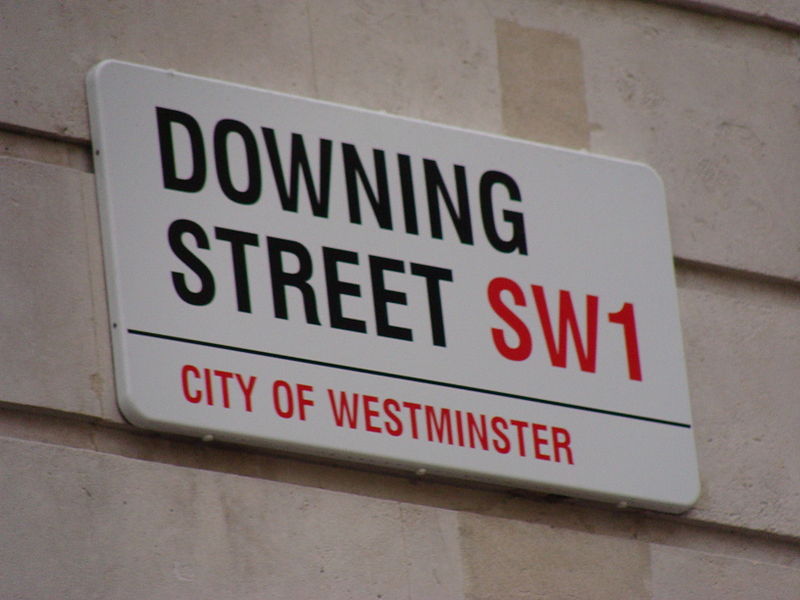
Image by Fernando Losada RodrÃguez from
The world’s most famous street bears George Downing’s name, who unfortunately was an unpleasant individual.
He was a capable diplomat and government administrator, but he was stingy and brutal at times.
George Downing was a former Commonwealth diplomat at the Hague who switched allegiances at a whim.
Between 1682 and 1684, he demolished existing properties and in their place he built a cul-de-sac of 15 to 20 terraced on the new street, Downing Street.
The houses were cheaply built, with poor foundations for the boggy ground in order to maximise profit.
Instead of neat brick façades, they had mortar lines drawn on to give the appearance of evenly spaced bricks.
In the 20th Century, Prime Minister Winston Churchill wrote that Number 10 was:
“Shaky and lightly built by the profiteering contractor whose name they bear.�
3. 10 Downing Street was Initially Given out as a Royal Gift

Image by Sergeant Tom Robinson RLC from
Sir Robert Walpole held the title of First Lord of the Treasury and practically functioned as the first Prime Minister.
King George II gifted Sir Walpole both the mansion on Downing Street and the property overlooking Horse Guards.
As a personal gift, Walpole declined the property, instead, he requested that the monarch make it accessible to him and future First Lords of the Treasury as an official house, beginning a practice that continues today.
10 Downing Street’s black front door still bears the brass letterbox with the title “First Lord of the Treasury� still inscribed on it.
Walpole moved in on September 22, 1735, after renovations of Downing Street and the property facing Horse Guards.
4. No.10 Famous Black Exterior was formerly of a Sunny Disposition

Image by Office of Vice President from
The black exterior of 10 Downing Street, is famous worldwide. But the iconic black facade was not always this colour.
During extensive renovations to Number 10 in the 1960s, workers discovered that the bricks were actually yellow.
Hundreds of years of heavy pollution and overpopulation had badly stained the sunny building.
Workers restored the bricks to their original bright appearance, but only to remove the grime and decay.
The building was painted black after cleaning because that’s 10 Downing Street that the world was familiar with.
What do you think of a yellow No. 10 Downing Street?
5. Every Prime Minister since 1997 has lived at No.11 Downing Street

President Volodymyr Zelensky official visit to the United Kingdom Image by Presidential Office of Ukraine from
At the turn of the 19th century, Downing Street had fallen on hard times.
Although Number 10 continued to serve as the Prime Minister’s office, it was not favoured as a home.
Most prime ministers preferred to live in their own townhouses.
Tony Blair and Chancellor of the Exchequer Gordon Brown renewed interest in the residential occupation of 10 Downing Street.
This is after they agreed to exchange properties since the flat of No. 11 was larger and provided more space for the Blair family of six.
After taking over the leadership, Brown started his term as Prime Minister in No. 11, before moving back to the official residence of the Prime Minister later in his appointment.
After the 2010 general election, David Cameron moved into No. 11, as the new Chancellor, George Osborne, originally remained at his private home in Notting Hill.
6. 10 Downing Street was a Target of the WW II Bombing
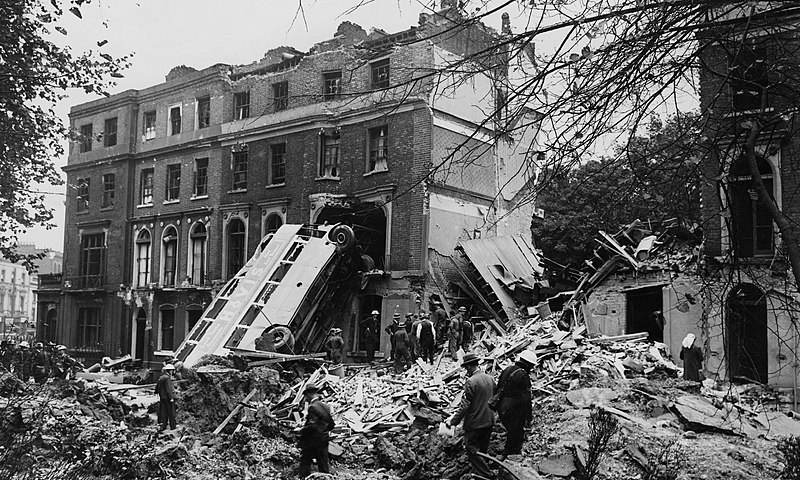
The aftermath of a German bombing raid on London in the first days of the Blitz Image by H.F. Davis from
On 14 October 1940, during the Blitz, the Luftwaffe nearly destroyed the building.
The close calls prompted Churchill to move his living quarters to an underground bunker in the reinforced war rooms of Her Majesty’s Treasury.
However, he continued to work and eat in the rooms of No. 10 throughout the war.
By the end of the Second World War, the building was in very poor condition.
Total demolition was proposed but rejected in favour of a major structural refurbishment.
7. No.10 Downing Street is a Place of Serious Entertainment

Image by Anne and David from
Every week, Number 10 is the venue for official functions including meetings, receptions, lunches and dinners.
Receptions tend to be informal gatherings. Lunches and dinners are more formal events.
The Small Dining Room will sit a maximum of 12, and the State Dining Room up to 65 around a large, U-shaped table.
The dining table is laid with items from the state silver collection: a range of modern silverware pieces commissioned by the Silver Trust to promote modern British craftsmanship.
These events consist of official dinners and events for foreign leaders and other dignitaries, receptions for business leaders, community and charity representatives and sportsmen and women.
8. No. 10 Downing Street, Feline Civil Servant!

Larry the cat Image by Parrot of Doom from
Downing Street has a long history of resident felines, including Munich Mouser, who served under Neville Chamberlain and Winston Churchill.
Later came Downing Street’s longest-serving mouser, Wilberforce, who notched up an impressive 18 years of service between 1970 and 1988.
Larry, a tabby cat, arrived from Battersea Dogs & Cats Home in 2011 but has since opted to spend more time sleeping or fighting with the Chancellor’s Chief Mouser known as Palmerston than dealing with rodents.
Chief Mouser’s excellent mousing skills secured him the position. He joined the Number 10 household and has made a significant impact.
He has captured the hearts of the Great British public and the press teams often camped outside the front door. In turn, the nation sends him gifts and treats daily.
Larry’s daily itinerary includes greeting guests to the house, inspecting security defences and testing antique furniture for sleep comfortability.
9. No. 10 Downing Street Door was once Painted Green
1908 was a fascinating year for historians.
A means-tested pension was introduced, London became the host city of the fifth modern Olympic Games and No. 10’s front door was painted a different colour.
Liberal Prime Minister Herbert Henry Asquith, who served in office from 1908 to 1916, instructed that the original black be changed to a shade of dark green.
Asquith’s second wife, Emma Alice Margaret Asquith (known as a glamorous outspoken society figure with an acerbic wit), is said to have influenced the decision.
Only after the fall of Asquith and the collapse of the Liberal party, was the door return to its original colour.
10. Number 10 was originally Number 5

Gandhi outside 10 Downing Street, London. Image from
The original numbering of the Downing Street houses was completely different from what we see today.
The houses were numbered haphazardly and they tended to be known by the name or title of their occupants.
The current Number 10 started out life as Number 5 and was not renumbered until 1779.
The area around Downing Street was home to ancient Roman, Anglo-Saxon and Norman settlements, hence was already a prestigious centre of government 1,000 years ago.
10 Downing Street in London is the traditional residence of the British Prime Minister, and in its rich history has witnessed some of the country’s most important political decisions.
From Sir Winston Churchill to Baroness Margaret Thatcher and many of Britain’s leaders have walked through its iconic black door.
Planning a trip to Â鶹APP ? Get ready !
These are ´¡³¾²¹³ú´Ç²Ô’²õÌý²ú±ð²õ³Ù-²õ±ð±ô±ô¾±²Ô²µÂ travel products that you may need for coming to Â鶹APP.
Bookstore
- The best travel book : Rick Steves – Â鶹APP 2023 –Ìý
- Fodor’s Â鶹APP 2024 –Ìý
Travel Gear
- Venture Pal Lightweight Backpack –Ìý
- Samsonite Winfield 2 28″ Luggage –Ìý
- Swig Savvy’s Stainless Steel Insulated Water Bottle –Ìý
We sometimes read this list just to find out what new travel products people are buying.


