
 English


Photo by Dom Le Roy from
Top 10 Astonishing Facts about the Clifton Suspension Bridge
In 1753, a Bristol-based merchant, William Vick, left a bequest of £1000 to the city to build a stone bridge between Clifton Down and Leigh Woods.
Vick’s bequest grew slowly because plans were drawn up several times, but nothing came to fruition.
In 1829, a competition was held to design a bridge, with a prize of 100 guineas. After several years of financial negotiations and re-designs, Isambard Kingdom Brunel was declared the winner
The bridge is built to a design by William Henry Barlow and John Hawkshaw, based on an earlier design by Isambard Kingdom Brunel.
Clifton Suspension Bridge is one of Bristol’s most recognisable structures. Designed by Isambard Kingdom Brunel, it marks a turning point in the history of engineering and has come to symbolise a city of original thinkers and independent spirit.
The bridge stands 75m above the river Avon high enough to allow boats in and out of Bristol Harbour. Many consider it one of the greatest feats of Victorian engineering on display in Britain today.
The bridge is still open to motor traffic as well as pedestrians. Here are 10 astonishing facts about the Clifton suspension bridge.
1.
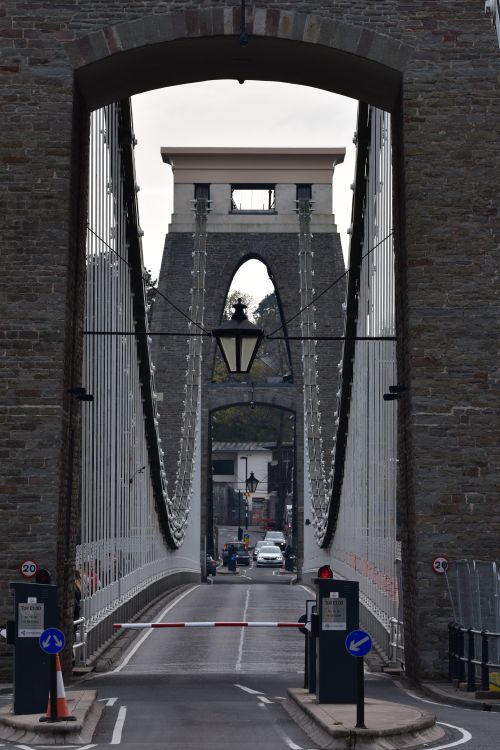
Photo by Wayne Jackson from
Clifton Suspension Bridge is and always has been, a toll bridge. It is open and manned 24 hours a day, seven days a week throughout the year.
Clifton Suspension Bridge is a major landmark in Somerset, United Kingdom. It was opened in 1864 and has remained a major attraction for locals and tourists alike.
Motorised vehicles (including motorcycles) pay £1 to cross the bridge, all of which goes towards its maintenance and upkeep. There is no charge for pedestrians, cyclists or horse riders crossing the bridge.
With around 90% of its original ironwork still in operation, maintenance work requires the utmost care in replacing parts like for like.
Clifton Suspension Bridge support is from users as it is a charity.
2. The Clifton Suspension Bridge is over 331 feet high

Photo by Máté Steinwender from
The Clifton Suspension Bridge spans the Avon Gorge and the River Avon, linking Clifton in Bristol to Leigh Woods in North Somerset.
From some angles, you might not realize how high this bridge really is, but it’s actually 331 feet (102.2 meters) high with the height of the towers included which stand 86 feet (26.2 meters) tall.
Finished in 1864, the bridge is 1,352 ft/412 m long and the central span is 702 ft/214 m.
You better don’t be afraid of heights when leaning over the edge because the clearance below the deck is 245 feet (76 meters) above high water level as well!
3. A Rich Merchant willed Money for the Bridge

Photograph by Mike Peel (www.mikepeel.net). From
A rich merchant and Bristolian named William Vick a wealthy Bristol wine merchant, was the man who came up with the idea to build a bridge in its current location.
This was quite a visionary idea because this area wasn’t very developed yet halfway through the 18th century.
To make things even better, in 1754, he left about £1,000, which is the equivalent of over £150,000 today, in his will for the purpose of constructing the bridge.
William Vick left a will with instructions that the money should be invested until it reached the sum of £10,000, an amount he felt would pay for the construction of a stone bridge across the gorge.
The bridge would be free to travellers and would link the hamlet of Clifton and the private estates of Leigh Woods.
As the proposed bridge would seem to serve little economic purpose, it is uncertain what Vick’s motive was in leaving these instructions.
4. The Clifton Suspension Bridge was Conceived after Bristol Bridge Riots

Image by Neil Parley from
An event referred to as the “Bristol Bridge Riots� in 1793, when an angry mob caused havoc in the city as they complained about the toll prices on the old Bristol Bridge.
After violent riots, architect William Bridges unveiled a proposal for a new bridge that would pay for itself.
He suggested a structure across the Avon Gorge in the spot where the Brunel-designed Clifton Suspension Bridge now stands.
His design was so fantastic and otherworldly that the bridge that was ultimately built seems ordinary in comparison.
The multi-storey arch was to be flanked by six 40-ft storeys of rooms and galleries, containing homes, a granary, corn exchange, chapel and tavern, museums, general market, a library, a nautical school, offices and stables. It would also feature a stone wharf on the Somerset side
This means that the idea to build the bridge was simply to have an alternative to cross the River Avon apart from the Bristol Bridge, which was the only stone bridge in the city since the 13th century.
5. The Clifton Suspension Bridge is a Suicide Spot

Image by from
There have been over 1,000 deaths and translating to almost 4 suicides per year.
The Clifton Suspension Bridge is well known as a suicide bridge and is fitted with plaques that advertise the telephone number of The Samaritans.
Between 1974 and 1993, 127 people fell to their deaths from the bridge.
Installation of barriers on the Clifton suspension bridge, Bristol, England, in 1998 had an effect on local suicides by jumping.
Deaths from this bridge halved from 8.2 per year (1994–1998) to 4.0 per year.
Although 90% of the suicides from the bridge were by males, there was no evidence of an increase in male suicide by jumping from other sites in the Bristol area after the erection of the barriers.
6. Engineer Sarah Guppy Designs influenced Clifton Suspension Bridge

Sarah Guppy’s Bridge Patent image by ArnosCourt from
Sarah Guppy is an English engineer and inventor associated with the Clifton Suspension Bridge.
As the first woman to patent a chain bridge, Guppy came up with her version in 1811.
In 1811 Sarah patented the “New Mode of Constructing and Erecting Bridges and Railroads without Arches� a method using piling for the construction of a suspension bridge.
She was ahead of her time, Brunel wasn’t born until 1806 and it was seven years before Thomas Telford started work on the suspension bridge over the Menai Strait.
When he began work on the bridge, she allowed Telford to use the design for free, sharing her knowledge for the greater good.
When her son Thomas Guppy went to work with Isambard Brunel the family forged even greater links with these engineering giants, there is however no evidence that her invention was ever acknowledged by either man.
7. Clifton Suspension Bridge Designer Never Saw His Creation
Brunel was aged just 24 and already regarded as a great engineer when his design for the bridge won a public competition.
The world-famous was designed by the great Victorian engineer Isambard Kingdom Brunel, although he never lived to see his creation finished in 1864.
His colleagues in the Institution of Civil Engineers felt that the completion of the Bridge would be a fitting memorial, and started to raise new funds.
Construction began in 1831 but it suffered several setbacks and was not completed until 1864. Brunel died in 1859 and it was finally finished as a memorial to him.
In 1864, when it was tested, about 500 tonnes of rubble was spread across the deck to test its strength
8. The Clifton Suspension Bridge took 33 Years to Construct
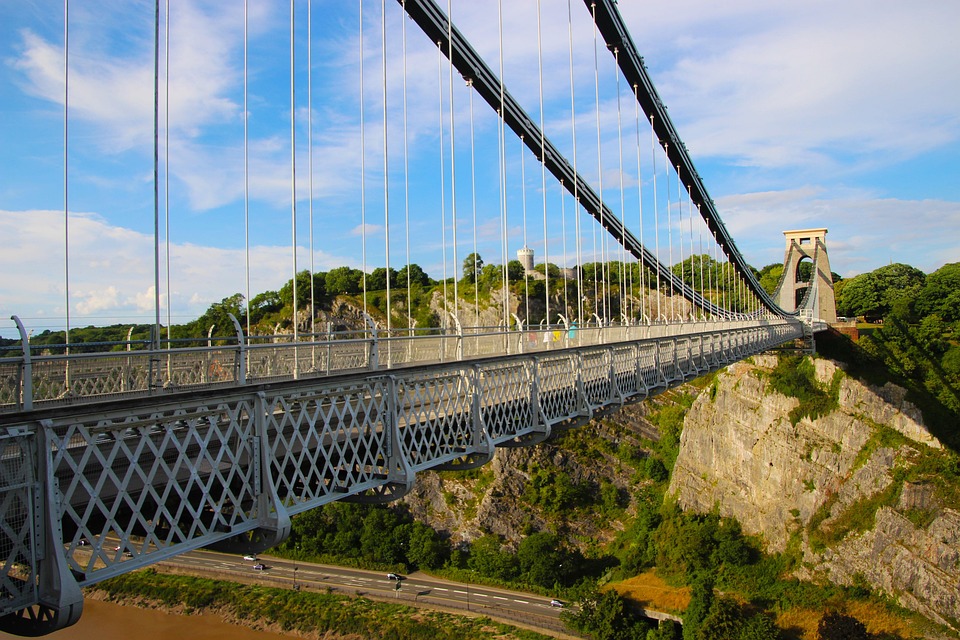
Image by from
An international symbol of the city of Bristol since its opening in 1864, Clifton Suspension Bridge was Brunel’s first major project.
And it remains one of Britain’s best-loved – and most useful – landmarks.
However, its journey into being was not a smooth one. The funding, design and construction of the bridge were all fraught with difficulty, as Brunel and his contemporaries worked at the forefront of engineering in their time, trying and testing unknown materials, techniques and theories.
In fact, it was not until five years after Brunel’s death, and an astonishing 33 years since construction began.
Clifton Bridge would have been the longest-spanning bridge if it had been completed soon after it was designed, but for financial reasons it was not put into service until 1864.
By that time an alternative design by Thomas Telford would have had the same span known as the Menai Straits Bridge.
9. The Clifton Suspension Bridge is a Chain Suspension Bridge

Photo by Michael Austin on
A chain bridge is a historic form of a suspension bridge for which chains or eyebars were used instead of wire ropes to carry the bridge deck.
Chain bridges were the first bridges able to cross wider spans than the previous wooden and stone bridges, combined with shorter building times and at lower costs.[
Clifton Suspension Bridge is an engineering masterpiece made up of 3,500 load bearing bolts and giant chains that stretch 20 metres underground.
The bridge has 4,200 links, each weighing ½ ton and 2ft in length. There are 400 connecting pins. 162 suspension rods and 81 cross girders.
In addition, the suspension rods vary in height from the tallest at 65ft to the shortest at 3ft.
The main chains are 20″ longer on a warm day than on a cold one, due to expansion. Finally, 4 million cars and ½ million pedestrians cross the bridge every year.
10. The Clifton Suspension Bridge Spans Avon Gorge and the River Avon
The Clifton Suspension Bridge is located in the city of Bristol in the southwest of England and connects Clifton in Bristol to Leigh Woods in North Somerset.
In order to do so, it spans the River Avon which runs through the Avon Gorge, a 1.5-mile (2.5-kilometer) gorge that runs all along the western part of the city.
Clifton Suspension Bridge is one of Bristol’s most recognisable structures.
Designed by Isambard Kingdom Brunel, it marks a turning point in the history of engineering and has come to symbolise a city of original thinkers and independent spirit.
Multi-award winning, the bridge is a must-see. The visitor’s centre will tell you all you need to know about Isambard Kingdom Brunel’s first bridge.
The bridge can be driven across, but the best views come from being on foot.
Nearby Clifton Village has parking should you wish to drive, otherwise the 8/9 First Bus takes you from the city centre to Clifton Village.
It’s about a 30-minute walk with some steep uphills from the harbourside to the bridge itself.
Planning a trip to Â鶹APP ? Get ready !
These are ´¡³¾²¹³ú´Ç²Ô’²õÌý²ú±ð²õ³Ù-²õ±ð±ô±ô¾±²Ô²µÂ travel products that you may need for coming to Â鶹APP.
Bookstore
- The best travel book : Rick Steves – Â鶹APP 2023 –Ìý
- Fodor’s Â鶹APP 2024 –Ìý
Travel Gear
- Venture Pal Lightweight Backpack –Ìý
- Samsonite Winfield 2 28″ Luggage –Ìý
- Swig Savvy’s Stainless Steel Insulated Water Bottle –Ìý
We sometimes read this list just to find out what new travel products people are buying.


