
 English


The Most Famous British Monarchs
1. Queen Elizabeth II

Reader’s Digest
Without a doubt the most famous British monarch, and arguably one of the world’s most famous monarchs, Her Majesty Queen Elizabeth II is the current Queen of the United Kingdom and the Commonwealth nations.
Elizabeth was born in 1926 and at the time was not in line to the throne, as her father was only the second son of the current king, George V. After his death and the subsequent abdication of her uncle Edward VIII, Elizabeth became first in line to the British throne upon the coronation of her father, George VI.
Since her own coronation in 1953, the Queen has ruled for 68 years making her, among many other accolades, the longest-lived and longest-reigning British monarch, as well as the world’s longest-serving female head of state. Her reign has seen a total of 14 British prime ministers come and go, as well as numerous momentous world events, such as the continued decolonisation of Africa from the 1960s, the Suez crisis in 1956, and the fall of the Soviet Union in 1991.
2. Queen Victoria
Until recent years, the record of the UK’s longest serving monarch was held by Queen Victoria, who ruled for an impressive 63 years until her death in 1901.
Victoria acceded to the throne at the age of just 18 following the death of her uncle, King William IV who had no surviving children. She was popular during her early reign and married her husband, Prince Albert, in 1840. They went on to have nine children.
Her reign was marked by tragedy when Albert died in 1861. From then, Victoria went into a period of deep mourning and was to wear only black clothes for the rest of her life. Although the monarchy was a constitutional one at the time, giving the monarch less political power than before, Victoria still held extensive political and social influence.
The marriages and children of her extensive family led to descendants in almost every royal house in Europe and beyond, earning her the nickname of “the grandmother of Europe.”
3. Henry VIII
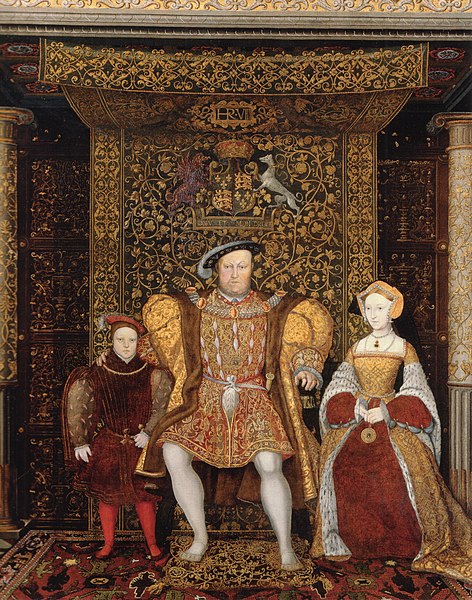
Wikimedia Commons
The second monarch of the famous Tudor dynasty, Henry VIII is a famous figure in British history for many reasons.
Perhaps the most well known of these are his six marriages. The capricious and impulsive Henry married six different women throughout his life, and most came to a tragic end. Two were divorced, and two were beheaded at Henry’s behest. One died of illness, while his sixth and final wife, Catherine Howard, was the only one to outlive him.
Henry is also best known for founding the Church Of England in order to divorce his first wife Catherine of Aragon, who had failed to give birth to a living son, and marry his mistress Anne Boleyn. This was not possible under Catholicism, so Henry created a new branch of Christianity where divorce was possible and of which he was the Supreme Head. To this day, the monarch of the United Kingdom still belongs to the Church of England.
4. George VI
Also known as ‘the reluctant king,’ King George VI was the shy younger son of King George V, who never expected to be crowned king.
In his early life George suffered from poor health, but attended the Royal Naval College and spent time at sea. In 1923, he married Lady Elizabeth Bowes-Lyon, who accepted on his third proposal. Upon the death of his father, George’s older brother became King Edward VIII. However, his short lived reign came to an end when he abdicated from the throne in order to marry his mistress, American divorcee Wallis Simpson. George became King George VI that same year, and was credited with leading the nation through the trials of the Second World War.
George, or Bertie as he was known by friends and family, also struggled with a stammer. Despite therapy in the 1920s and later, made famous by the Oscar winning film The King’s Speech, he never fully overcame the impediment, and it added a lot of stress to his reign, which involved much public speaking.
5. George III

Wikimedia Commons
George III of the House of Hanover was King of Great Britain and Ireland upon his coronation in 1760. It was only in 1801, when the two countries were unified, that he became King of the United Kingdom of Great Britain and Ireland.
George’s reign was most notable for the many military conflicts which occurred, including the defeat of France in the Seven Years’ War, the American War of Independence and the Napoleonic Wars. Although he opposed the abolition of the slave trade, a motion was eventually passed in 1807 to abolish it during his reign.
During his later life, George suffered increasingly from mental and physical illness, made worse by the stress from the death of his youngest and favourite daughter Princess Amelia. George was one of the country’s longest reigning monarchs, making for a long wait for his son, who served as the Prince Regent for ten years.
6. Edward VIII
One of the more infamous monarchs in recent years, Edward VIII ruled for just 326 days.
Crowned king upon the death of his father in 1936, Edward struggled with the restrictions and traditions imposed upon him as a monarch. The chief of these was the Royal Family’s refusal to accept his relationship with Wallis Simpson, who as a non British divorcee from a common background, was not deemed an appropriate royal spouse.
Subsequently, Edward abdicated on 10th December that same year, leaving the throne to his younger brother. This caused much unrest among the Royal Family, and Edward retired with Wallis to a life in France. In 1940 he was appointed Governor of the Bahamas.
The ex-king was eventually fully banished from the family when the Queen discovered the extent of his sympathies with the Nazi ideology.
7. George V

Wikimedia Commons
Another unexpected king, George V was also a younger son who was not originally in line to the throne.
Born in 1865 during the reign of his grandmother, Queen Victoria, he was only third in line behind his father. However, in 1892 his older brother, Prince Albert, died aged just 28 of influenza during a pandemic. This made George first in line when his father became king in 1901.
George’s reign lasted from 1910 to 1936, and saw a time of great upheaval in Europe. From the outset of the First World War in 1914, George suffered through the deposition and death of his two cousins, the Russian Tsar Nicholas II and the German Kaiser Wilhelm II. However, he also saw the expansion of the British Empire to its greatest extent.
However, the war took a toll on his health, and this combined with lifelong smoking caused him to develop bronchitis which would eventually kill him.
8. Richard III
Another infamous monarch, this time of an age long gone, is Richard III. The last king of the House of York, Richard’s reign was marked by the Wars of the Roses in England. After the death of his brother King Edward IV, Richard was named Lord Protector of the Realm until Edward’s son, Edward V, came of age. However, shortly after the marriage of the boy’s parents was declared bigamous and their two sons illegitimate. The boys were not seen in public again, and it is commonly thought that Richard had them murdered in order to claim the throne for himself.
Immortalised in William Shakespeare’s great eponymous play, Richard was portrayed to the public as a vicious, power hungry hunchback.
His death at the Battle of Bosworth Field marked both the end of the Wars of the Roses and the end of the middle ages in England, and the beginning of the Tudor era.
9. John

Wikimedia Commons
The only king of this name, King John reigned from 1199 until 1216. During his early life, he attempted a rebellion against his brother King Richard, but only became king after Richard died. His reign saw England’s defeat in a number of battles against France. He was also excommunicated by the Pope for a short time.
After a baronial rebellion in 1214, John agreed to sign the Magna Carta, a document which limited the powers of the monarch. After dying of dysentery in 1216, he was succeeded by his son Henry III.
10. Mary I
Also known as Bloody Mary, Mary I of England was Queen from 1553 to 1558 after the death of her younger brother, Edward VI, and Lady Jane Grey who claimed the throne after him.
The eldest surviving child of King Henry VIII, she struggled with her relationship with her father in early life, particularly after her mother Catherine of Aragon was divorced.
As Queen, she was a devout Catholic, and reversed the English Reformation, restoring the Catholic Church. She was notoriously intolerant of Protestants, and any dissenters were burned at the stake at her orders. She was succeeded by her younger sister, Elizabeth I, daughter of Anne Boleyn.
Planning a trip to Â鶹APP ? Get ready !
These are ´¡³¾²¹³ú´Ç²Ô’²õÌý²ú±ð²õ³Ù-²õ±ð±ô±ô¾±²Ô²µÂ travel products that you may need for coming to Â鶹APP.
Bookstore
- The best travel book : Rick Steves – Â鶹APP 2023 –Ìý
- Fodor’s Â鶹APP 2024 –Ìý
Travel Gear
- Venture Pal Lightweight Backpack –Ìý
- Samsonite Winfield 2 28″ Luggage –Ìý
- Swig Savvy’s Stainless Steel Insulated Water Bottle –Ìý
We sometimes read this list just to find out what new travel products people are buying.


