
 English


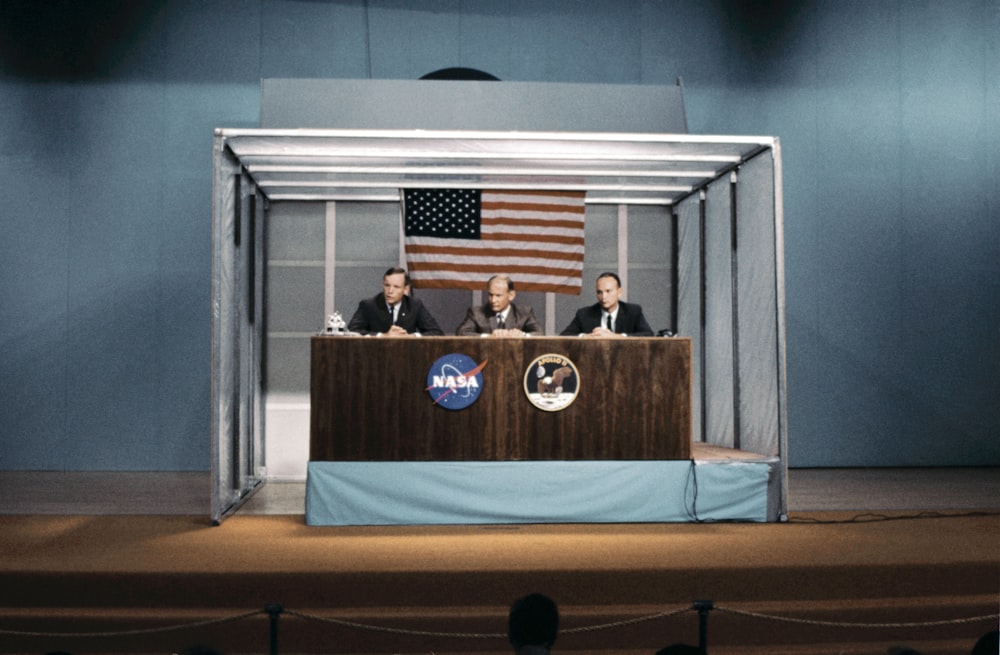
Neil Armstrong, Buzz Aldrin, and Michael Collins of the Apollo 11 lunar landing mission participate in a preflight press conference in the Building 1 auditorium on July 5, 1969. Photo by NASA- Unsplash
Top 10 Cool Facts about Michael Collins
Michael Collins, (born October 31, 1930 in Rome, Italy—died April 28, 2021 in Naples, Florida, United States), was a United States astronaut who piloted the crew capsule of Apollo 11, the first crewed lunar landing mission.
Collins, a graduate of the United States Military Academy in West Point, New York, transferred to the air force and became a test pilot at Edwards Air Force Base in California. In 1963, he enlisted to the space program.
1.Michael’s upbringing and brief family background
He was the second son of James Lawton Collins (1882-1963), a career United States soldier. Army officer who served as the United States’ military diplomat in the country from 1928 to 1932, and Virginia C. Collins (1895–1986).
Collins had two older sisters, Virginia and Agnes, as well as an older brother, James Lawton Collins Jr. (1917-2002). Collins’ mother was of British ancestry, and his father’s family was Irish.
Collins grew up in a variety of locations during his first 17 years of life, including Rome, Oklahoma, Governors Island, New York, Fort Hoyle (near Baltimore, Maryland), Fort Hayes (near Columbus, Ohio), Puerto Rico, San Antonio, Texas, and Alexandria, Virginia.
2.He had his first opportunity to fly a plane while in Puerto Rico, this led to his legendary career
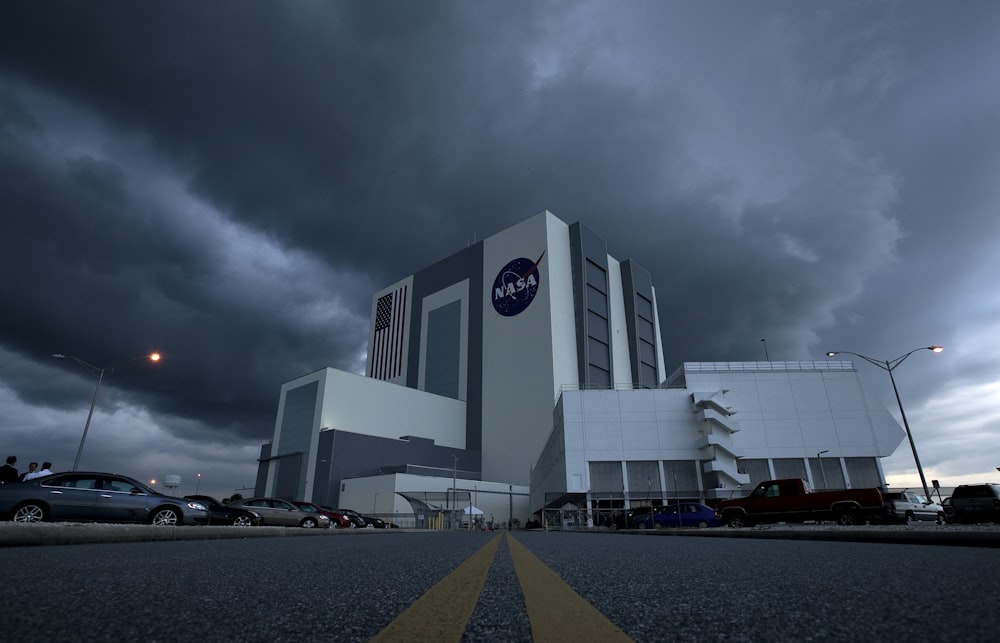
NASA Kennedy Space Center in Cape Canaveral, Florida. Photo by NASA- Unsplash
In Puerto Rico, he took his first flight in a Grumman Widgeon, which the pilot let him fly for a part of the trip. He desired to fly again however, he couldn’t because World War II broke out shortly after. He attended the Academia del Perpetuo Socorro in San Juan, Puerto Rico, for two years.
After the United States entered World War II, Collins’ family relocated to Washington, D.C., where he earned a degree from St. Albans School in 1948. His mother wanted him to join the diplomatic service however, he chose to join the military like his father, two uncles, brother, and cousin.
He was admitted to the United States Military Academy in West Point, New York, where his father and older brother both graduated in 1907 and 1939, respectively. On June 3, 1952, he received his Bachelor of Science degree in military science, successfully completing at 185th out of 527 junior officers in the class, which included future astronaut Ed White.
Collins’ choice to serve in the United States Air Force (USAF) was influenced by a need to avoid scrutiny of nepotism if he had enrolled in the Army, where his brother was already a colonel, his father had attained the status of major general, and his uncle, General J. Lawton Collins (1896-1987), was the Chief of Staff of the United States Army.
The Air Force Academy, which was still being built, would not graduate its first class for many years. In the meantime, Military Academy graduates were qualified for Air Force commissions.
Air Force commissions were available to graduates of the Military Academy. As a result of significant number of young officers endorsed and encouraged during WWII, advancement in the Air Force was extremely slow compared to the Army.
3.Collins was one of the most impactful individuals involved in landing on the moon 1969
The legendary first Moon landing in 1969 was dominated by Neil Armstrong and Buzz Aldrin.
However, their coworker, Michael Collins, was vitally valuable to the operation’s success.
Collins, as the space shuttle pilot, remained in lunar orbit whereas Neil and Buzz raced across the ground. However, he performed critical space maneuvers required to reach the Moon.
“I definitely thought that I did not have the best seat of the three,” he said of others getting the spotlight. “And yet, in all truthfulness, I was delighted with the seat that I did have.”
4.His very first flight in NASA took him three whole days to complete!
His first mission aboard Gemini 10, that started on July 18, 1966, was a three-day journey. The adventure performed a landing test and a double rendezvous in orbit, as such Collins became the third person in US history to perform a spacewalk during the flight.
5.Michael spent more than 24 hours alone in the spaceship

Belgium welcomes Apollo 11 astronauts Neil Armstrong, Buzz Aldrin, Michael Collins, and their wives. Photo by NASA- Unsplash
Collins, dubbed “the loneliest man in history,” was the pilot of the Apollo 11 mission, which placed humans on the moon for the first time in 1969.
Collins piloted the crew capsule Columbia for nearly 28 hours while his co-workers Armstrong and Aldrin landed to the moon’s surface.
The mission record stated, “Not since Adam has any person has experienced such loneliness as Mike Collins is undergoing throughout this 47 minutes of every lunar revolution.”
In a 2019 NPR interview, Collins reflected on his time by myself in space, saying, “I don’t think solitude really factors into the equation, aside from in the minds of the press at the time.”
6.After the crew came back from their trip, Collins got to travel to 21 nations
The three astronauts were quarantined for 18 days to avoid risk of contamination by lunar microbes. They were commended for their role in ushering in a new historical period in humanity’s discovery of the universe in the days that followed, in addition to during a tour of 21 nations.
7.He left NASA to explore his other interests and moved to Florida too
After leaving Nasa, he briefly entered politics before retiring to Florida, where he painted and wrote.
Notwithstanding joining Twitter in 2019, at the age of 88, he publicly acknowledged that he never liked being the center of attention.
However, his legacy will live on as a young generation of astronauts prepares to return to the Moon in the near future, following in the path of Collins and the other Apollo pioneers.
8.Even after retiring Collins kept achieving amazing things to help the society
Collins graduated from Harvard Business School’s Advanced Management Program in 1974 and was appointed vice president of LTV Aerospace in Arlington, Virginia, in 1980. In 1985, he stepped down to start his own consulting company, Michael Collins Associates.
Carrying the Fire: An Astronaut’s Journeys, his autobiography, was published in 1974. According to John Wilford of the New York Times, it is “typically thought to be the finest record of what it is like to be an astronaut.”
Collins has also published Liftoff: The Story of America’s Adventure in Space (1988), a background of the American space program, Mission to Mars (1990), a non-fiction book on human spaceflight to Mars, and Flying to the Moon and Other Strange Places (1976), a children’s book based on his personal experiences.
He has painted water-colors, mainly of the Florida Everglades or aircraft he has piloted; they are seldom if ever space-related. He did not sign his paintings at first in in order to prevent them gaining value simply because they bore his autograph.
9.The landing in July 24th was broadcasted all over the world and everyone was tuned in
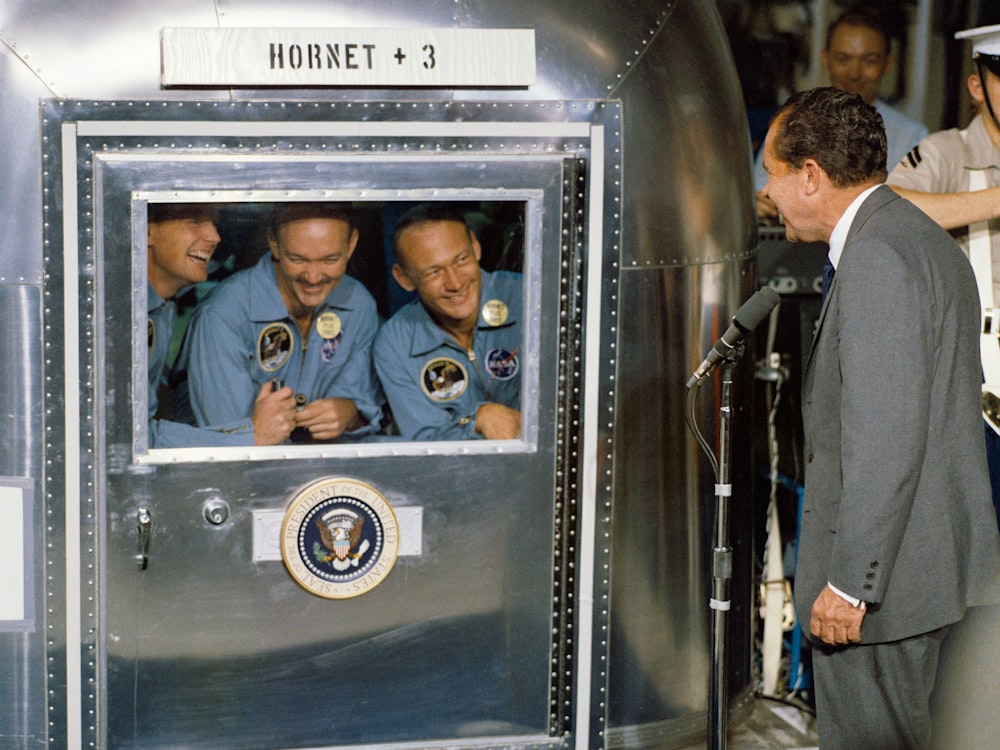
On July 24, 1969, President Richard Nixon welcomes the quarantined Apollo 11 astronauts, Neil Armstrong, Michael Collins, and Buzz Aldrin, aboard the U.S.S. Hornet after the historic Apollo 11 lunar landing mission. Photo by History in HD- Unsplash
The Moon landing was witnessed by an approximate of 650 million people around the world. The accomplishment aided the United States in demonstrating its authority to a global audience.
10.His unfortunate passing due to cancer at the age of 90
Michael Collins, a member of the Apollo 11 mission that landed on the moon, died at the age of 90.
“We regret to inform you that our adored father and grandfather passed away today, following a courageous fight against cancer,” Collins’ family said in a Twitter statement. “He spent his final days peacefully, with his family by his corner. Mike always encountered life’s challenges with humility and grace, and he faced this, his final battle, in the same way. We will miss him dearly, but we also know how fortunate Mike felt to have lived the life he did.”
Planning a trip to Â鶹APP ? Get ready !
These are ´¡³¾²¹³ú´Ç²Ô’²õÌý²ú±ð²õ³Ù-²õ±ð±ô±ô¾±²Ô²µÂ travel products that you may need for coming to Â鶹APP.
Bookstore
- The best travel book : Rick Steves – Â鶹APP 2023 –Ìý
- Fodor’s Â鶹APP 2024 –Ìý
Travel Gear
- Venture Pal Lightweight Backpack –Ìý
- Samsonite Winfield 2 28″ Luggage –Ìý
- Swig Savvy’s Stainless Steel Insulated Water Bottle –Ìý
We sometimes read this list just to find out what new travel products people are buying.


