
 English


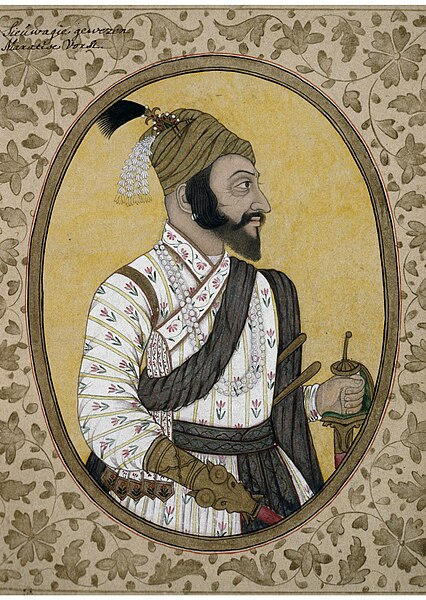
Image Source:
Top 10 Facts about King Shivaji
Regarded as one of the most important figures in Indian history, Shivaji was the founder and the first King of the Maratha Empire from 1674 to 1680. He is well-known for his unconventional guerilla tactics, which helped him to defeat more powerful adversaries.
Even though he had been dead for over 300 years now, his legacy is still very much alive in India, and he is considered to be one the greatest warriors of all time.
Let’s look at the top 10 facts about him.
I. He was named after a local Deity
Most of the earliest surviving records of Shivaji’s birth and childhood were composed around 150 years after his birth. Due to the time it took before they were composed, Some of these records are said to contain several stories that are historically unreliable.
Nevertheless, according to the records, Shivaji was born on 19 January 1630, to Shahaji and Jijabai at the time of the severe Mahadurga famine in the Maharashtra region. Due to the fact that her parents had lost several other children in infancy when his mother became pregnant, she was sent to the hill fort of Shivneri where Shivaji was born.
Being a devotee of goddess Durga, Jijabai named her son after a famous local deity ‘Shivai Devi’, in the hope that the goddess would protect her newborn son from harm that had befallen her previous babies.
2. He was raised by his Mother

Photo by Nikhil More from
Due to his military engagement, which meant he was mostly away fighting on the battlefields, Shivaji’s father was rarely home and hence spent no time with his son. Shivaji was single-handedly raised by his mother who was fully devoted to him and molded him to be a great leader and a brave warrior.
According to Indian folklore, Shivaji’s mother had prayed for a son who would lead the Marathas one day, and when her prayers were answered, she spared no efforts in molding him to become a responsible and great Maratha ruler.
3. He accommodated all Religions
While other Indian Kingdoms were strictly adhering to their traditional religious beliefs, King Shivaji was known for his liberal and tolerant religious policies. Although a Hindu himself, he allowed Muslims to practice freely, and also supported their ministries with endowments.
Shivaji had little trouble forming alliances with the surrounding Muslim nations even against Hindu powers. In his own army, he had a significant number of Muslim soldiers, and also his first naval admiral was a Muslim.
4. He was Well educated
In absence of his father, Shivaji spent his formative years with his mother who had a profound influence on him. Neglected by her husband, she led a deeply religious life and she instilled in him a strict sense of honesty from an early age.
As the son of a jagirdar, the responsibility of overseeing his education rested on the shoulders of a small council of ministers. His early training included some reading and writing, horse riding, martial arts, and religious practice.
A special instructor was also appointed to give him military training, and as his biographer stated, he became “very learned� by the age of 10.
5. He used Guerrilla Tactics Warfare

Photo by Prashant Nadar from
Shivaji is more famous for the guerrilla tactics he formulated and used to fight his enemies in difficult terrains. He recognized his men’s inability to face a big conventional army on a battlefield, and hence maintained a small army that was very effective in small-scale raids.
Due to his advanced knowledge of the area, his guerrilla tactics helped him to capture many forts within no time and brought a significant portion of the region under his control.
6. He became a Military Commander at the age of 15
Shivaji turned out to be a born leader from a very young age. As a teenager, Shivaji explored the hilly area surrounding his fort and became very familiar with the region. By the time he was 15, he had accumulated a band of faithful soldiers from the Maval region who later aided him in his early conquests.
Shivaji was ready to lead the troops on the battlefield at the early age of 16. By this time, he commanded over a thousand soldiers. In a letter to a Hindu official, dated 17 April 1645, he wrote that God wished them to be independent under a self-ruled state.
By 1647, Shivaji had taken over the administration of Poona from the Bijapur government and also captured the forts of Purandhara, Kondhana, and Chakan. This caused panic among his opponents and also earned him the respect and confidence of his followers.
7. He was the founder of the Maratha Empire

Photo by Nikhil More from
After having consolidated considerable control over territories adjoining Poona and Konkan, Shivaji decided to establish the first Hindu Sovereign state in the South, which until then was largely dominated by Muslims.
He was crowned the first King of Marathas on June 6, 1674, at Raigadh in an elaborate coronation ceremony which was officiated by Pandit Gaga Bhatt in front of a gathering of around 50,000 people. He took upon several titles like the paramount sovereign, founder of an empire, and protector of Hinduism.
Under his reign, the Maratha administration was established where Chhatrapati was the supreme sovereign and a team of eight ministers was appointed to oversee the proper enforcement of various policies. Shivaji died at the age of 52 on April 3, 1680, at the Raigad Fort, after suffering from a bout of dysentery.
8. He built the first Indian Navy
Aware of the need for a naval power to maintain control along the Konkan coast, Shivaji began to build his navy at the end of the 1650s, with the purchase of twenty small armed boats from the Portuguese shipyards of Bassein. He gradually increase the number of his fleet to an estimated 400 warships within the next few years.
With his men being accustomed to a land-based military, Shivaji widened his search for qualified crews for his ships, taking on lower-caste Hindus of the coast who were long familiar with naval operations as well as Muslim mercenaries.
Noting the power of the Portuguese navy, Shivaji hired a number of Portuguese sailors and Goan Christian converts and made one of the Portuguese navy admirals as commander of his fleet.
9. He was nicknamed “The Mountain Rat�
Shivaji was contemptuously called a “Mountain Rat” by the rival army’s generals because of his guerilla tactics of attacking enemy forces and then retreating into his mountain forts. His strategies consistently perplexed and defeated armies sent against him, as he had perfected the art of attacking large slow- moving armies.
He utilized his fast knowledge of the local terrain and the superior mobility of his light cavalry to cut off supplies to the enemy, and continuously refused to be dragged into the conventional battles. Instead, he lured the enemy into difficult terrains of his own choice and put them at a disadvantage situation.
Shivaji didn’t stick to a particular tactic but used several methods to undermine his enemies depending on the circumstances, like ambushes, and psychological warfare.
10. He is commemorated all over India

Photo by Adbh266 from
Despite being dead for over 300 years, King Shivaji’s Commemorations are found throughout India. His statues and monuments are found almost in every town of Maharashtra state as well as in other different places across India.
Some of his commemorations include the Indian Navy’s station INS Shivaji, numerous postage stamps, and the main airport and railway headquarters in Mumbai. In Maharashtra, there has been a long tradition of children building a replica fort with toy soldiers and other figures during the festival of Diwali in memory of Shivaji.
In 2018, the construction of a giant memorial called Shiv Smarak was commissioned on a small island in the Arabian Sea near Mumbai. Upon its completion, it will be 210 meters tall, making it the world’s largest statue.
Planning a trip to Â鶹APP ? Get ready !
These are ´¡³¾²¹³ú´Ç²Ô’²õÌý²ú±ð²õ³Ù-²õ±ð±ô±ô¾±²Ô²µÂ travel products that you may need for coming to Â鶹APP.
Bookstore
- The best travel book : Rick Steves – Â鶹APP 2023 –Ìý
- Fodor’s Â鶹APP 2024 –Ìý
Travel Gear
- Venture Pal Lightweight Backpack –Ìý
- Samsonite Winfield 2 28″ Luggage –Ìý
- Swig Savvy’s Stainless Steel Insulated Water Bottle –Ìý
We sometimes read this list just to find out what new travel products people are buying.


