
 English


Emperor Shah Jahan – Image Source:
Top 10 Facts about Emperor Shah Jahan
Popularly known for his construction of the Taj Mahal, Emperor Shah Jahan was the fifth emperor of the Mughal Empire, reigning from January 1628 until July 1658. Under his emperorship, the Mughals reached the peak of their architectural achievements and cultural glory.
Shah Jahan was born on 5 January 1592 in Lahore, present-day Pakistan as the third son of Prince Salim and his wife Jagat Gosain. His real name was Shihab-ud-Din Muhammad Khurram and he came from a long line of successful Mughal emperors, including his grandfather Akbar the Great.
The emperor is widely remembered for the undying love he had for his wife, Mumtaz Mahal, and their love story has been heavily adapted into Indian art, literature, and cinema.
In this article, let’s look at the top 10 facts about him.
1. He built the Taj Mahal in memory of his beloved Wife

Photo by Jakub Halun from
In 1631, Shah Jahan commissioned the construction of the Taj Mahal. It is one of the most famous structures in the world and was built to commemorate the death of his beloved wife Mumtaz Mahal, who died while giving birth to their 14th child.
The Taj Mahal construction started in 1632 and was designed to house the tomb of his beloved wife together with a mosque and a guest house. Its construction was essentially completed in 1643, while the surrounding buildings and gardens were completed five years later.
Today, the Taj Mahal is considered to be one of the greatest architectural achievements of all time and a symbol of India’s rich history. It was designated as a UNESCO World Heritage site in 1983 and attracts more than 6 million visitors every year.
2. He Brought Stability into the Empire
Although his father’s rule was generally peaceful, the empire was experiencing challenges by the end of his reign. Shah Jahan reversed this trend by putting down an Islamic rebellion in Ahmednagar, repulsing the Portuguese in Bengal, and capturing the Rajput kingdoms of Baglana and Bundelkhand.
Under his rule, the state became a huge military machine and the nobles and their contingents multiplied almost fourfold, as did the demands for more revenue from the peasantry. It was however a period of general stability — the administration was centralized and court affairs systematized.
Historiography and the arts increasingly became instruments of propaganda, where beautiful artworks or poetry expressed specific state ideologies which held that central power and hierarchical order would create balance and harmony.
3. He loved his Wife Dearly
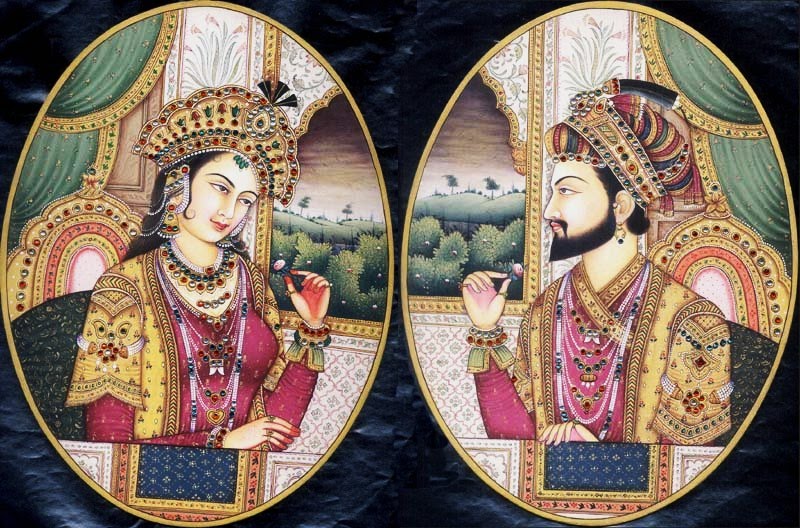
Emperor Shah Jahan and Mumtaz Mahal – Photo Source:
The most significant part of Shah Jahan’s life history began when he was betrothed to Arjumand Banu Begum, the granddaughter of a Persian. They got married in 1612 and she immediately became the unquestionable love of his life.
According to his official court chronicler, Shah Jahan, bestowed her with the title of Mumtaz Mahal, meaning “Jewel of the Palace”, after he found her beauty and character to be more than he had seen in any other woman at the time.
Although Shah Jahan was also married to other two women, he had no affection left for them and they enjoyed only the status of being royal wives. all his attention, affection as well as favors were directed to Mumtaz Mahal. She accompanied him everywhere and even became her trusted confidant which allowed her to review official documents in their final draft.
4. He executed most of his Family Members
Inheritance of power and wealth in the Mughal Empire was not determined through primogeniture, but by princely sons competing to achieve military successes and consolidating their power at court. This often led to rebellions and wars of succession.
In order to succeed in his quest for the throne, Shah Jahan learned from an early age that he needed military prowess and people of influence on his side. He raised an army went out on his own and conquered territories in the name of the Mughals.
When his father died in 1627, Jahan assisted by senior officials from his father’s court was quickly able to subdue his brothers and claim the throne for himself. He ascended to the throne on January 19, 1628, and was coronated one month later.
His first act as ruler was to execute all his chief rivals who challenged his authority. Those put to death immediately after his coronation included his two brothers, his two cousins, and a number of his nephews.
5. He constructed Major Monumental Structures

Red Fort in Delhi – Photo by A. Savin from
Shah Jah�n had an almost insatiable passion for building and left behind a grand legacy of monumental structures. He was one of the greatest patrons of Mughal architecture and he ushered in the golden age of Mughal architecture.
Apart from his most famous building, The Taj Mahal, his other constructions include a huge fortress-palace complex called the Red Fort, the great mosque of J�miʿ Masjid, the Shalimar gardens, the Mahabat Khan Mosque in Peshawar, and sections of the Lahore Fort.
6. He was confined by his Son

Aurangzeb – Photo Source:
When Shah Jahan became ill in 1658, his eldest son assumed the role of the emperor in the acting capacity on behalf of his father who was recovering from his illness. This did not go well with his younger brothers as they started a revolt against him in a bid to remove him from his assumed role.
After a long period of a power struggle between the brothers, Aurangzeb, the third son of Shan Jahan, emerged victorious and declared himself Emperor. He immediately started a process of eliminating every member of his family he deemed a threat to his status. He also declared his father unfit to rule even though he had fully recovered from his illness.
Having secured his position, Aurangzeb confined his frail father at the Agra Fort but did not mistreat him. He accused him of Funds misappropriation as he was planning to build another monument. In his confinement, Shah Jahan was nursed by his eldest daughter until his death in 1666.
7. He was Well educated
As a child, Shah Jahan received a broad education befitting his status as a Mughal prince. It included martial training, archery, military tactics, and exposure to a wide variety of cultural arts, such as poetry and music.
According to his chronicler Qazvini, as a child, Shah Jahan was only familiar with a few Turki words and showed little interest in the study of any other language rather than his mother tongue.
However, Shah Jahan was very much attracted to Hindi literature since his childhood, and his Hindi letters were mentioned in his father’s autobiography manuscripts.
8. He was buried Next to his Beloved Wife
For the eight years that Shah Jahan lived in confinement, his eldest daughter, Jahanara Begum Sahib, voluntarily shared the confinement and nursed him. Jahan fell ill in January 1666 and progressively became weaker until he died on the 30th of January 1666 at the age of 74.
Jahanara planned a state funeral for him which was to include a procession with his body carried by eminent nobles followed by the notable citizens of Agra and officials scattering coins for the poor and needy.
However, his son refused to accommodate such ostentation, but as an acknowledgment of the love his parents had shared, he agreed his body be interred next to his beloved wife Mumtaz Mahar. “My father showed a great affection for my mother;” he wrote, “so let his last resting place be close to hers.
9. He was raised by his Grandfather
When Shah Jahan was born, his grandfather insisted on raising him in his household rather than his father’s house. The responsibility to raise him was fully entrusted to the chief emperor’s wife, Ruqaiya Sultan Begum.
Ruqaiya assumed the primary responsibility of raising him and she is noted to have raised him affectionately. In his memoirs, Jahan’s father noted that Ruqaiya had loved his son “a thousand times more than she would have loved her own son�.
However, after the death of his grandfather in 1605, he returned to the care of his mother, whom he cared for and loved immensely despite being separated from her at birth.
10. He built the Shah Jahan Mosque as a Token of Gratitude

Shah Jahan Mosque – Photo by Hassocks5489 from
Before Shah Jahan became an Emperor, he had once lived as a refugee in Thatta after rebelling against his father. During his time there, he was very much impressed by the hospitality he received from the Sindhi people, the reason he ordered the construction of the Shah Jahan mosque as a token of gratitude.
Today, the mosque serves as the central mosque for the city of Thatta, in the Pakistani province of Sindh, and it has the most elaborate display of tile work in the whole of South Asia.
Planning a trip to Â鶹APP ? Get ready !
These are ´¡³¾²¹³ú´Ç²Ô’²õÌý²ú±ð²õ³Ù-²õ±ð±ô±ô¾±²Ô²µÂ travel products that you may need for coming to Â鶹APP.
Bookstore
- The best travel book : Rick Steves – Â鶹APP 2023 –Ìý
- Fodor’s Â鶹APP 2024 –Ìý
Travel Gear
- Venture Pal Lightweight Backpack –Ìý
- Samsonite Winfield 2 28″ Luggage –Ìý
- Swig Savvy’s Stainless Steel Insulated Water Bottle –Ìý
We sometimes read this list just to find out what new travel products people are buying.


