
 English


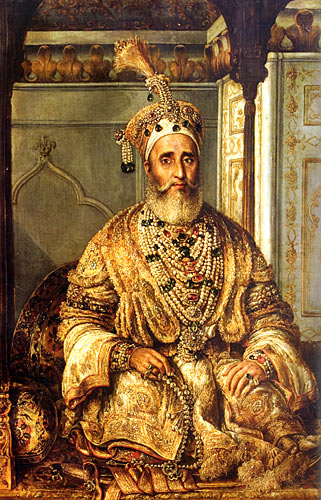
Image by Josef August Schoefft from
Top 10 Facts about Emperor Bahadur Shah Zafar
Regarded as one of the Finest Urdu poets, Bahadur Shah Zafar was the twentieth and the last Mughal Emperor of India who remained at the helm from 1837 to 1857. He was born on October 24, 1775, and was the son of Emperor Akbar Shah II.
After the Indian Rebellion of 1857, Bahadur Shah Zafar was arrested and exiled to Burma, where he died in 1862 at the age of 87. For more than a century after his death, the last Mughal emperor was almost forgotten but a chance finding of his grave helped to resurrect his legacy.
Here are the top 10 Facts about Emperor Bahadur Shah Zafar
1. He was a great Urdu Language Poet
Regarded as one of the greatest Urdu poets in the history of India, Bahadur Shah Zafar wrote a large number of Urdu Ghazals most of which were lost or destroyed during the Indian Rebellion of 1857.
However, many of them were recovered, later compiled into Kulliyat-I-Zafar, and have been sung by famous singers like Jagjit Singh, Mehdi Hassan, and Ghulam Ali. In 2007 Jagjit Singh performed one of Zafar’s famous ghazals ‘Lagta Nahin Hai Dil Mera’ in Parliament during the 150th-year commemoration of the 1857 War.
His court was also the home of a large number of great Urdu poets of the time including Mirza Ghalib, Daagh Dehlvi, Momin Khan Momin, and Mohammad Ibrahim Zauq.
2. He was not the Preferred Successor of his Father

Image by Ghulam ‘Ali Khan from
Although Bahadur Shah Zafar was the firstborn son of Emperor Akbar Shah, he was not his preferred successor. His father had yielded to pressure from one of his queens and nominated her son, Mirza Jahangir, as his successor.
However, things did not go according to the plans as the East India Company exiled Jahangir after he attacked their residence in the Red Fort, paving the way for Bahadur Shah to assume the throne.
At the time Bahadur Shah Zafar ascended to the throne, the British had taken all the military and political power, and the Mughal Empire had been reduced to only the city of Delhi and the surrounding territories.
learn more about Indian Emperors here
3. He was arrested and Exiled by the British
Following the Indian Mutiny of 1857, Bahadur Shah Zafar surrendered and was arrested for his involvement in the rebellion. He was charged with four counts of culpability which carried the death penalty if he was found Guilty.
His trial began on January 27, 1858, and it lasted for 41 days with 21 witnesses and over a hundred documents in Persian and Urdu languages being produced in court. Zafar seemed to be unaware of what was going on, but he briefly defended himself arguing that he had no power to stop the mutiny.
After the trial ended on 9 March 1858, Zafar was found guilty on all 4 charges and was sentenced to be deported. The unanimous guilty verdict would have given him the death sentence but the British had promised not to give him the death penalty.
4. He was a strong Believer in Magic and Superstition
Bahadur Shah Zafar was a strong believer in the magical and superstitious side of Orthodox Sufism. Like many of his followers, he believed that his position as both a Sufi and emperor gave him spiritual powers.
In an incident in which one of his followers was bitten by a snake, Zafar tried to cure him by giving a “seal of Bezoar” (a stone antidote to poison) and some water that he had breathed to the man to drink.
The emperor also had a staunch belief in charms. For instance at one time during his illness, he told a group of Sufi pirs that he suspected that someone had cast a spell over him.
5. His Wife held a great Influence on Him

Portrait of Zeenat Mahal – Image by Adam Jones from
Bahadur Shah Zafar married Zeenat Mahal in 1840 and she was the mother to his favorite son Mir Jawan Bakht. She held a great influence on him which made him hand over all his imperial powers to her. This made her very powerful and she became the de facto ruler of India.
Her greatest desire was to make his son the next emperor of India but the English law of primogeniture was the main hurdle to her ambitions. During the war of independence, she prevented her son from participating in the rebellion hoping to make her son the ruler of India after the end of the rebellion.
However, her plans did not materialize because the British wanted to end the monarchy, and therefore, she and her son were also exiled to Rangoon where they both died in the late 19th century.
6. He was accused of leading the 1857 Indian Uprising
In 1857 Indians made concerted efforts to liberate their country from British occupation. They declared Bahadur Shah Zafar as India’s sole supreme leader, a role he also grandly accepted.
The emperor appointed his son Mirza Mughal as the commander in chief of the armed forces and directed him to lead the march towards Delhi. However, the rebellion was ultimately suppressed by the British and Bahadur Shah Zafar took refuge in the Humayun’s tomb from where he was later apprehended by the British forces.
In the days following the uprising, his sons Mirza Mughal, Mirza Khizzer Sultan, and grandson Mirza Abu Bakar were all arrested and executed by the British. Bahadur Shah himself was arrested, tried, and exiled to Rangoon where he died in 1862 at the age of 87.
Read more about Indian history here
7. He was an Emperor with no Power

Image Source:
At the time Bahadur Shah Zafar succeeded his father as the emperor, the Mughal Empire had been reduced to only the city of Delhi and the surrounding territory, and his authority was limited only to the walled city of Old Delhi.
The East India Company was the dominant political and military power but they preferred to rule and collect taxes in the name of the Mughals. In return, the company provided him with a pension which he used to maintain himself and his family.
8. He died in Exile
In 1862, 5 years into his exile, Bahadur Shah Zafar reportedly became ill. He was “spoon-fed on broth” but his condition continued to deteriorate. The British Commissioner H.N. Davies recorded that Zafar “is evidently sinking from pure desuetude and paralysis in the region of his throat”.
To prepare for his death Davies commanded the collection of lime and bricks and a spot was selected at the “back of Zafar’s enclosure” for his burial. Zafar died on Friday, 7 November 1862, and was buried near the Shwedagon Pagoda in Yangon.
In one of his ghazals, Zafar described the pain he was undergoing as he missed his homeland while in exile in Burma. In one of the lines, he laments about his unfortunate fate as he couldn’t get a few yards of land in his homeland to get buried.
9. His Tomb is an Important Muslim Religious Site

Photo by Emelard Range from
At the time of his wife’s death in 1882, the location of Zafar’s grave had already been forgotten and could not be located. She was buried in a roughly similar position near a tree where his grave was assumed to be. His son died two years later and was also buried at the same site.
His grave was discovered more than 100 years later when workers digging for a drain discovered a “brick-lined tombâ€�, which was later identified as the emperor’s long-lost grave site.
A few years later, an Islamic shrine was built, which was inaugurated on 15 December 1994. Zafar is respected as an “Emperor-Saint,” and hence this shrine has become an important place for pilgrimage by Muslims.
Discover more Muslim religious sites
10. He has been portrayed in Various TV series and Films
Bahadur Shah Zafar has been portrayed in various Indian TV series and films. Like in 1960 a Hindi-Urdu black-and-white movie, Lal Quila directed by Nanabhai Bhatt, showcased him extensively.
A television show titled Bahadur Shah Zafar was aired on Doordarshan in 1986, and the Hindi historical drama series 1857 Kranti, on DD National was aired in 2001. In 2005 a Hindi movie titled (The Rising) directed by Ketan Mehta, was released in which Habib Tanveer played the role of Bahadur Shah Zafar.
Planning a trip to Â鶹APP ? Get ready !
These are ´¡³¾²¹³ú´Ç²Ô’²õÌý²ú±ð²õ³Ù-²õ±ð±ô±ô¾±²Ô²µÂ travel products that you may need for coming to Â鶹APP.
Bookstore
- The best travel book : Rick Steves – Â鶹APP 2023 –Ìý
- Fodor’s Â鶹APP 2024 –Ìý
Travel Gear
- Venture Pal Lightweight Backpack –Ìý
- Samsonite Winfield 2 28″ Luggage –Ìý
- Swig Savvy’s Stainless Steel Insulated Water Bottle –Ìý
We sometimes read this list just to find out what new travel products people are buying.


