
 English


Image by from
Top 10 Fascinating Facts about Speyer Cathedral
Speyer Cathedral, officially the Imperial Cathedral Basilica of the Assumption and St Stephen, in Latin: Domus sanctae Mariae Spirae in Speyer, Germany, is the seat of the Roman Catholic Bishop of Speyer and is suffragan to the Roman Catholic Archdiocese of Bamberg.
The Speyer Cathedral is an Episcopal church, a parish church and a pilgrimage destination. The cathedral was consecrated in 1061 to the Blessed Virgin Mary and the Protomartyr Stephen.
The cathedral was built by the Emperor to show his power, which is why it is also known as the Kaiser Dome and a large statue of Conrad II was placed in the entrance hall. Construction was started in 1030 and took 80 years to complete.
Today after the destruction of the Abbey of Cluny – Speyer Cathedral is the biggest Romanesque church in the world. Likewise, its crypt, consecrated in 1041, is the biggest hall of the Romanesque era. For 10 more fascinating facts about Speyer Cathedral, read on.
1. Speyer Cathedral is the Burial Place for Emperors

Image by from
The cathedral was the burial place of the German emperors for almost 300 years. The Salian emperors wanted Speyer Cathedral to bear witness to the sacredness and continuity of the empire and the emperors’ royal dignity.
In line with this tradition, all the Salian emperors and two empresses were buried here. For two hundred years after the Salian dynasty, members of the Hohenstaufen, Habsburg and Nassauer dynasties also chose the cathedral as their resting place. This makes it the most important burial place of kings and emperors in Germany, comparable to the burial places of kings in other European countries:
Among the leaders buried there are; King Philipp of Swabia (died 1208), son of Frederick Barbarossa. King Rudolph of Habsburg (died 1291) King Adolph of Nassau (died 1298) King Albert I of Germany (died 1308), son of Rudolph of Habsburg.
2. Speyer Cathedral Took 80 years to Complete
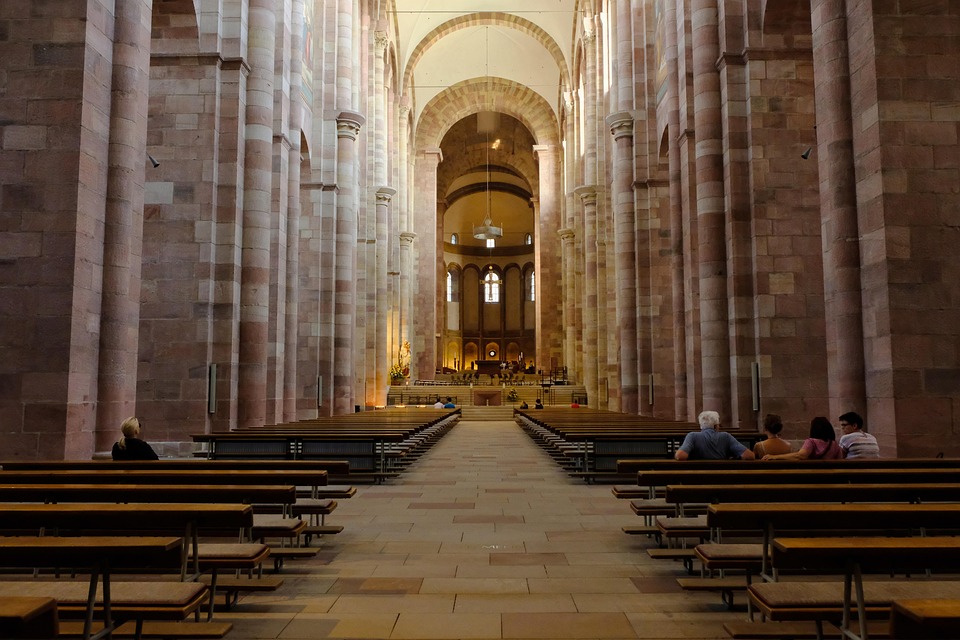
Image by from
Speyer Cathedral, a basilica with four towers and two domes, was founded by Conrad II in 1030 and remodelled at the end of the 11th century. It is one of the most important Romanesque monuments from the time of the Holy Roman Empire.
The cathedral was built by the Emperor to show his power, which is why it is also known as the Kaiser Dome and a large statue of Conrad II was placed in the entrance hall. Construction was started in 1030 and took 80 years to complete.
The Emperor made numerous seemingly impossible demands, which eventually promoted new developments in architecture. Semi-circular columns hold up the stone roof. It became a characteristic feature in the design and structure of German Romanesque buildings.
3. Speyer Cathedral was the first Building to be Constructed entirely of Stone in Europe

Image by from
At the time of Construction stained glass was used for the chapel windows, instead, natural light was allowed to come through. In those days stone buildings had wooden roofs, but the cathedral had a stone roof from the very beginning. It was the first building constructed entirely from stone in Europe.
The quarried tile-stone was called ‘pendle’ and had to be split, generally by frost action. The stone would be laid in the open during the winter and the moisture in the saturated stone would freeze, expand and split the stone along the laminations producing stone of suitable thickness for roofs. Alternatively, the stone could be split along the laminations or bedding planes with a suitable hammer and chisel.
4. Speyer Cathedral has been a UNESCO World Heritage Site since 1981

File: Flag of UNESCO.svg from
What’s fascinating about Speyer Cathedral is that the core structure of the building, including the lower floors and crypt, is still the same as the one completed in 1061. This makes the cathedral one of the best-preserved feats of Romanesque architecture. It also served as the model for multiple other buildings in Europe.
The importance of the building in the history of architecture in Western Europe has been recognized by UNESCO as it was designed as a World Heritage site in 1981.
The building featuring 4 towers and 2 domes is described by UNESCO as one of the most important Romanesque monuments in Europe.
5. Speyer Cathedral was commissioned by Conrad II in the year 1025
Image by from
It was commissioned by the Holy Roman Emperor in the year 1025., also known as Conrad the Elder (989-1039), was the Holy Roman Emperor in the 11th century. Ambitious as he was, he wanted to build the largest and most amazing church in the Western World. He conceived the plan in the year 1025 and the first stone of Speyer Cathedral was laid in 1030.
Conrad surely knew that he wouldn’t live to see this magnificent feat of architecture completed, so he also wanted it to serve as his final resting place. The official name of the cathedral is the “Imperial Cathedral Basilica of the Assumption and St Stephen.� His son Henry III (1016-1056) continued the work but neither saw the building completed in 1061.
6. Conrad II’s Grandson enlarged the Cathedral in the 12th Century

Image by from
Conrad’s grandson, Holy Roman Emperor Henry IV (1050-1106), wasn’t satisfied with the completed Romanesque structure just yet. The church had been consecrated in 1061 when it was just about completed and it was one of the main building projects in Europe at the time.
It was just as ambitious as Santiago de Compostela Cathedral (started in 1075), Cluny Abbey (Cluny III, started in 1085), and Durham Cathedral (started in 1093). Regardless, he partially reconstructed the building by elevating the nave by about 5 meters (16.4 feet). He also integrated a groin vault featuring square bays, an incredible feat of Romanesque architecture.
7. The Original Eastern Section of Speyer Cathedral was Demolished and Replaced in 1106

Image by from
The expansion phase of Henry IV only preserved the lower floors and the crypt of the original cathedral. He also had the foundations deeper to up to 8 meters (26.24 feet).
Equally striking is the fact that he had the entire eastern end of the cathedral, which is referred to as “Speyer I,� demolished.
This was replaced by an eastern end that is dominated by twin towers that stand 71.2 meters (233.59 feet) tall and an encircling gallery.
8. Speyer Cathedral was one of the Largest Romanesque Buildings in the World and Still is….

Image by from
Conrad II wanted to build the largest Roman Catholic cathedral in the Western World and although he didn’t succeed at the time (Cluny Abbey was bigger), it was still one of the largest Romanesque buildings in the world. Because Cluny Abbey in France was largely destroyed in the decades following the French Revolution, it remains the largest completely Romanesque building in the world today.
Here are some of the dimensions of Speyer Cathedral:
Length: 134 meters (439.63 feet)
Width: 37.62 meters (123.42 feet)
Nave width: 14 meters (45.93 feet)
Nave height: 33 meters (108.26 feet)
Height (western towers): 65.6 meters (215.22 feet)
Height (eastern towers): 71.2 meters (233.59 feet)
9. After the 17th Century Destruction of the Cathedral it was supposed to be replaced with a Palace

Image by from
Some new elements were added to the building over the centuries, including some Gothic decorations. These were all destroyed when French troops set fire to the church in the late 17th century. The damage was severe and there were even plans to build a palace to replace the church. Because the people of Speyer didn’t want to let go of their beloved church, this plan never materialized.
There was, however, a renovation project which saw the addition of a new Westwork in the Baroque architectural style. King Maximilian II ended up replacing this Baroque addition (completed between 1748 and 1772) with a neo-Romanesque façade that resembles the original structure.
10. The Speyer Cathedral Features the Largest Romanesque Columned Crypt in Europe
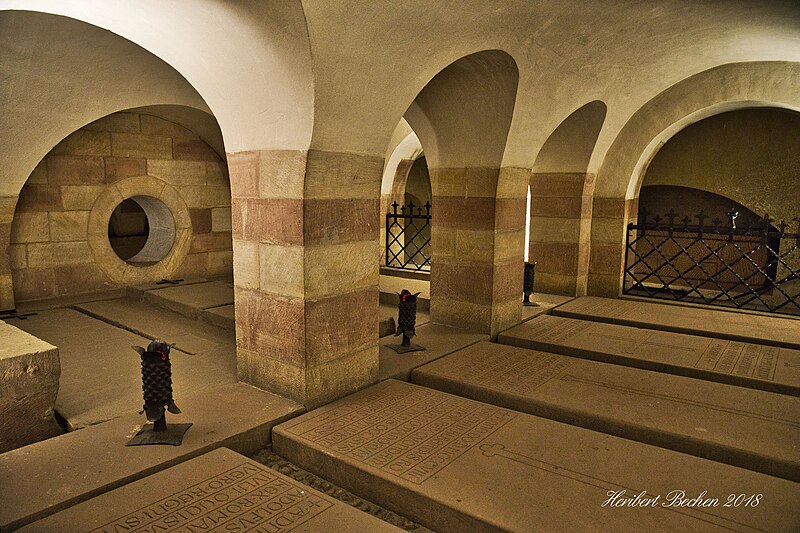
Image by Heribert Bechen from
In the history of architecture, the crypt of the Speyer Cathedral is considered the culmination of the Middle Ages. Its design and harmony are remarkable. It is the largest Romanesque crypt in the world, built in the form of a hall. The crypt has a width of 35 meters and a length of 46 meters. The vault has an enormous height of 7 meters.
The crypt consists of four rooms, situated beneath the choir, the crossing and the transepts. The centre, under the crossing, is a square room, divided into 3 x 3 = 9 bays. This construction is emphasized by the vaults of the ceiling with their alternating bands of red and yellow sandstone.
On the northern and southern sides of this central room beneath the transepts, separated by mighty pillars, you will find rooms with the same measurements. On the eastern side, under the cathedral’s choir, there is another room which ends with an apse. This is the oldest part of the cathedral.
Planning a trip to Â鶹APP ? Get ready !
These are ´¡³¾²¹³ú´Ç²Ô’²õÌý²ú±ð²õ³Ù-²õ±ð±ô±ô¾±²Ô²µÂ travel products that you may need for coming to Â鶹APP.
Bookstore
- The best travel book : Rick Steves – Â鶹APP 2023 –Ìý
- Fodor’s Â鶹APP 2024 –Ìý
Travel Gear
- Venture Pal Lightweight Backpack –Ìý
- Samsonite Winfield 2 28″ Luggage –Ìý
- Swig Savvy’s Stainless Steel Insulated Water Bottle –Ìý
We sometimes read this list just to find out what new travel products people are buying.


