
 English


Image Source:
Top 10 Incredible Facts about Louis Braille
Louis Braille was a French educator who invented a reading and writing system for visually impaired people. The system, which is named after him, remains virtually unchanged to this day.
The last born of Simon-René and Monique, Braille was born in Coupvray, a small town about twenty miles east of Â鶹APP, on 4 January 1809. He was raised together with his three siblings on a small piece of land in the countryside, where his father operated a successful leather-making business.
Braille’s revolutionary invention has been adapted and is being used in almost all languages across the globe.
Here are the top 10 incredible facts about him.
1. Louis Braille Lost his Eyesight during his Childhood

Photo by Mariaelizabeth124 from
Louis was not born blind. He was blinded at the age of three in one eye as a result of an accident with a stitching awl in his father’s leather-making shop.
In his childhood, Braille spent most of his time playing in his father’s workshop. At the age of three, as he was playing with some of the tools, he accidentally stuck a stitching awl in one of his eyes.
With the lack of proper medicine at that time, his injured eye got infected and soon the infection spread to his other eye too, resulting in total blindness at the age of five
2. He attended the Royal Institute for Blind Youth
Braille studied in Coupvray until the age of ten, when due to his combination of intelligence and diligence, he was permitted to attend the Royal Institute for Blind Youth, one of the first schools for blind children in the world.
At that time the Royal Institute was an underfunded, ramshackle affair, but it provided a relatively conducive environment for visually impaired children to learn and socialize.
3. He was Inspired by a Retired army Captain
While paying a visit to Louis’ school, a retired army captain, Charles Barbier, told the students about a method the soldiers used to use to communicate with each other.
The method involved writing a message in code by punching dots and dashes into heavy paper with a sharp tool. It could be done in silence and without light so they wouldn’t give themselves away to the enemy.
Barbier’s invention was a code of up to twelve dots in two columns, impressed into thick paper. These impressions could be interpreted entirely by the fingers. The invention inspired Braille to start developing a system of his own.
4. He Invented the Braille System at the age of 15
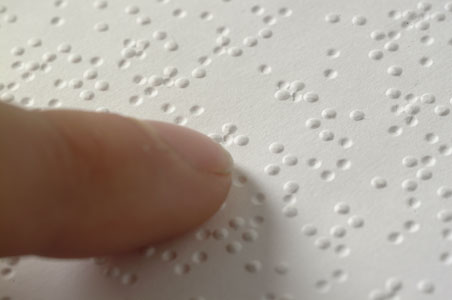
Photo by Lrcg2012 from
Learning from the Barbier system, Braille was determined to invent a system of reading and writing that could bridge the gap in communication between the sighted and the blind.
He worked tirelessly on his ideas, and his system was largely completed by 1824 when he was fifteen years old. From Barbier’s system, he innovated by simplifying its form and maximizing its efficiency.
His first version used both dots and dashes. He published his system in 1829, and by the second edition in 1837 he had discarded the dashes because they were too difficult to read. Crucially, Braille’s smaller cells were capable of being recognized as letters with a single touch of a finger.
5. His System was only adopted after his Death

Photo by Celette from
Following the overwhelming insistence of the visually impaired students, Braille’s system was finally adopted by the Institute in 1854, two years after his death.
The system spread throughout the French-speaking world, and eventually, it spread throughout other places in Europe. It was officially adopted by schools for the blind in the United States in 1916, and a universal braille code for English was formalized in 1932.
Almost two centuries after its invention, braille remains a system of powerful and enduring utility. Its technology continues to grow, including such innovations as braille computer terminals, Braille email delivery service; and Nemeth Braille.
6. Braille Spent most of his Life as a Teacher for the Blind
Braille studied through a system devised by the school’s founder, Valentin Haüy, a philanthropist who devoted his life to helping the blind.
Hauy had designed and manufactured a small library of books for the children using a technique of embossing heavy paper with the raised imprints of Latin letters. Braille read the books repeatedly, and he was equally attentive to the oral instruction offered by the school.
He proved to be a highly proficient student, and after he had exhausted the school’s curriculum, he was immediately asked to remain as a teacher’s aide. By 1833, he was elevated to a full professorship. For much of the rest of his life, Braille stayed at the Institute where he taught history, geometry, and algebra.
7. He extended Braille System into the Musical Notation
The Braille system was soon extended to include braille musical notation. Passionate about his own music, he took meticulous care in its planning to ensure that the musical code met the requirements of any instrument.
In 1829, he published the first book about his system, Method of Writing Words, Music, and Plain Songs by Means of Dots, for Use by the Blind and Arranged for Them.
8. His Home was Turned into a Museum
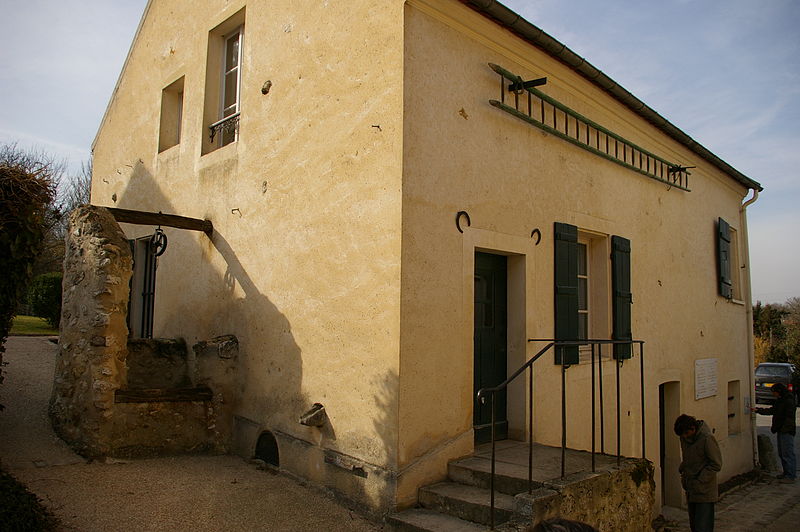
Photo by Kou07kou from
Braille’s childhood home in Coupvray is a listed historic building and houses the Louis Braille Museum. A large monument to him was erected in the town square which was itself renamed Braille Square.
A marble tablet fixed to the outer wall of the house reads “In this house on January 4, 1809, was born Louise Braille inventor of writing in raised dots for use of the blind. He opened the doors of knowledge to those who cannot see�
9. Louis Braille Remains are Buried in two Different Sites
Upon his death, Louis Braille was buried at his birthplace, Coupvray. Delegates from at least 20 countries attended his funeral. President of the Republic, Vincent Auriol, too was an attendee at the funeral ceremony of Louis Braille.
A century after his death, his remains were moved to Â鶹APP and were buried in Pantheon. In a symbolic gesture, Braille’s hands were left in Coupvray, reverently buried near his home.
10. Louis Braille was Sickly Throughout his Life
Braille was always sickly since his childhood, and his condition worsened as he grew older. A persistent respiratory illness, believed to be tuberculosis, dogged him throughout his life.
Despite the lack of a cure at the time, Braille lived with the illness for 16 years. By the age of 40, he was forced to relinquish his position as a teacher, when his condition worsened.
Braille was admitted to the Royal Institution, where he died in 1852, two days after his 43rd birthday.
Planning a trip to Â鶹APP ? Get ready !
These are ´¡³¾²¹³ú´Ç²Ô’²õÌý²ú±ð²õ³Ù-²õ±ð±ô±ô¾±²Ô²µÂ travel products that you may need for coming to Â鶹APP.
Bookstore
- The best travel book : Rick Steves – Â鶹APP 2023 –Ìý
- Fodor’s Â鶹APP 2024 –Ìý
Travel Gear
- Venture Pal Lightweight Backpack –Ìý
- Samsonite Winfield 2 28″ Luggage –Ìý
- Swig Savvy’s Stainless Steel Insulated Water Bottle –Ìý
We sometimes read this list just to find out what new travel products people are buying.


