
 English


Image by antonikon from
Top 10 Historical Facts about Château de Saint-Germain-en-Laye
The castle of Saint-Germain-en-Laye is also known as the Château-Vieux (Old Castle). It is closely linked to the history of France.
This is part of the Renaissance period of architecture which consists of many characteristics as observed in the different rooms, the architecture and many other artistic, historical or architectural elements that will truly amaze you.
At the time it was more complicated to build these castles so the construction could drag on for a long time. The Château de Saint-Germain-en-Laye remained “under construction” for a long time from 1124, and continued until the 20th century (beginning).
Its pentagon shape partly comes from the foundations of a former medieval castle that was built by Louis VI in around 1122. On 15 August 1346, during the Hundred Years’ War, the castle was burnt down by the Black Prince. It was later rebuilt by King Charles V (in 1364).
Visit the castle to discover an ancient and rich period of culture and have a good time with family or friends. Now for the top 10 historical facts about Château de Saint-Germain-en-Laye, keep on this page.
1. The Site of Signing of the Treaty of Saint-Germain-en-Laye

Ratification certificate of Treaty of St. Germain. Image by Bwag from
It was in the castle that was signed the Treaty of Saint-Germain-en-Laye on 10 September 1919. The peace treaty officially ended the WW1 hostilities between the Allies and Austria. It also ratified the disintegration of the Austro-Hungarian empire.
The treaty officially registered the breakup of the Habsburg empire, recognizing the independence of Czechoslovakia, Poland, Hungary, and the Kingdom of the Serbs, Croats, and Slovenes (Yugoslavia) and ceding eastern Galicia, Trento, southern Tirol, Trieste and Istria.
The Covenant of the League of Nations was integrally included in the treaty, and the union of Austria with Germany was expressly forbidden without the consent of the Council of the League. The military clauses limited Austria’s long-service volunteer army to 30,000 men and broke up the Austro-Hungarian navy, distributing it among the Allies.
During the German occupation (14 June 1940 – 25 August 1944), the castle housed the headquarters of the German Army in France.
2. Saint-Germain-en-Laye hosts the largest collection of Prehistoric Art
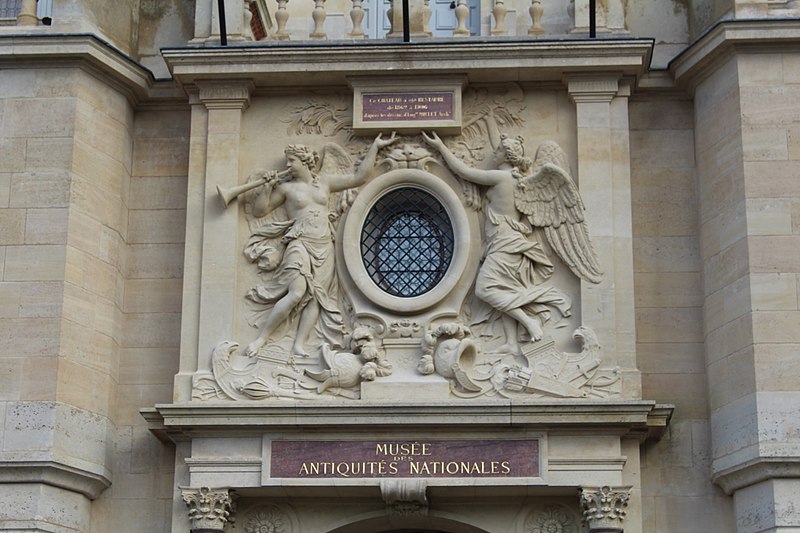
Image by Chabe 01 from
Surrounded by dry moats, the castle and its large circular towers today house the National Museum of Archeology. This is the world’s largest collection of prehistoric art. Napoleon III had the Château-Vieux restored by Eugène Millet. In 1867, the Emperor set up the Museum of Celtic and Gallo-Roman Antiquities (‘Musée d’antiquités celtiques et gallo-romaines’).
Today, the museum has a vast collection of artefacts from all over the country representing all periods in prehistory, from the earliest Palaeolithic to the early Medieval. A final permanent exhibition room, called “L’archéologie Comparée� (Comparative Archaeology), showcases displays the museum’s collections of archaeological artefacts from five different continents.
The museum also has a temporary exhibition area, which has seen some exceptional exhibitions in the past.
3. Each Resident King Expanded the Castle

Image by Unknown Author from
It has been inhabited since 1122 by Louis VI, who decided to build a residence near the Saint Germain priory and the Laye game forest. This radiant Gothic chapel served as an inspiration to the Sainte-Chapelle in Â鶹APP: a single nave with 3 spans and very high glass windows cutting almost all the walls, the whole set being covered with a slate roof with an arrow.
Around 1238 Louis IX replaced an earlier chapel of 1223 built by Philip II Augustus with the present Sainte Chapelle, consisting of three bays and an apse. It has portals, a rose window and sharp tracery details that are clearly by the same hand as the later parts of the abbey church of Saint-Denis.
Saint Louis welcomed Emperor Baudoin II of Constantinople to the chateau who gifted him the precious relic of Christ’s Crown of Thorns. Later, Charles V fortified this residence on a pentagonal plane. It was then transformed by Francis 1 as a Renaissance castle (brick and stone) with Italian decorative elements such as terraces and window pediments.
His son Henry II began the construction of a new castle with terraced gardens on the Seine, of which nothing remains today. Louis XIV, who had the gardens redesigned by Le Notre, was the last king to stay at the castle before he moved to Â鶹APP.
4. King Louis XIV gifted King James II of England Château de Saint-Germain-en-Laye

Image by National Portrait Gallery from
King Louis XIV made the castle of Saint-Germain his residence from 1666 to 1681. This before moving definitely to Â鶹APP with his court. Once installed in Â鶹APP, Louis XIV turned the castle over to his cousin King James II of England (1633-1701). The English king had fled England following the 1688 Glorious Revolution.
King James lived in the château for thirteen years, and his daughter Louise-Marie Stuart, Princess Royal was born in exile here in 1692. She also died here on April 18, 1712, of smallpox when she was just 19.
Just across from the château is the Saint-Germain Church which has been around since the 11th century, although the building dates from 1827. It houses the mausoleum of King James II Stuart, of England, who died in exile in France. His wife Mary Beatrice remained at the château until her death in 1718. Their son James left the château in 1716, ultimately settling in Rome.
5. The Napoleon Bonaparte Connection
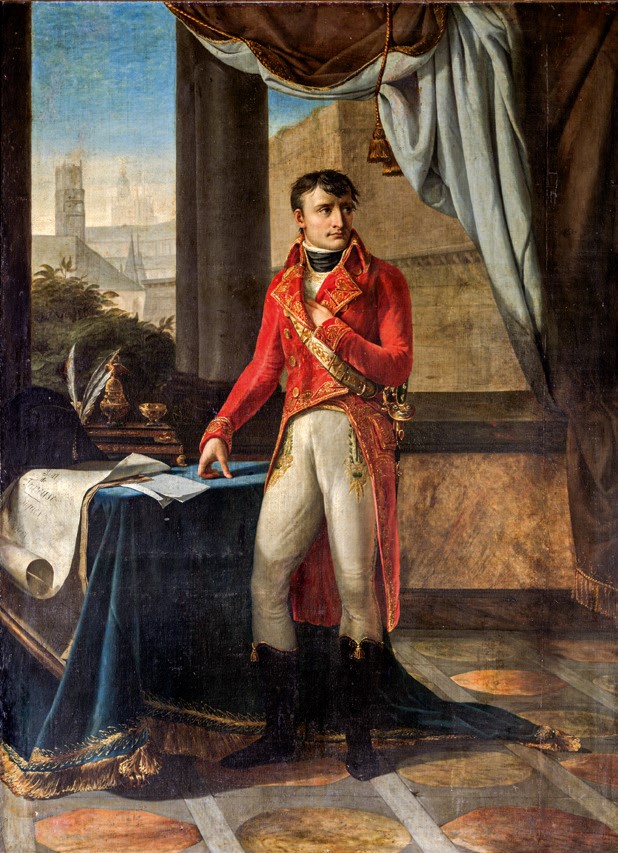
Image by Marie Guillarme Benoist fron
From Consulate to Empire, Saint-Germain-en-Laye followed the imperial epic. Napoleon did not live in Saint-Germain, but came to hunt several times between 1806 and 1809; his name is mainly linked to the creation of two schools: one for cavalry and Maison d’Education de la Légion d’Honneur.
When the first decrees General Bonaparte declared after 18 Brumaire, Year VIII, were announced in Saint-Germain-en-Laye, the “Place de la Révolution� plate was crossed out and became “Place Royale�, as a sign of hope raised by the young general.
During the French Revolution, the castle was turned into a prison. One of his famous prisoners was Rouget de Lisle, composer of La Marseillaise, the French National anthem.
6. Château de Saint-Germain-en-Laye provided Refuge for Grande Mademoiselle

Image by Gilbert de Seve from
During the Fronde, the French civil war in the mid-17th century, the “Grande Mademoiselle”, Anne Marie Louise, Duchess of Montpensier, came to Saint-Germain seeking asylum and installed herself at Château-Neuf where “she lay in a wonderfully beautiful chamber in a ruined tower, well-gilded and large but with no glass in the windows and a meagre fire.”
Anne Marie Louise d’Orléans, Duchess of Montpensier, was one of the greatest heiresses in history. She died unmarried and childless, leaving her vast fortune to her cousin Philippe I, Duke of Orléans. She rejected a string of proposals from various members of European ruling families, including Charles II of England, Afonso VI of Portugal and Charles Emmanuel II of Savoy.
Eventually fell in love with the courtier Antoine Nompar de Caumont a union was viewed as scandalous at the time. She is best remembered for her role in the Fronde/ French civil war and her role in bringing the famous composer Jean-Baptiste Lully to the king’s court.
7. Château de Saint-Germain-en-Laye was a Much Loved Royal Castle
Under the reign of Louis XIV, Saint-Germain became the seat of the kingdom’s government for some time. The castle of Saint-Germain was frequently visited by the kings of France from François I to Louis XIV. During his reign King François I stayed over 1,000 days at Saint-Germain which is double the time he spent at Fontainebleau. He was so fond of the fortress that he embellished it in 1539 with Renaissance elements.
He commissioned Chambiges to reconstruct the facades. The architect introduced a building technique that was unprecedented in France: the use of combined stone and brick to provide the façades with polychrome features.
In 1559 the castle covered 8,000 m2 which included 55 apartments, a banquet hall (or party hall), 7 chapels, and one kitchen. Without forgetting a prison in the vaulted cellars of the keepers’ tower.
On the 10th February 1638, it was in the castle of Saint-Germain-en-Laye that King Louis XIII published a royal declaration dedicating the Kingdom of France to the Virgin Mary.
8. The Chapel at Château de Saint-Germain-en-Laye

Image by Spedona from
It was Louis IX, known as Saint Louis, who, in 1230–38, added a chapel whose style prefigured that of the Sainte-Chapelle de Â鶹APP. Many royal christenings and marriages took place here.
Later, François I, adding bricks to stone, built the Renaissance château that you can discover today. And it was in the palace chapel that he married Claude of France on 18 May 1514.
In the courtyard, a hidden trompe-l’Å“il (Optical Illusion) presents itself to keen-eyed visitors. Visit to see if you can find it.
As you enter the Rayonnant Gothic-style chapel, the oldest of the preserved buildings, look up and admire the corners of the rib vaults and their seven round bushes heads and if you are keen enough you can spot the one of Saint Louis.
9. The Jacobites Chateau
Many Jacobites remained at the château until the French Revolution, leaving in 1793. The Jacobites often consisted of former members of the Jacobite court and the apartments left empty in the chateau by the Jacobite court pensioners upon their death, were often passed down to their widows and children by the caretaker of the chateau, Adrien Maurice, the Duke de Noailles.
The Jacobite colony at Saint-Germain was still dominant in the 1750s, when they were however treated with increasing hostility. After the death of the Duke de Noailles in 1766, who had been responsible for the continuing Jacobite dominance because of his preference to give rooms to Jacobites, the British dominance quickly decreased and more French inhabitants were given lodgings in the chateau.
The last member of the Stuart court was Theresa O´ Connel, who died in 1778. The last descendants of the British Jacobites by then mostly bearing French names, were evicted when the building was confiscated by the government during the French revolution in 1793.
10. Château de Saint-Germain-en-Laye was the Site of many a Royal Nuptials

Image by Michael Wassmer from
The wedding of Henry’s parents: Francis I and Queen Claude, Duchess of Brittany took place here on May 18, 1514.
The wedding of Henry II, Duke of Lorraine and Catherine de Bourbon, Duchess de Albret took place here on January 31, 1599. Henry was the eldest son of Princess Claude of Valois and Charles, Duke of Lorraine and Catherine was the daughter of Jeanne III, and Antoine, Queen and King of Navarre.
Saint-Germain-en-Laye is a town of history and culture. Its chateau was built under the seal of history, having been where numerous historical events took place. A visit to this castle is perfect for those who have already experienced the more famous castles and want to taste real French country life without all the tourists present.
Planning a trip to Â鶹APP ? Get ready !
These are ´¡³¾²¹³ú´Ç²Ô’²õÌý²ú±ð²õ³Ù-²õ±ð±ô±ô¾±²Ô²µÂ travel products that you may need for coming to Â鶹APP.
Bookstore
- The best travel book : Rick Steves – Â鶹APP 2023 –Ìý
- Fodor’s Â鶹APP 2024 –Ìý
Travel Gear
- Venture Pal Lightweight Backpack –Ìý
- Samsonite Winfield 2 28″ Luggage –Ìý
- Swig Savvy’s Stainless Steel Insulated Water Bottle –Ìý
We sometimes read this list just to find out what new travel products people are buying.


