
 English


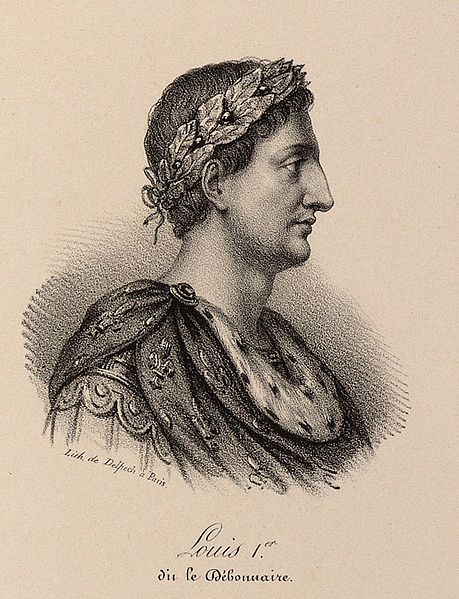
Photo Source: Royalcollection.org.uk – from
Top 10 Fascinating Facts about Louis The Pious
Also called the Fair, and the Debonaire, Louis The Pious was king of the Franks and emperor of the West from 814 to 840. The son and successor of Charlemagne, he was the last ruler to maintain the unity of the Carolingian Empire.
During his reign, Louis the Pious faced several challenges including revolts from his sons which he was able to overcome and retain his crown despite being deposed between 833–34.
Louis was married twice and had four sons. He fell ill and died on June 20, 0840 A.D., and was interred in the Abbey of Saint-Arnould in Metz.
Let’s look at the top 10 Fascinating Facts about him.
1. He was the only surviving son of Emperor Charlemagne
Louis was born in 778, the third son of Charlemagne and his wife Hildegard. His two elder brothers, Charles and Pepin, died between 806 and 814 leaving him as the only surviving son and the sole heir of his father’s crown.
In 813 Louis was personally crowned by Charlemagne as co-emperor, a practice initiated at the Byzantine court. He became the sole ruler of the Franks after his father’s death in 814, a position which he held until his death, save for the period 833–34, during which he was deposed.
Read more about Emperor Charlemagne
2. He was the third son of Emperor Charlemagne

Emperor Charlemagne РImage by Louis-F̩lix Amiel from
Louis the Pious was born as Louis I on 16 April, 0778 A.D. in the Carolingian villa of Cassinogilum, Chassineuil Poitou, Western France. He was the third son of Charlemagne and his second wife, Hildegarde and he had a twin brother named Lothair, who died young.
Louis grew up in Aquitaine (present-day France) and received a good quality clerical education. He was one of Charlemagne’s three legitimate sons who survived infancy and was crowned King of Aquitaine as a three-year-old child in 781. The two other brothers were also assigned the inheritance of equal territories within the empire.
3. Louis was crowned king at the age of 3

Coronation of Louis the Pious king of Aquitane – Image Source:
Louis was crowned King of Aquitaine as a three-year-old child in 781, and in the following year, he was sent to Aquitaine accompanied by regents and a court.
His father constituted this sub-kingdom in order to secure the border of his realm after the destructive war against the Aquitanians and Basques which culminated in the disastrous Battle of Roncesvalles.
During his reign in Aquitaine, Louis was charged with the defense of the empire’s southwestern frontier. He conquered Barcelona from the Emirate of Córdoba in 801 and asserted Frankish authority over Pamplona and the Basques south of the Pyrenees in 812.
4. He divided his empire among his Sons
Following the tradition of his father and ancient Frankish practice, Louis divided his empire among his sons. At the same time, however, he sought to preserve the unity of the empire. Louis designated his eldest son, Lothair I, as his successor and as superior to the other two.
He also confirmed his nephew, Bernard of Italy, as the rightful heir to the Italian throne. This solution, however, proved unworkable and initiated a series of conflicts among his sons and other relatives.
5. His Nephew Plotted against him
Immediately after the partition of the empire, Bernard, Louis’s nephew, who had been confirmed as the rightful heir to the Italian throne went against his uncle, demanding full independence in his territory
When Louis marched against him, Bernard surrendered, and Instead of executing him for treason, Louis had the sentence commuted to blinding, which was duly carried out. However, Bernard did not survive the ordeal and he died two days later due to the trauma of losing his eyes.
The fate of his nephew deeply marked Louis’s conscience for the rest of his life, and as a deeply religious man, he performed penance for causing Bernard’s death, at his palace of Attigny near Vouziers in the Ardennes, before Pope Paschal I.
6. He was a Staunch Christian

Photo Source:
Being a staunch Christian, Louis strove to ensure that the kingdom was ruled through Christian principles and customs and he took Steps to place his kingdom under the protection and approval of the church and the pope.
Immediately after establishing himself at the imperial court at Aachen (Aix-la-Chapelle), Louis the Pious started getting rid of those people from the court whose morals or conduct was suspected. In fact, he was brutal to the people who were pagans and he stressed that his subjects should uphold Christian values of humility and obedience
He sent his sisters to a convent and brought in Benedict of Aniane as his chief counselor on religious matters and made him the abbot of the nearby monastery of Kornelimünste.
7. His sons Revolted against Him
In 820, Louis the Pious married Judith, daughter of Welf, count of Altdorf following the death of his first wife two years earlier. The couple gave birth to a son named Charles three years later In 823.
This complicated matters for him as he was compelled to re-divide his empire to provide for his infant son Charles. In 829, the reapportionment took place which favored his six-year-old son Charles, who received much of Germany as his share.
The other three sons from his first marriage, especially his eldest son Lothair, disagreed with the decision and rose in revolt against their father. Louis the Pious was forced to surrender his kingdom to Lothair after being captured by his sons at Compiègne. However, constant squabbling and disunity among the rebel brothers enabled Louis to regain his crown a few months later.
8. Louis Re- divided his Empire after the Death of one of his Son

Solidus of Louis the Pious – Photo Source:
Following the death of his second eldest son Pepin, in 0838 A.D., Louis the Pious was again forced to re–divide his kingdom between his three surviving sons.
His third son was allocated only the region of Bavaria as his share, and the rest of the kingdom was equally divided between Lothair and Charles leaving Lothair with Italy and the land east of the Rhone-Saône valley.
Charles got the entire of Western France. In spite of the appeasement policy adopted by Louis towards his sons and immediate relatives, internal strife and shifting allegiances continued throughout his reign and into subsequent generations.
9. He died at the age of 62
Louis fell ill soon after his final victorious campaigns and retreated to his summer hunting lodge on an island in the Rhine near his palace at Ingelheim. On June 20, 840, Louis succumbed to his illness at the age of 62 years and was buried in the Abbey of Saint-Arnould, in Metz.
Soon after his burial, the civil war was fueled by disputes among his surviving brothers on who was the rightful successor to his seat. The dispute was never settled until 843 with the signing of the Treaty of Verdun, in which the division of the empire into three sovereign entities was settled.
10. His Major Achievement Centred on the Church
The major achievements of Louis’s reign centered on his program of Church reform and the expansion of the Carolingian intellectual revival initiated a generation earlier. The monastic schools, the most notable of which was Fulda, produced a series of important scholars.
Like his predecessors, Louis frequently intervened in ecclesiastical affairs, but his reforms were not only more extensive but different in nature. Earlier Carolingian reforms dealing with the Church had been primarily educational and institutional. Louis’s reforms, largely inspired by Benedict of Aniane, aimed at a revival of the inner spiritual and moral life of the clergy. In order to achieve this goal, Louis called two councils at Aachen, the first in 816 and the second in 817.
Planning a trip to Â鶹APP ? Get ready !
These are ´¡³¾²¹³ú´Ç²Ô’²õÌý²ú±ð²õ³Ù-²õ±ð±ô±ô¾±²Ô²µÂ travel products that you may need for coming to Â鶹APP.
Bookstore
- The best travel book : Rick Steves – Â鶹APP 2023 –Ìý
- Fodor’s Â鶹APP 2024 –Ìý
Travel Gear
- Venture Pal Lightweight Backpack –Ìý
- Samsonite Winfield 2 28″ Luggage –Ìý
- Swig Savvy’s Stainless Steel Insulated Water Bottle –Ìý
We sometimes read this list just to find out what new travel products people are buying.


