
 English


One of Gustave Courbet’s nude painting. Photo by Metropolitan Museum of Art.
Top 10 Amazing Facts about Gustave Courbet
Throughout the nineteenth century, Gustave Courbet was a pivotal figure in the French Realism movement. He was an inspiration to the impressionists and cubists and was known for his unique painting style (particularly during the 1840s). Though he attended painting schools as a child, he was primarily a self-taught artist who learned by imitating the work of the masters.
He was not a fan of the traditional art styles of his time. His paintings included still life, nudists, landscapes, and hunting scenes. He was a vocal opponent of Romanticism in art, preferring to paint only what was visible.
He was a free-spirited and daring artist who defied social norms. Traditionally, large scale paintings were reserved for historical and mythological subjects, but he used large canvas to depict everyday people and activities. His later work possessed a sensual quality. He frequently courted controversy with his rebellious attitude. He was a socialist who engaged in political activity for which he was imprisoned. Later, he went into self-imposed exile in Switzerland, where he stayed until his death.
1. He was born in a small town in eastern France
Gustave Courbet was born on June 12, 1819, in the Doubs department of eastern France, in the small town of Ornans. He was born into a wealthy family with a farming background.
Courbet was a socialist throughout his life, and his political beliefs would eventually lead to his downfall.
2. Courbet quickly developed his own style

Gustave Courbet-The Wheat Sifters. Photo by Web Gallery of Art.
Courbet moved to Â鶹APP in 1839, when he was in his early twenties, in search of a career as an artist. Like most aspiring young French artists, he visited the Louvre Museum frequently and studied the works of the great masters in the Louvre’s extensive collection.
During this early period of his career, the majority of his works were self-portraits. As he idealized himself, he was still heavily influenced by the dominant Romantic art movement.
This quickly changed, and he developed his style solely on what he could observe, with no added drama or special effects.
3. Courbet’s art rose to prominence in the late 1840s

Gustave Courbet. Photo by Ateliers Nadar.
During the 1840s, the artist submitted several works for exhibition at the Â鶹APP Salon. During this time, he also visited Belgium and the Netherlands for inspiration.
The works of Dutch Master, particularly Rembrandt and Frans Hals, inspired the young artist to continue on the realistic path he had begun.
While some of these were accepted by the Salon jury, such as “Self-Portrait with Black Dog” in 1844, he didn’t receive the acclaim he desired until 1849, when he submitted “After Dinner at Ornans.”
This work catapulted his career because he won a gold medal at the Â鶹APP Salon, which meant that his work no longer needed approval to be exhibited at the Salon.
4. He set up an exhibition of rejected artworks

Gustave Courbet-The Sculptor. Photo by Web Gallery of Art.
One of the most remarkable facts about Gustave Courbet is that, despite his complete rejection of painting historical works, the type of painting favored by the Pairs Salon, he was able to gain recognition during this early stage of his career.
Following his early success in 1849, he was able to gain recognition for works submitted in the early 1850s as well. Among these were “The Stone Breakers,” which was destroyed during WWII, “The Peasants of Flagey,” and “A Burial at Ornans.” The Burial at Ornans, which depicted the actual burial of his grandfather in 1848, was praised and is now considered one of his most famous works.
When Courbet submitted 14 paintings for the 1855 Exposition Universelle on the Champs-Élysées, he was surprised that none of them were improved. Even “The Artist’s Studio,” which he considered his magnum opus, was rejected.
5. Courbet stood up to “looting mobs” and defended the Louvre and other museums
According to one legend, Courbet defended the Louvre and other museums from “looting mobs,” but no such attacks on the museums are documented. During “Bloody Week,” 21-28 May 1871, a unit of Communards led by Commune general Jules Bergeret set fire to the Tuileries Palace, next to the Louvre.
The fire spread to the Louvre’s library, which was destroyed, but the art gallery was saved thanks to the efforts of museum curators and firefighters.
6. Courbet made a proposal that came back to haunt him
During the Franco-Prussian War on September 4, 1870, Courbet made a proposal that would later come back to haunt him. He wrote a letter to the Government of National Defense proposing that the column in Place Vendôme, erected by Napoleon I to commemorate French Army victories, be demolished.
Courbet suggested relocating the Column to a more appropriate location, such as the Hotel des Invalides, a military hospital. He also wrote an open letter to the German Army and German artists, proposing that German and French cannons be melted down, crowned with a liberty cap, and erected as a new monument on Place Vendôme to commemorate the federation of the German and French peoples. The National Defense Government did nothing about his suggestion to demolish the column, but it was not forgotten.
7. Courbet was arrested in June 1871
Following France’s defeat in the war, the Â鶹APP Commune, a political movement that briefly took control of the city, took his demand seriously and toppled this column.
He had to flee when the Â鶹APP Commune was suppressed in 1871, but he was eventually apprehended and imprisoned for 6 months. Following his release, the newly elected French government sent him the bill for rebuilding the Vendôme Column, which had been destroyed: 323,091 francs and 68 centimes.
8. Courbet died at the age of 58
Gustave Courbet. Photo by Ateliers Nadar.
In 1873, he fled to Switzerland, but agreed to pay 10,000 francs per year until his 91st birthday. He died on December 31, 1877, at the age of 58, from liver disease caused by heavy drinking, a day before he was supposed to pay the first installment.
9. His first models were his sisters
Courbet’s sisters, Zoé, Zélie, and Juliette, were his first drawing and painting models. He frequently returned to Ornans after moving to Â鶹APP to hunt, fish, and find inspiration.
Courbet moved to Â鶹APP in 1839 and worked at Steuben and Hesse’s studio. He soon left, preferring to develop his own style by studying and painting copies of the paintings of Spanish, Flemish, and French masters in the Louvre.
10. Courbet influenced a number of artists of the younger generation during his lifetime
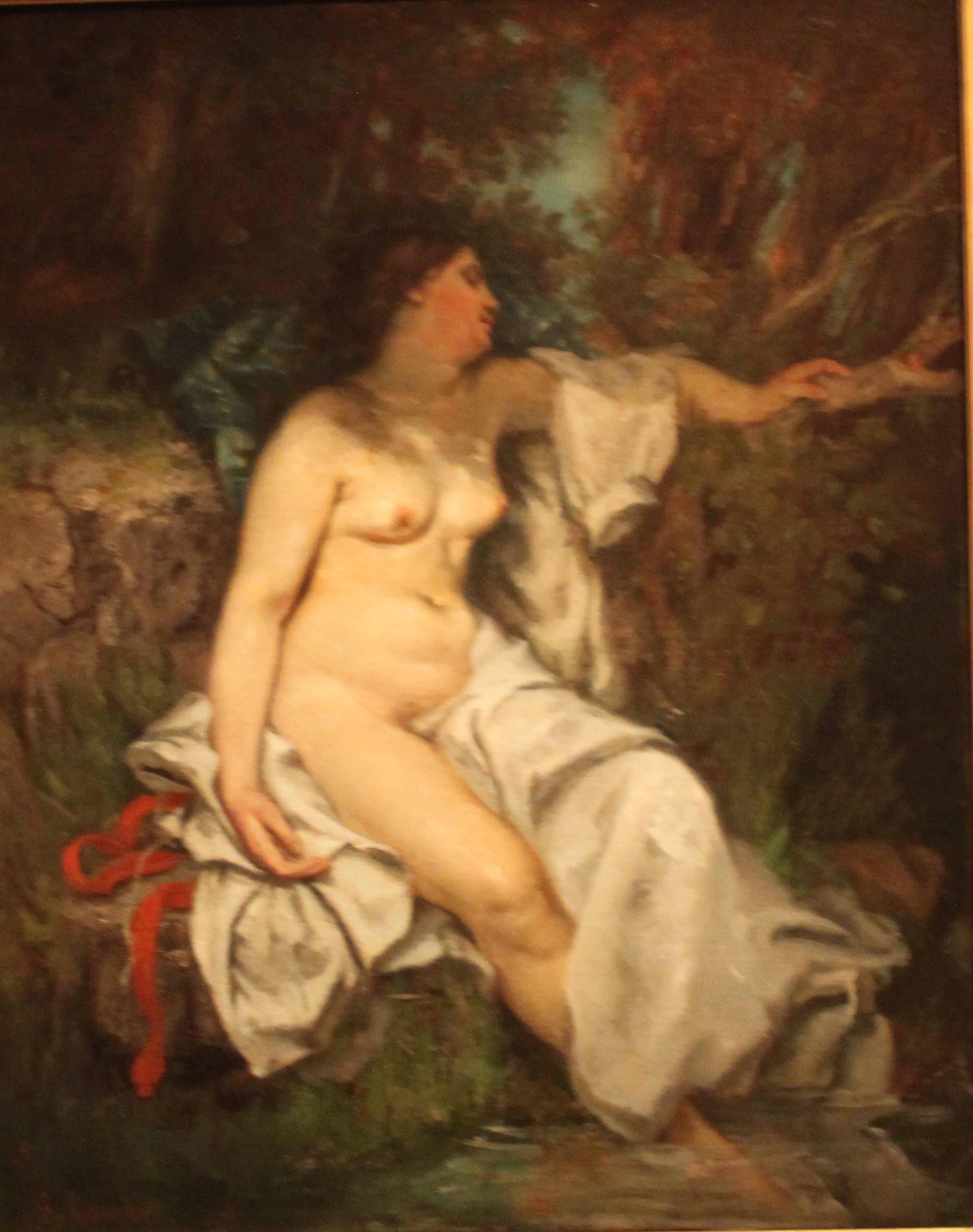
Gustave Courbet-Bather Sleeping by a Brook. Photo by Detroit Institute of Arts. Wikimedia Commons
Claude Monet included a portrait of himself in his painting Le Déjeuner sur l’herbe. Courbet developed an independent realism style that influenced several artists, including the Liebl Circle of German artists. His distinct style can also be seen in the works of Vincent van Gogh, Paul Cezanne, James McNeil Whistler, and Henri Fantin-Latour.
Despite his personal trials and challenges during his lifetime, Courbet has managed to remain an inspiration to many. His ingenuity and craftsmanship made him one of history’s most revered artists, and his legacies live on years after his death.
Planning a trip to Â鶹APP ? Get ready !
These are ´¡³¾²¹³ú´Ç²Ô’²õÌý²ú±ð²õ³Ù-²õ±ð±ô±ô¾±²Ô²µÂ travel products that you may need for coming to Â鶹APP.
Bookstore
- The best travel book : Rick Steves – Â鶹APP 2023 –Ìý
- Fodor’s Â鶹APP 2024 –Ìý
Travel Gear
- Venture Pal Lightweight Backpack –Ìý
- Samsonite Winfield 2 28″ Luggage –Ìý
- Swig Savvy’s Stainless Steel Insulated Water Bottle –Ìý
We sometimes read this list just to find out what new travel products people are buying.


