
 English


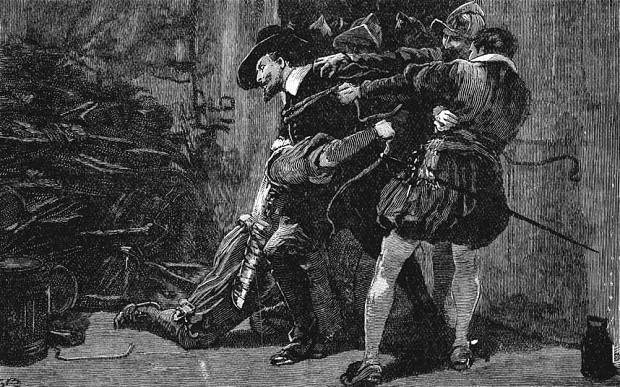
Fawkes Arrest – Image Source:
Top 10 Facts about Guy Fawkes and The Gunpowder Plot
The Gunpowder Plot was a failed assassination attempt against King James I by a group of 13 provincial English Catholics including Guy Fawkes, who sought to restore the Catholic monarchy to England after decades of persecution against the Catholics.
Although Guy Fawkes was not the mastermind behind the failed Gunpowder plot, he became its figurehead. Unlucky for him, out of the 13 conspirators, he was the one who was caught red-handed with 36 barrels of Gun powder, went through severe torture, and was also the last to be executed.
The story of Guy Fawkes and the Gunpowder Plot has continued to be told for centuries now, and in the 19th century, it became customary to burn an effigy of Guy Fawkes on a bonfire every year on 5 November, Bonfire Night, to mark the failure of the plot.
Let’s look at the top 10 facts about Guy Fawkes and the Gunpowder plot.
1. Guy Fawkes played a key role in the Gunpowder Plot

Photo by Ardfern from
As a staunch catholic, Fawkes joined a small group of English Catholics who planned to assassinate Protestant King James during the State Opening of Parliament on 5 November 1605. England had become a Protestant country after the Reformation, and as a result, Catholics were persecuted and forced to practice their religion in secret.
The conspirators rented a cellar underneath the Houses of Parliament, and Guy Fawkes disguised as a servant named John Johnson began filling it with barrels of gunpowder, with intention to blow and kill everyone within the building including the King.
It was Fawkes responsibility to light the fuse and then escape across the Thames. He was then to head to the continent, where he would explain to the Catholic powers about the plot.
2. Guy Fawkes died before going through the whole Execution Process

Photo by Lit. de J. Donon from
Although sentenced to be hanged, drawn and quartered, Fawkes died before going through the whole execution process. According to the reports, on 31 January 1606, Fawkes and three others were dragged from the Tower on wattled hurdles to the Old Palace Yard at Westminster where his fellow conspirators were immediately hanged and then quartered.
However, Fawkes managed to avoid the agony of the latter part of his execution by breaking his neck as he was hanged. Some sources claims that he deliberately made this to happen by climbing too high on the ladder and jumping before the rope was correctly set.
Nevertheless, his lifeless body was quartered and as was the custom, his body parts were then distributed to the four corners of the Kingdom to serve as a warning to other would-be traitors.
3. Fawkes earned Admiration from the king

Photo by William Ralston from
Asked why he was in possession of such a big amount of gunpowder, Fawkes said his intention was to blow out the parliament building and kill the King. He also said he was in much regret that his mission did not go through and that he was proud of what he had tried to do.
In the initial questioning, Fawkes revealed nothing about the plot to his interrogators, rather than identified himself as a 36-year-old Catholic from Netherdale in Yorkshire. He also gave the name of his father name as Thomas and his mother as Edith Jackson and insisted that he had acted alone.
His composure and unwillingness to give out his fellow conspirators despite sustained questioning earned him admiration from the king, who described him as possessing “a Roman resolution”
4. Fawkes was not the Mastermind behind the Gunpowder Plot
Although Fawkes is the most famous among the gunpowder plot conspirators, he was neither the mastermind nor the leader of the group. There were a total of 13 conspirators in the plot, which was masterminded and led by Robert Catesby.
Apart from Catesby and Fawkes, others involved in the plot were Thomas Bates, Robert and Thomas Wintour, Thomas Percy, Christopher and John Wright, Francis Tresham, Everard Digby, Ambrose Rookwood, Robert Keyes, Hugh Owen and John Grant.
5. November 5 is Celebrate as Guy Fawkes Day across Britain

Photo by Tony Webster from
In 1606, one year after the failed gunpowder plot, the Parliament declared November 5 as a day of public thanksgiving. Guy Fawkes Day, also referred to as Guy Fawkes Night or Bonfire Night is now celebrated annually across Britain each November 5 in remembrance of the Gunpowder Plot.
As dusk falls, villagers and city dwellers across Britain light bonfires, set off fireworks and burn effigies of Fawkes. Traditionally, in the weeks running up to the 5th of November, children made effigies usually using old clothes stuffed with newspaper, and fitted with a grotesque mask, to be burnt on 5 November bonfire.
6. Fawkes was caught Red-handed with 36 Barrels of Gunpowder
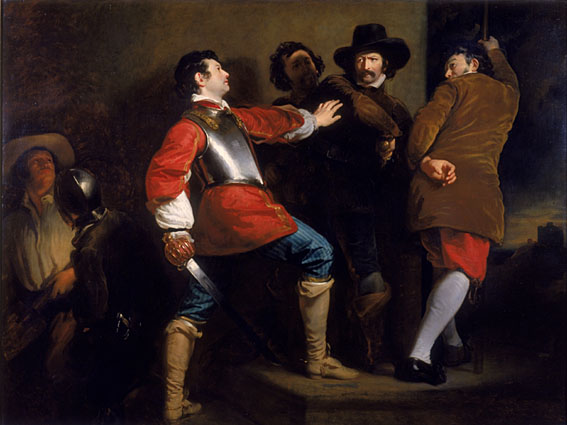
Image Source:
Shortly after the gunpowder plot was leaked, the king ordered a thorough search in and around the parliament building. When they arrived the search party led by Thomas Knyvet, a member of parliament himself, found Fawkes alone in the cellar of the parliament building.
He gave his name as John Johnson and added that he worked for Thomas Percy. When the search was done, he was found to have a pocket watch, several slow matches, and touchwood. 36 barrels of gunpowder were also discovered hidden under piles of faggots and coal.
Fawkes who himself was found dressed in a cloak and hat, and wearing boots and spurs, was immediately arrested and was taken to the King early on the morning of 5 November for questioning.
7. Guy Fawkes has an Island named after Him
Considering Fawkes was one of Britain’s most infamous villains, it is perhaps surprising to learn that he has an island named after him called “Guy Fawkes Island� or “Isla Guy Fawkes�.
“Isla Guy Fawkes� is a collection of two crescent-shaped islands and two small rocks northwest of Santa Cruz Island, in the Galápagos Islands, which are part of Ecuador. It is uninhabited but known to be used by scuba divers who amongst other things view the underwater zoanthids near it.
8. Fawkes came from a Protestants Family
Although he was a staunch catholic and a sworn enemy of the protestant church, Fawkes himself was born in a protestant family. His parents were regular communicants of the Church of England, as were his paternal grandparents.
In 1579, when Guy was eight years old, his father died and his mother remarried several years later, to the Catholic Dionis Baynbrigge of Scotton, Harrogate. It is believed that Fawkes became a Catholic through the Baynbrigge family’s recusant tendencies.
9. Fawkes went through a Severe Torture
Following his arrest, Guy Fawkes was taken to the Tower of London to be tortured to give up the names of his friends and co-conspirators with the instruction that he should be tortured lightly at first with the use of manacles and then onto the rack.
The King composed a list of questions for him to be asked as no amount of investigation was revealing anything about him. Fawkes finally cracked and gave out information about his fellow conspirators after three days of severe torture.
Although it has never been determined if he was indeed subjected to the rack, his signature on his Confession is really shaky and bears witness to the suffering he had endured.
10. The Houses of Parliament are still searched for hidden Explosives
Though the failed Gunpowder Plot occurred more than 400 years ago, it’s still a tradition for the Yeomen of the Guard to search the cellars of the Houses of Parliament before the State Opening each year.
The original spot where Fawkes hid his gunpowder burned down during a fire at the Palace of Westminster in 1834, but officials still scour the existing cellars, just to be sure. However, the searches are performed more for tradition and ritual rather than security.
Planning a trip to Â鶹APP ? Get ready !
These are ´¡³¾²¹³ú´Ç²Ô’²õÌý²ú±ð²õ³Ù-²õ±ð±ô±ô¾±²Ô²µÂ travel products that you may need for coming to Â鶹APP.
Bookstore
- The best travel book : Rick Steves – Â鶹APP 2023 –Ìý
- Fodor’s Â鶹APP 2024 –Ìý
Travel Gear
- Venture Pal Lightweight Backpack –Ìý
- Samsonite Winfield 2 28″ Luggage –Ìý
- Swig Savvy’s Stainless Steel Insulated Water Bottle –Ìý
We sometimes read this list just to find out what new travel products people are buying.


