
 English


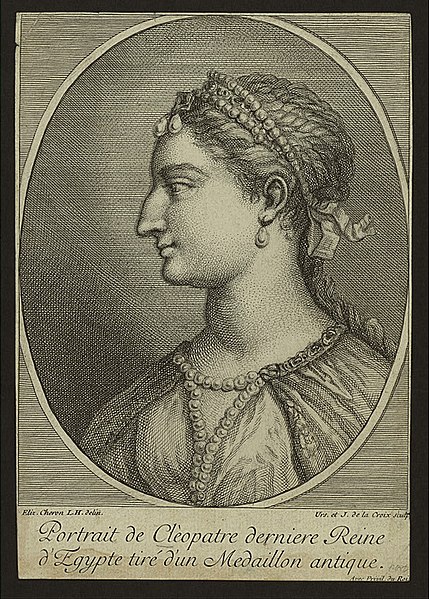
Image by Jocelyn Alvarez Bibian from
Top 10 Historical Facts about the Death of Cleopatra
More than 2000 years after her death, Queen Cleopatra’s leadership, lifetime, and even her death, still intrigue modern scholars and historians. She is one of the most famous and most studied ancient Egyptian rulers.
Born in early 69 BC to the ruling Ptolemaic pharaoh Ptolemy XII, Cleopatra was Queen of the Ptolemaic Kingdom of Egypt from 51 to 30 BC and the last known active Pharaoh.
Cleopatra was intelligent, charismatic, and cunning, qualities she used to further her personal political ambitions. She was also ruthless, reportedly killing several of her family members in order to solidify her political power.
Of all Cleopatra’s life history, nothing intrigues modern scholars more than the events that happened before and after her controversial death. Let’s look at the top 10 historical facts about her death.
1. She died at the Age of 39 Years
Although there are no surviving records indicating an exact date of Cleopatra’s death, modern Historians and scholars agree that her death occurred on either 10 or 12 August, 30 BC, when she was 39 years old.
Before her death, Cleopatra had ruled Egypt for over 20 years. She ascended to the throne in 51B.C at the age of 18 after the death of her father, Ptolemy XII. Initially, she co-inherited the crown together with her younger brother whom she later married before side-lining him and becoming the sole dominant ruler of Egypt.
2. Cleopatra died by Suicide

Image by Jean-André Rixens from
After suffering heavy defeat and losing her kingdom to Octavian, Cleopatra decided to commit suicide rather than be paraded and humiliated by Romans, a fate her sister, Arsinoe IV, had suffered a few years earlier.
According to popular belief, Cleopatra killed herself by allowing an Egyptian poisonous cobra to bite her. Other narrations state that she killed herself by introducing a poison of some kind to her body using a sharp implement such as a hairpin.
Although Cleopatra’s personal physician did not explain her cause of death and Modern scholars still debate on which manner she killed herself, one fact everyone agrees is that she died by suicide.
3. She died in Alexandria
Following their defeat in the naval Battle of Actium at the Ambracian Gulf of Greece in 31 BC, Cleopatra and her long-time partner Anthony, retreated to Alexandria to recuperate and prepare for the defense of the city against Octavian’s forces.
After a long period of failed negotiations, Octavian’s forces invaded Egypt in the early 30 BC. He quickly advanced towards Alexandria, and although Antony scored a small victory at the gates of the city, he finally surrendered on 1 August 30 BC.
With Octavian’s forces finally in Alexandria, Octavia occupied the palace and seized Cleopatra’s three youngest children. Cleopatra withdrew to her tomb with her closest attendants where she killed herself after she was informed that Octavian planned to move her to Rome for a triumphant victory parade.
4. She Planned her Death

Image Source:
Cleopatra’s suicide was not a spontaneous action, but rather a premeditated and well-planned scheme. She even sent a message to her long-time partner Anthony, stating that she had died by suicide, long before she was actually dead.
According to Ancient Egyptian sources, once Cleopatra decided that she did not want to be paraded through the streets of Rome before a grisly, public execution, she began studying the effects of different poisons while ordering the design and construction of her own mausoleum.
She determined that fast poisons were too painful and slow poisons too dreadful, and settled for death from asp or cobra venom. In his writings, an ancient historian described how Cleopatra approached her suicide in an almost ritual process that involved bathing and then a fine meal before taking her own life.
5. Her Death has been depicted in Various Works of Art
The death of Cleopatra has been depicted in various works of art throughout history. These include the visual, literary, and performance arts, ranging from sculptures and paintings to poetry and plays, as well as modern films.
She also featured prominently in the prose and poetry of ancient Latin literature, with the story of her suicide by snakebite being often depicted in medieval and renaissance art.
In other modern visual arts, Cleopatra has been depicted in mediums such as paintings and sculptures, with Ancient Greco-Roman sculptures serving as inspirations for modern artworks.
6. Cleopatra’s Death Marked the end of the Ptolemaic Dynasty
The death of Cleopatra marked the end of the Ptolemaic royal dynasty which ruled Ancient Egypt for 275 years during the Hellenistic period. Their rule had lasted since the reign of Alexander the Great and was the last dynasty of ancient Egypt.
Like the earlier dynasties of ancient Egypt, the Ptolemaic dynasty practiced inbreeding including sibling marriage. All the male rulers of the dynasty took the name, Ptolemy, while the queen’s regnant were all called Cleopatra, Arsinoe, or Berenice.
Cleopatra was the last and the most famous member of the Ptolemaic royal dynasty line, and After her death, Egypt became a province of the newly established Roman Empire, with Octavian becoming its first Roman emperor.
7. She was buried next to Mark Anthony

Image by Thomas Watson from
Before Cleopatra killed herself, she had a letter delivered to Anthony, informing him that she has committed suicide. In despair, Antony responded to this by stabbing himself in the stomach and taking his own life at age 53.
According to ancient Egyptian sources, Cleopatra was then allowed to embalm and bury Antony within her tomb before she was forcefully escorted to the palace, where she eventually met with Octavian, who had also detained three of her children.
After her meeting with Octavian, Cleopatra retreated back to her tomb with her closest servant where she sent her final message to Octavian requesting to be interred next to Anthony.
Although Octavian was outraged by these events which robbed him of the full splendor of his victory, he nevertheless had Cleopatra interred next to Antony in their tomb as she had requested.
8. The Location of her Tomb is Unknown

Image by August German Von Bohm from
Over 2000 after their death, the site of the mausoleum of Cleopatra and Mark Antony remains undiscovered. The Egyptian Antiquities Service believes that it is in or near a temple of Taposiris Magna, southwest of Alexandria.
Over the years, archaeologists dedicated to finding the lost tomb have done numerous excavations, but their search has been unsuccessful so far.
In their excavations of the temple of Osiris at Taposiris Magna, archaeologists have discovered six burial chambers and their artifacts, including coins minted by Cleopatra and Antony but the tomb itself remains elusive.
9. She was Survived by three children
Cleopatra had four children: one with Caesar and three with Mark Antony. Her firstborn son Caesarion, was captured and executed on Octavian’s orders shortly after her mother’s death.
Her other three surviving children, Cleopatra Selene II, Alexander Helios, and Ptolemy Philadelphos, were sent to Rome with Octavian’s sister Octavia the Younger, a former wife of their father, as their guardian.
Cleopatra Selene II was later married off to Juba II, son of Juba I, where she became the Queen of Numidia and Mauretania Kingdom in North Africa. The fate of Alexander Helios and Ptolemy Philadelphus remains unknown to this date.
10. Her Death marked the Birth of the Roman Empire
Cleopatra’s death effectively ended the final war of the Roman Republic between the remaining triumvirs Octavian and Antony, in which Cleopatra aligned herself with Antony, father to three of her children.
Antony and Cleopatra fled to Egypt following their loss at the 31 BC Battle of Actium in Roman Greece, after which Octavian invaded Egypt and defeated their forces.
After Cleopatra’s death, the Roman province of Egypt was established and Octavian became its ruler. He later changed his name to Augustus and eventually established himself as the first Roman emperor.
Planning a trip to Â鶹APP ? Get ready !
These are ´¡³¾²¹³ú´Ç²Ô’²õÌý²ú±ð²õ³Ù-²õ±ð±ô±ô¾±²Ô²µÂ travel products that you may need for coming to Â鶹APP.
Bookstore
- The best travel book : Rick Steves – Â鶹APP 2023 –Ìý
- Fodor’s Â鶹APP 2024 –Ìý
Travel Gear
- Venture Pal Lightweight Backpack –Ìý
- Samsonite Winfield 2 28″ Luggage –Ìý
- Swig Savvy’s Stainless Steel Insulated Water Bottle –Ìý
We sometimes read this list just to find out what new travel products people are buying.


