
 English


One of the six devas making an offering to the Big Buddha in Hong Kong. Photo by: Beej Nodora- Wikimedia.
Top 10 Astonishing Facts about Big Buddha and Po Lin Monastery, Hong Kong
The Big Buddha on Lantau Island, which is surrounded by the Po Lin Monastery, the slightly typical tourist attraction in Ngong Ping Village, and miles of hiking trails, is one of the most common Hong Kong sights.
Buddhist pilgrims flock to see the Big Buddha and Po Lin Monastery. And these majestic religious monuments, set against stunning mountain and coastal landscapes, are equally popular with Hong Kong’s diverse tourist population.
1. The largest outdoor sitting Buddha
The Big Buddha on Lantau Island is the world’s largest outdoor sitting Buddha statue. This magnificent statue stands atop Mount Muk Yue’s peak. Po Lin Monastery took 12 years to plan and build this bronze Buddha statue that represents Hong Kong’s stability, China’s wealth, and world peace.
The Big Buddha Statue has become a major landmark in Hong Kong, drawing both local and international Buddhists and tourists. It is not only a phenomenal work project, but also a significant piece of Buddhist sculptural art in recent history. It is a valuable human legacy.
2. Big Buddha and Po Lin Monastery origin story
Lantau Island, New Territories, Hong Kong. Photo by: Rutger van der Maar- Wikimedia.
Mount Muk Yue’s majestic outdoor bronze Buddha statue sits solemnly atop the peak. It is situated to the south and faces north toward Beijing, China’s capital. The statue’s body is divided into two parts and stands 26.4m tall, totaling 34m from the floral crown to the base.
It took 12 years and 250 tonnes of bronze to complete. The Po Lin Monastery was built in the secluded mountains of Lantau Island more than a century ago. The statue was inspired by Siddhartha, who attained enlightenment beneath the Bodhi tree.
The “imparting fearlessness” mudra of the right hand represents compassion to save all sentient beings from their sufferings; the “fulfilling wishes” mudra of the left hand resting on the lap represents the vow to bestow blessings and happiness on all.
3. How to get to Big Buddha
Many people prefer to take the MTR (subway) to Tung Chung Station. Exit at Exit B. (knowing your exit is extremely important at big Hong Kong stations). You then have two options.
Walk about a block to the Ngong Ping 360 cable car, which will take you up to Ngong Ping Village in 25 minutes. After exiting the cable car in Ngong Ping Village, continue walking for about 10 minutes to the Big Buddha and Po Lin Monastery.
Alternatively, walk to Tung Chung Town Centre and transfer to New Lantao Bus 23, which takes about 45 minutes. The Big Buddha is then less than a 10-minute walk away. If you are visiting the Big Buddha with children, I strongly advise you to take the cable car.
4. A significant place of worship

Po Lin Monastery. Photo by: Ovedc- Wikimedia.
While the Big Buddha and Po Lin Monastery are popular tourist destinations, it is important to remember that they are also religious places for many people.
My daughter was fascinated by the incense offerings, which I believe provided her with an interesting cultural experience. You can buy incense at nearby stalls to make your own offering.
There are candles nearby that can be used to light incense. It takes some time for it to properly light. However, in case you need any help a helpful observer can give you a hand in lighting it.
5. Lantau Island hiking
Lantau Island, believe it or not, has some truly spectacular nature trails. People do hike up to and around the Big Buddha, but going uphill or downhill is not for the faint of heart.
It’s a challenging multi-hour adventure that you shouldn’t attempt unless you’re in great physical shape. There is also the Lantau Trail, which makes a nice loop around the island.
As it is quite long (43 miles), most people hike it in sections, but you can catch it just off the Wisdom Path. Prepare by researching the sections ahead of time so you know where you’ll end up. If you have the time, this is highly recommend hiking in Hong Kong.
6. Cable cars to and from the Big Buddha
Travel to Lantau Island by bus or taxi to see the local villages, such as Tai O, a charming fishing village surrounded by lush countryside. Make sure to see the dolphins before heading to Ngong Ping to see the iconic Big Buddha statue.
The Big Buddha, the world’s largest seated outdoor bronze Buddha, was built in 1993. While enjoying the scenery, stop for lunch at Po Lin Monastery and enjoy a simple but delicious vegetarian meal.
Take the glass bottom cable cars back to Tung Chung from the Big Buddha, which is an amazing ride, and then take the train back to town from Tung Chung.
7. Ngong Ping village

Po Lin Monastery. Photo by: Daniel Gerhard- Wikimedia.
When you arrive by Ngong Ping 360 cable car (or bus), you will immediately end up in Ngong Ping Village. A man-made village with numerous entertainment and souvenir shops, such as Walking with Buddha and the Ngong Ping Tea House.
However, there are restaurants for the many visitors.
The village was built in traditional Chinese style to blend in with the surrounding landscape. After passing through Ngong Ping Village, you will come to a kind of portal that leads to the Tian Tan Buddha.
8. Big Buddha or Tian Tan Buddha
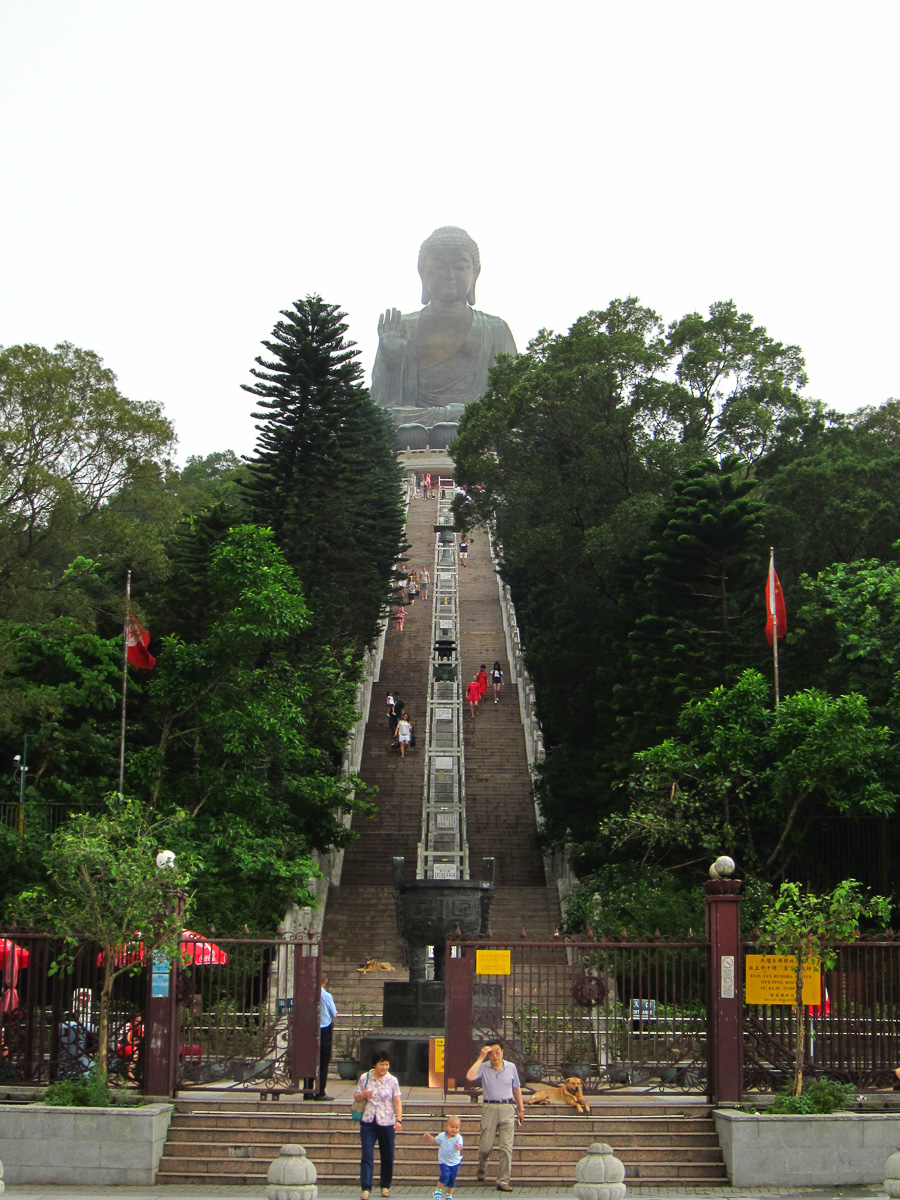
From a distance, you can see the Tian Tan Buddha on a hill near the Po Lin Monastery. The statue is the main attraction in Ngong Ping and thus draws the majority of tourists.
The Big Buddha, as it is also known, stands 34 meters tall and is made of bronze. Its gaze is fixed on the Chinese mainland, more specifically on Beijing.
The Tian Tan Buddha is also the largest Buddhist monument in Hong Kong and one of China’s five largest Buddha statues. It depicts the Amitabha Buddha, a transcendent Buddha who is worshipped in East Asia. The statue sits on a floral crown and is accessible via 268 steps.
Visitors can enjoy free exhibitions on the three-tiered altar beneath the Lotus throne of the Tian Tan Buddha. Around the Big Buddha, there are six statues that symbolize Bodhisattvas, or divinities.
They each display various symbols to the Buddha, representing wisdom, meditation, willpower, patience, generosity, and morality – the six Paramita qualities that lead to awakening.
Note: If you’re wondering about the symbol on the chest of the Buddha statue, it’s a Swastika. It was initially used as a lucky charm and has nothing to do with the Third Reich or World War II.
9. The path of wisdom

Hong Kong – Po Lin Monastery. Photo by: Deror Avi- Wikimedia.
The Wisdom Path is located near the Big Buddha and Po Lin Monastery. A 10-minute walk takes you into the heart of Lantau Island’s hills, where the Wisdom Path is located.
Simply follow the signs from the Tian Tan Buddha’s feet. Many tourists visit to Ngong Ping Village solely to see the Tian Tan Buddha, but they frequently overlook the Wisdom Path.
It’s mostly unoccupied here, and you only meet a few other tourists, making it a kind of insider tip. The Wisdom Path has been made up of 38 wooden piles arranged in the shape of an 8 since 2005. The path gradually ascends and descends the mountain, and the number 8 represents infinity.
10. Other activities to do near Big Buddha and Po Lin Monastery
If the vegetarian lunch at Po Lin Monastery or the standard options in Ngong Ping Village do not appeal, take a taxi to Tai O fishing village. It is one of the few remaining villages with Chinese stilt houses suspended over water (makes really great photographs).
Ask your hotel manager for suggestions, but for roast goose, try the Tai O Crossing Boat restaurant or one of the many market stalls. Buy XO sauce here.
Viator, a location affiliate partner, provides guided day tours that include almost everything I mentioned above and more. It begins with a coach ride to Cheung Sha Beach (Hong Kong’s longest beach), Tai O, the Big Buddha, lunch at the monastery, and a cable car ride back down.
Planning a trip to Â鶹APP ? Get ready !
These are ´¡³¾²¹³ú´Ç²Ô’²õÌý²ú±ð²õ³Ù-²õ±ð±ô±ô¾±²Ô²µÂ travel products that you may need for coming to Â鶹APP.
Bookstore
- The best travel book : Rick Steves – Â鶹APP 2023 –Ìý
- Fodor’s Â鶹APP 2024 –Ìý
Travel Gear
- Venture Pal Lightweight Backpack –Ìý
- Samsonite Winfield 2 28″ Luggage –Ìý
- Swig Savvy’s Stainless Steel Insulated Water Bottle –Ìý
We sometimes read this list just to find out what new travel products people are buying.


