
 English


Kenojuak Ashevak’s star on Canada’s Walk of Fame. Photo by: Tabercil- Wikimedia.
Top 10 Interesting Facts about Kenojuak Ashevak
Due to her famous print The Enchanted Owl (1960), which was featured on a Canada Post stamp, Ashevak might be the most well-known Inuit artist. She was also the first woman to work in the newly opened printmaking shop in Cape Dorset.
1. The creation of an artist
Kenojuak Ashevak was born and raised on the land, living in igloos and skin tents in the traditional, semi-nomadic hunting lifestyle. She was admitted to hospital at Parc Savard Hospital in Québec City from 1952 to 1955 after being diagnosed with tuberculosis.
There, she met Harold Pfeiffer, who taught patients arts and crafts as a way to pass the time while also earning extra money — the hospital sold the work on behalf of the patients.
When Ashevak came back to Cape Dorset, James Houston, who taught Inuit printmaking techniques and founded the West Baffin Co-operative, urged her to continue making art.
2. Prints and drawings that Ashevak has made
Ashevak’s work drew immediate attention. For example, her first print, Rabbit Eating Seaweed (1958), was included in the Cape Dorset Print Collection and Catalogue.
Ashevak’s early drawings were simple and bold, with birds and creatures metamorphosing into one another.
Her iconic The Enchanted Owl (1960), which was used on a postage stamp commemorating the centennial of the Northwest Territories in the 1970s, depicts a spotted blue-grey owl gazing out at the viewer, with feathers fanning out above its head and curving up from its tail.
An untitled engraving from 1962 depicts elongated twin bird-like creatures with a star and human faces in the center.
3. Ashevak’s arts and entertainment history
Her fame began in 1962, when she was the subject of a National Film Board documentary. To commemorate the signing of the Inuit Land Claim Agreement in Principle in 1990, Indian and Northern Affairs Canada commissioned Kenojuak’s print Nunavut Qajanatuk.
Kenojuak went on to create the stunning hand-colored lithograph Nunavut to commemorate the signing of the Final Agreement. She was appointed an Officer of the Order of Canada in 1967 and promoted to Companion of the Order of Canada in 1982.
She also received honorary degrees from Queen’s University in Kingston and the University of Toronto.
4. A brief explanation on Ashevak’s art
Kenojuak Ashevak’s star on Canada’s Walk of Fame. Photo by: Tabercil- Wikimedia.
“I just take these things out of my thoughts and out of my imagination, and I don’t really give any weight to the idea of it being an image of something,” Kenojuak explained to Jean Blodgett, written several books and essays on the artist, in 1980.
I’m just focusing on getting it down on paper in a way that looks good to me, whether or not it has anything to do with subjective reality. And that is how I have always attempted to create my images, and it is still how I do it, and I haven’t really considered it any other way.
That is simply my style, and it is how I began and continues to be.
5. The Cooperative of West Baffin Eskimo
In the 1950s, Houston established printmaking to Cape Dorset artists. In 1959, Houston established the West Baffin Eskimo Cooperative and began marketing and showing Inuit arts and crafts.
Kenojuak’s drawings were included in collections every year until her death, and her enthralling fame earned her numerous honors and recognitions over the years.
6. Ashevak’s painting and drawing style

Oolooreak (left) and Kenojuak Ashevak (right) on board the Eastern Arctic patrol ship MV Regina Polaris. Photo by: S.J. Bailey- Wikimedia.
Ashevak used graphite, colored pencils, and felt-tip pens to create his artwork. She used poster paints, watercolors, and acrylics on occasion. She carved soapstone and produced thousands of drawings, etchings, stone-cut prints, and prints. Her subjects are all natural, from brightly colored fish to her favorite birds to radiant suns.
Kenojuak explained her creative process as follows:
“I just take these things out of my thoughts and imagination, and I don’t give much weight to the idea that it’s an image of something… I’m just concentrating on getting it down on paper in a way that looks good to me, regardless of whether it has anything to do with subjective reality.
“I just take these things from my thoughts and imagination, and I don’t give much weight to the idea that it’s an image of something… I’m just focusing on getting it down on paper in a way that looks good to me, irrespective of whether it has anything to do with subjective reality.
And that is how I have always attempted to create my images, and it is still how I do it, and I haven’t really considered it any other way. That is simply my style, and it is how I began and continues to be.”
7. The well-known Enchanted Owl drawing
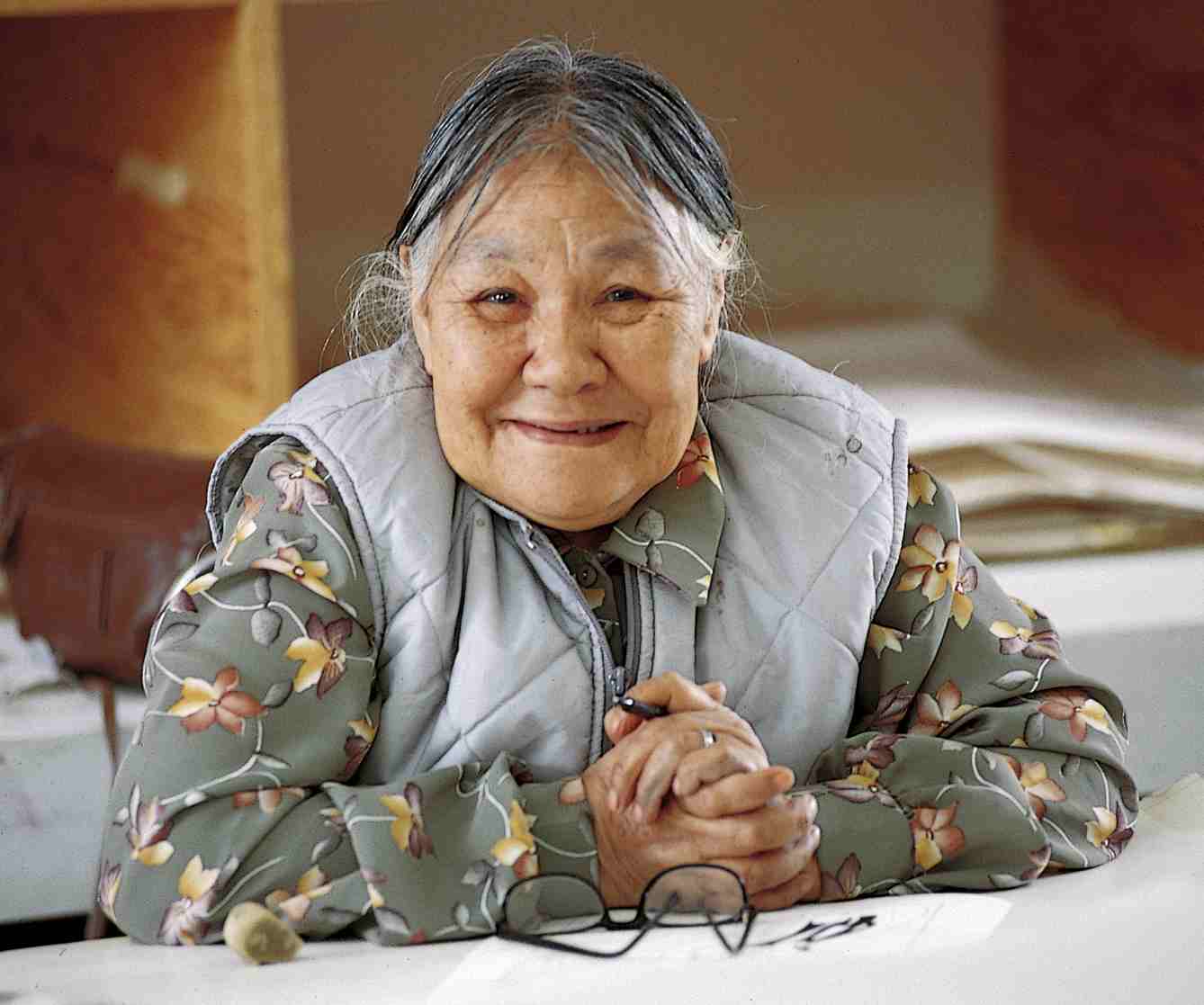
Kenojuak Ashevak while drawing in the litho-shop of Est Baffin Eskimo Co-operative (Cape Dorset, Nunavut, Canada). Photo by: Ansgar Walk- Wikimedia.
One of Kenojuak’s most well-known works is this 1960 print. One of her favorite birds to draw, this image has vibrant colors, simple rounded forms, and a strong composition. It exemplifies her style and the Inuit mythology themes that appear in her work.
The Enchanted Owl appeared on a stamp commemorating the centennial of the Northwest Territories in 1970.
8. Accomplishments Kenojuak received throughout her career
Kenojuak has got countless special honors over the years. She was appointed a Companion in the Order of Canada in 1967. She received two honorary degrees from Queen’s University and the University of Toronto in 1992.
At the National Aboriginal Achievement Awards Ceremony in Vancouver in 1996, she won the prestigious Lifetime Achievement Award.
Kenojuak was the first Inuit artist to be inducted into Canada’s Walk of Fame in 2001. She received the Governor General’s Award for Visual Arts Excellence in 2008.
9. Kenojuak’s family history
Kenojuak Ashevak while drawing in the litho-shop of Est Baffin Eskimo Co-operative (Cape Dorset, Nunavut, Canada). Photo by: Ansgar Walk- Wikimedia.
Kenojuak and Johnniebo relocated to Cape Dorset in 1966. Her husband died of cancer after 26 years of marriage, as did many of their children and grandchildren.
Kenojuak had three daughters, Mary, Elisapee Qiqituk, and Aggeok, who died as children, as well as four sons, Jamasie, her adopted son Ashevak, and Kadlarjuk and Qiqituk. The latter two were adopted by another family at birth.
Kenojuak remarried to Etyguyakjua Pee the year after Johnniebo died in 1972; he died in 1977. She married Joanassie Igiu in 1978.
Her first husband fathered 11 children, and she adopted five more; seven of her children died as children. She was living in a wood-frame house in Kinngait (Cape Town) when she died of lung cancer on January 8, 2013.
10. Her last project before passing away
During her stay at Parc Savard hospital in Quebec City from 1952 to 1955, she started to make dolls and do beadwork from Harold Pfeiffer.
Later, civil administrator and pioneer Inuit art promoter James Archibald Houston and his wife Alma became interested in these crafts.
In the 1950s, Houston introduced Cape Dorset artists to printmaking, and he and his wife began marketing Inuit arts and crafts, including an exhibit of Inuit art in 1959.
Planning a trip to Â鶹APP ? Get ready !
These are ´¡³¾²¹³ú´Ç²Ô’²õÌý²ú±ð²õ³Ù-²õ±ð±ô±ô¾±²Ô²µÂ travel products that you may need for coming to Â鶹APP.
Bookstore
- The best travel book : Rick Steves – Â鶹APP 2023 –Ìý
- Fodor’s Â鶹APP 2024 –Ìý
Travel Gear
- Venture Pal Lightweight Backpack –Ìý
- Samsonite Winfield 2 28″ Luggage –Ìý
- Swig Savvy’s Stainless Steel Insulated Water Bottle –Ìý
We sometimes read this list just to find out what new travel products people are buying.


