
 English


Photo of Terry Fox, Canadian cancer fund-raiser, during his 1980 “Marathon of Hope” fund-raising run across Canada. Photo by: Jeremy Gilbert- Wikimedia
Top 10 Amazing Facts about Terry Fox
The well-known Canadian athlete Terrance Stanley Fox is his full name. People are more familiar with him as Terry Fox. He was born on July 28, 1958, and died on June 28, 1981. Fox also acted as a cancer researcher, activist, and humanitarian.
In 1980, Fox made an incredible move by running across Canada from east to west. It drew a lot of attention because he did it with one leg amputated due to cancer. He wished to raise funds and raise public awareness about cancer research.
Let us look at some more Terry Fox facts below:
1. The charity event he ran in
Terry Fox Event is significant for cancer research because it has the potential to raise millions of dollars for cancer research. It is no surprise that the event is regarded as the world’s largest fundraiser for cancer research. It had collected more than C$750 million as of January 2018.
2. The reason Terry decided to run at his condition
Photo of Terry Fox, Canadian cancer fund-raiser, during his 1980 “Marathon of Hope” fund-raising run across Canada. Photo by: Jeremy Gilbert- Wikimedia
Terry Fox was born in Winnipeg, Manitoba, and raised in Port Coquitlam, British Columbia, a community on Canada’s west coast near Vancouver. Terry was just 18 years old when he was diagnosed with osteogenic sarcoma (bone cancer) and required to have his right leg amputated 15 centimetres (six inches) above the knee in 1977.
Terry was so moved by the hardship of other cancer patients, many of whom were children, that is when he decided to run across Canada to raise funds for cancer research while in the hospital.
3. How far did Terry get with the Marathon of Hope
His journey would be known as the Marathon of Hope. Terry began his run in St. John’s, Newfoundland on April 12, 1980, after 18 months of preparation and running over 5,000 kilometres (3,107 miles).
Although it was harder to gain recognition at first, enthusiasm quickly grew, and the money collected along his route began to add up. He ran nearly 42 kilometres (26 miles) per day through the Atlantic provinces, Quebec, and Ontario of Canada.
4. Terry Fox is considered one of Canada’s greatest hero

Terry Fox’s “favourite” prosthetic leg. This leg was built by prosthetic specialist Ben Speicher of Vancouver, British Columbia. Photo by: Gbuchana- Wikimedia
Every year, millions of people from nearly 25 countries take part in National School Run Day, The Terry Fox Run, and Terry Fox fundraising events. He was named Canada’s greatest hero in a national poll in 1999, and he came in second to Tommy Douglas in the 2004 program The Greatest Canadian.
5. Many schools and roads in Canada are named after him
Terry has 14 schools and 15 roads named after him in Canada. (In Terry’s honor, an 83-kilometer (52-mile) section of the Trans-Canada Highway between Thunder Bay and Nipigon is renamed the Terry Fox Courage Highway.)
6. Terry Fox’s cancer getting worse
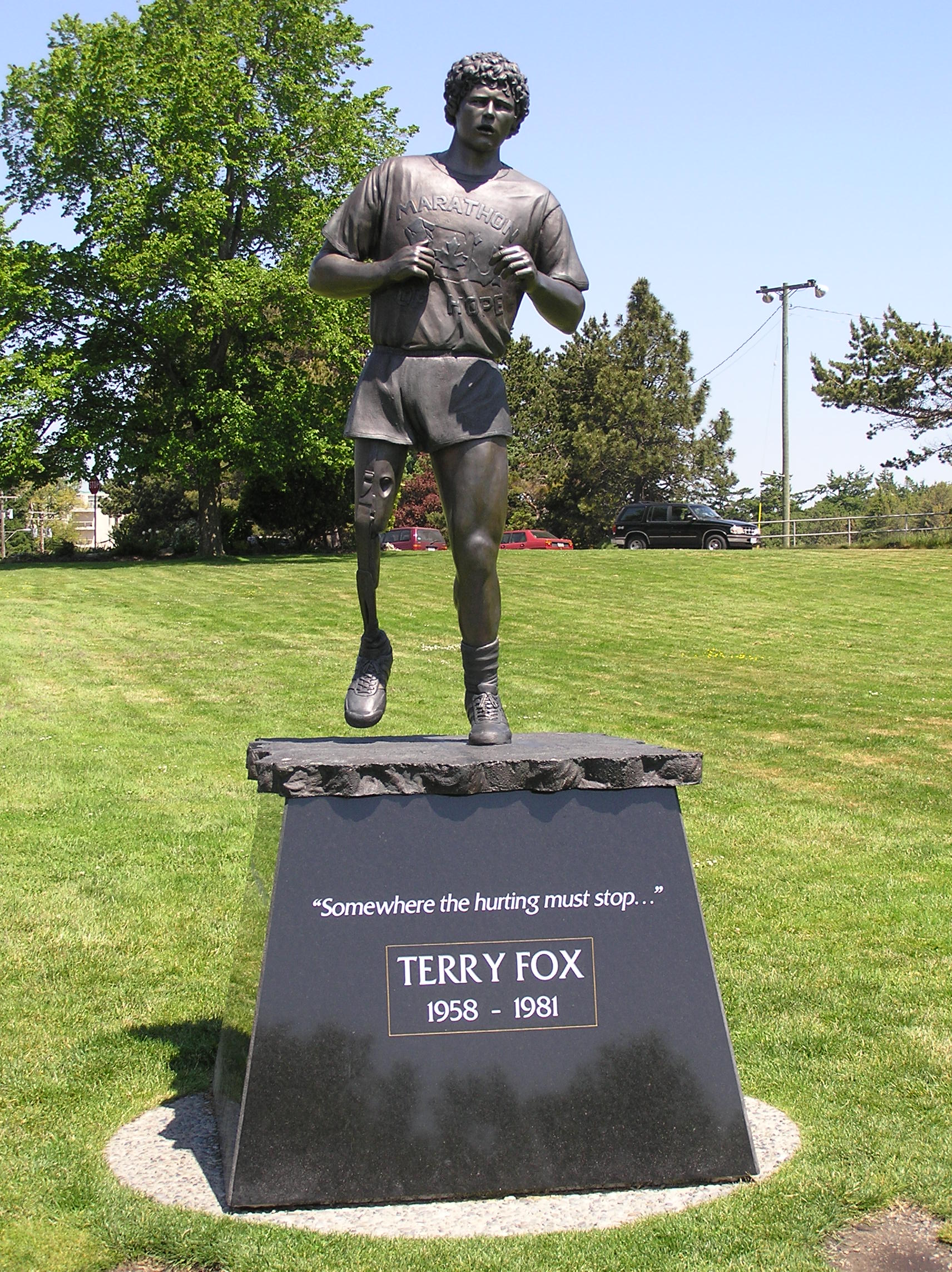
Monument in honour of Terry Fox at the Beacon Hill Park in Victoria BC. Photo by: Hans-Peter Eckhardt- Wikimedia
Fox reached the halfway point in eastern Ontario, but on September 1, 1980, chest pains forced him to turn around just outside Thunder Bay. It was soon discovered that the cancer had spread to his lungs, and he was unable to continue.
Fox had travelled 3,339 miles (5,374 kilometres) and raised $1.7 million by that point (Canadian). In early 1981, the Marathon of Hope surpassed Fox’s $24 million donation goal.
Despite countless treatments, Fox died on June 28, 1981. Prior to his death, the government appointed him as the youngest ever Companion of the Order of Canada, and he was named Canadian of the Year twice.
The Terry Fox Foundation organizes Terry Fox Runs, these events normally happen yearly throughout Canadian cities and internationally.
7. How did Terry Fox set an example to us?
He wasn’t running to become popular; he wanted to make a difference and raise funds for a cure for all cancers. Terry covered nearly 42 kilometres (26 miles) per day while running across Newfoundland and Labrador, Prince Edward Island, Nova Scotia, New Brunswick, Quebec, and Ontario.
He ran in the snow, rain, wind, heat, and humidity. He visited over 400 towns, schools, and cities to explain why he was running. He began at 4:30 a.m. and frequently did not finish his last mile until 7 p.m.
Terry and Doug, his best friend and driver, would sometimes sleep in the van because they couldn’t afford to stay anywhere else.
On some days, numerous people cheered him on, while on others, he was the only one on the street and no money was collected. Terry, on the other hand, never lost hope that Canadians would react to his story, to his efforts… and he was correct.
When Terry arrived in Ontario on June 28th, the entire country was rooting for him and donating to cancer research. Terry’s attempt was seen as limitless by Canadians.
8. How was high school and college experience for Terry Fox
Terry grew up playing soccer, rugby, and baseball. He enjoyed basketball the most, but he was not very good at it. Bob McGill, his junior high school physical education teacher and basketball coach, urged him to start running long distances.
While running, Terry carried on playing basketball, and in his senior year, he and his friend Doug Alward were named athletes of the year.
Fox’s mother persuaded him to attend Simon Fraser University, where he studied kinesiology, despite his reservations about going to college. He aspired to be a physical education instructor.
He tried out for the junior varsity basketball team, and his dedication earned him a spot ahead of more talented players.
9. Terry Fox was of Métis descent!
First and foremost, he was of Métis descent. Marian Wark, née Gladue, his maternal grandmother, was Métis. Regrettably, Fox’s grandmother kept her family’s heritage a secret, and it’s unclear how much of his Métis culture the famous Fox was aware of. Luckily, his younger brother Darrell Fox is Métis and announced in 2018 that “Terry Fox is Métis.”
Métis people emerged in the 1700s when French and Scottish fur traders married Aboriginal women such as Cree and Anishinabe (Ojibway). In the Northwest, their generations established an unique culture, collective consciousness, and nationhood.
Along the fur trade networks, distinct Métis communities arose. This Métis Nation Homeland includes Manitoba, Saskatchewan, and Alberta, as well as parts of Ontario, British Columbia, the Northwest Territories, and the northern United States.
Prior to the Northwest becoming a part of Canada, the Métis Nation developed a distinct culture and became a people.
10. Terry joined the Canadian Wheelchair Sport Association
Fox was picked to play basketball by the Canadian Wheelchair Sports Association while receiving treatment. He and his team won three national titles in that wheelchair, and he was named an all-star by the North American Wheelchair Basketball Association in 1980.
All of this while learning to play wheelchair basketball in less than two months.
Planning a trip to Â鶹APP ? Get ready !
These are ´¡³¾²¹³ú´Ç²Ô’²õÌý²ú±ð²õ³Ù-²õ±ð±ô±ô¾±²Ô²µÂ travel products that you may need for coming to Â鶹APP.
Bookstore
- The best travel book : Rick Steves – Â鶹APP 2023 –Ìý
- Fodor’s Â鶹APP 2024 –Ìý
Travel Gear
- Venture Pal Lightweight Backpack –Ìý
- Samsonite Winfield 2 28″ Luggage –Ìý
- Swig Savvy’s Stainless Steel Insulated Water Bottle –Ìý
We sometimes read this list just to find out what new travel products people are buying.


