
 English


Carrick-a-Rede rope bridge. Image by David Jones from
Top 10 Astonishing Facts about Carrick-a-Rede
Northern Ireland is home to one of the most interesting bridges in the world, the Carrick a Rede Rope Bridge.
The rope bridge is situated in County Antrim near the town of Ballintoy. The history of the Carrick, a Rede rope bridge, goes back to the late 18th century.
Carrick-a-rede’s original rope bridge was constructed in 1755 by local salmon fishermen as a way of accessing the small Carrickarede Island.
The area around the bridge was a favourite spot for salmon fishing, and the opening of the bridge facilitated the growth of fishing in the area. The bridge is a simple suspension bridge that is made out of rope.
It links the island of Carrick-a-rede to the mainland, and it is from this tiny island that the bridge gets its name.
The name “Carrickarede� is derived from the Irish phrase “Carraig a’Raid� whose literal translation is “the boulder of the casting.
Not only is Carrick-a-Rede Rope Bridge an incredible tourist attraction, but also offers a fascinating history to uncover.
Keep reading to find out the top 10 astonishing facts about this famous tourist attraction in Northern Ireland.
1. Carrick-a-Rede is a Scottish Gaelic Term

Image by from
The name comes from the Gaelic “Carraig a Rade“, meaning “the rock of the road�.
In Northern Ireland is a tiny island, barely anything more than a large rock jutting out of the sea. It’s known as Carrick-a-Rede, meaning ”rock in the road” in ancient Irish.
Whose road could possibly be going through this rocky outlet that connects the sea to the rivers Bann and Bush? Well, it’s not a human road.
The island of Carrick-a-Rede was an obstacle on the river- used by migrating salmons to return home
Carrick-a-Rede represented a major obstacle right in the middle of salmon spawning routes, which may have been irritating to them, but provided a great opportunity for salmon fishermen.
2. Local Fishermen built Carrick-a-rede Rope Bridge

Carrick-a-Rede Rope bridge in 1914. Image by Public Record Office of Northern Ireland from
Evidence suggests that salmon fishermen have been building basic rope bridges to Carrick-a-Rede since the 18th century. The first one we know of for sure was constructed in 1755.
A rope bridge is a simple suspension bridge, in which the load-bearing deck is suspended from ropes that are anchored on either end of the span.
Considering that the crossing where the Carrick-a-Rede Bridge has been located for centuries is 66 feet long and elevated 100 feet over the water, we can appreciate what a difficult task building even such a simple bridge would have been.
The Carrick-a-Rede Rope Bridge is a testament to the lengths fishermen of the past would go to in order to find that perfect spot.
3. Carrickarede island is a remnant of Volcanic Activity

Image by Diego Cue from
Carrickarede island is the best example of a volcanic plug in Northern Ireland. Marine erosion has exposed a section through the neck of this old volcano.
The presence of tuff, explosion breccias, grey volcanic ash and explosion bombs show the extreme violence of the eruptions about 60 million years ago when molten rock punched its way through chalk.
Along the coast of this area, as with much of the Antrim plateau, the cliffs are of basalt with the characteristic Ulster chalk underneath.
At Carrickarede, the ancient volcanic pipe has left dolerite, a tougher rock than basalt, which erodes more slowly.
The combination of the hard rock out front and the softer rock behind, with long-term erosion by the waves, has eventually left this small island.
4. Carrick-a-Rede rope Bridge will Mitigate your fear of Heights

Image by from
Carrick-A-Rede is a must-visit for adventure seekers and nature lovers alike.
The 20-metre-long rope bridge connects Carrick Island to the Antrim mainland, over a steep gorge.
Then, there’s an almost 100-foot drop down to the sea.
The bridge is regularly maintained by the National Trust and is completely safe to cross.
There is a limit to the number of people who are allowed to cross the bridge at any one time.
Terror-struck visitors have been known to be rescued from Carrickarede Island by boat from time to time.
5. The Carrickarede used to be a rich Fishing Ground

Fishermen’s cottage. Image by Peter Gumbrell from
Salmon fishing had been happening in the area since the early 17th century, but it was only in 1755 that fishermen erected a bridge in order to reduce reliance on boats to be ferried to the island.
In the 19th century and early 20th century, salmon fishing boomed in these waters, with up to 300 salmon being caught a day until the 1960s.
80 fishers and 21 salmon fishers are recorded as working in Ballintoy Â鶹APPh at its peak.
The salmon fishing industry in the area is long since over: the last salmon was caught in 2002.
Increased pollution and over-fishing meant the industry was no longer viable. From 300 a day, in the final years only 250 salmon were caught over the whole season.
6. Observe Wildlife at Carrickarede Island

Dolphins in Carricarede. Image by from
On the other side of the rope bridge, you will find Carrick Island, the reward for bravely crossing the bridge is the diverse birdlife on show and a completely uninterrupted view across Scotland and Rathlin Island.
Visitors will also have a great time keeping their eyes peeled for all the local sea life.
Seals are common, and the water is clear, so there’s a good chance you might see a friendly face pop up.
There’s also a chance of seeing creatures such as dolphins, porpoises and basking sharks!
There is even the possibility of swimming nearby if the weather suits, but you might want to bring a wetsuit as the water is a little cold.
7. Carrick-A-Rede is a key attraction of the Causeway Coastal Route
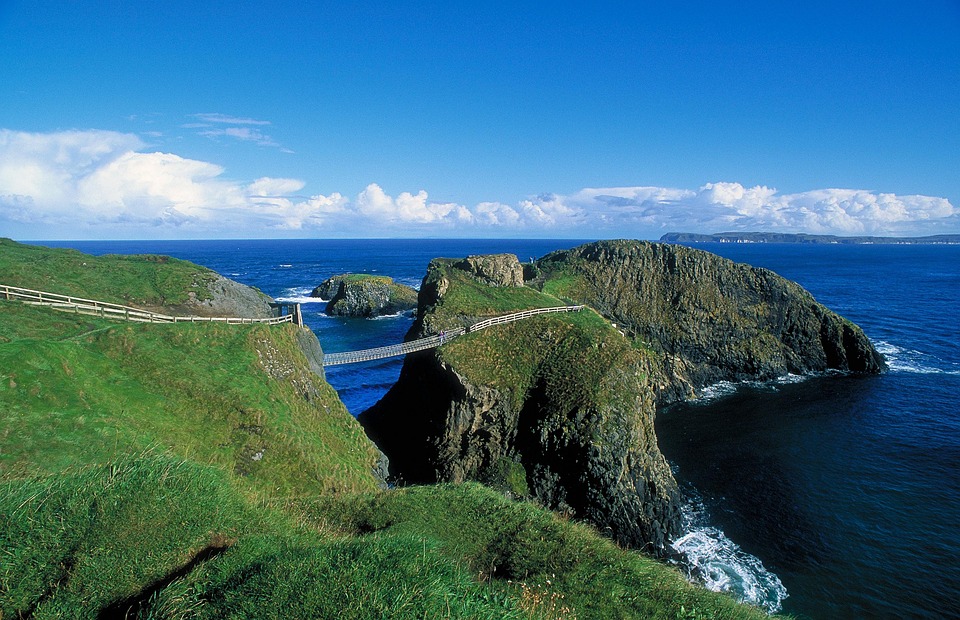
Image by from
The Antrim Coast road starts in Belfast City and ends in Derry. It follows the coast road through the nine Glens of Antrim, peaking at the Giant’s Causeway before powering on through to its final destination – Derry.
The entire Antrim Coastal Route is 313km/195-mile in length. You can tackle it all at once, or you can split it up into several visits, depending on how much time you have to play with.
Carrick-A-Rede is also one of the key attractions of the Causeway Coastal Route, a roughly three-hour drive along the coastline from Belfast to Derry, with options to stop off at several attractions and local beauty spots..
The Causeway Coastal Route is arguably one of the best things to do in Northern Ireland.
Packed with scenery, historical sites and colourful coastal villages, the 313km/195-mile Antrim Coast Road packs a punch.
8. The Carrick-a-Rede Rope Bridge has been Replaced Severally

Carrick-a-Rede rope bridge Circa1890. Image by National Library of Ireland on The Commons from
The bridge has been replaced and rethought many times over the years. In the 1970s, for example, it was particularly precarious, with only a single handrail and large gaps in between slats.
The old bridge was improved by The National Trust in 2000. It was tested for up to 10 tonnes then a new caged structure was installed as an additional safety measure to protect tourists.
Subsequently, this was replaced in 2004 and 2008 respectively.
The current bridge is made from wire rope and Douglas fir: constructed in Belfast, it cost over 16,000 pounds. It was opened to the general public in March 2008.
However, even though the bridge is safer the fear is still there and visitors come for the trepidation and exhilaration that the Carrick-A-Rede rope bridge offers them.
9. Carrick-a-Rede is under preservation The National Trust

National Trust Sign at CarrIckarede Rope bridge. Image by Ross from
The National Trust for Places of Historic Interest is a renowned charity and membership organisation in England, Northern Ireland and Wales. It offers natural preservation for the most beloved heritage locations in the UK, including houses, buildings, coastlines, gardens and parks.
With over 500 sites and attractions under their conservation and an ever-increasing 5.6 million members, the Trust is one of the largest wilderness and heritage protectors in the world.
Pre-booking is essential to avoid disappointment.
10. Carrick-a-Rede Rope Bridge has a 100% Safety Record

Photo by Hugo van Dalen from
Connected to the cliffs by a rope bridge across the Atlantic Ocean, Carrick-a-Rede Island (home to a single building – a fisherman’s cottage) is the final destination.
Suspended almost 100 ft (30 m) above sea level, the rope bridge was first erected by salmon fishermen over 250 years ago.
Back in the 70s and 80s, it was blooming dangerous as it had no sides – if you slipped and fell then down you would go.
Vandals tried to cut through its ropes in 2017. It was closed for repairs and reopened for the public in a couple of days.
However, NO one has ever been injured falling off the bridge, there have been many instances of visitors being unable to face the return walk back across the bridge, resulting in them being taken off the island by boat!!
Visitors who want to experience seeing these natural wonders in a unique way should head towards the Carrick-A-Rede Rope Bridge, located in the far north of County Antrim.
Planning a trip to Â鶹APP ? Get ready !
These are ´¡³¾²¹³ú´Ç²Ô’²õÌý²ú±ð²õ³Ù-²õ±ð±ô±ô¾±²Ô²µÂ travel products that you may need for coming to Â鶹APP.
Bookstore
- The best travel book : Rick Steves – Â鶹APP 2023 –Ìý
- Fodor’s Â鶹APP 2024 –Ìý
Travel Gear
- Venture Pal Lightweight Backpack –Ìý
- Samsonite Winfield 2 28″ Luggage –Ìý
- Swig Savvy’s Stainless Steel Insulated Water Bottle –Ìý
We sometimes read this list just to find out what new travel products people are buying.


