
 English


Image by Plani from
Top 10 Fascinating Facts about Ai Weiwei
Ai Weiwei (1957) is the most famous Chinese artist living today. The Chinese government labels him as the most dangerous man in the country.
His rebellion against the Chinese culture brought him misery. He was critical of the Chinese government’s human rights record.
Over the years, art is becoming a way to express feelings without the need for violence.
Ai Weiwei is one of the well-known conscious artists who create art projects to speak against injustices by China’s communist government.
Art speaks for itself without the need for violence.
China does not recognise the right to free speech,
The police have beaten him up, kept him under house arrest, bulldozed his newly-built studio and subjected him to intrusive surveillance.
Weiwei is many things and uses multiple forms of media. He’s an artist, filmmaker, photographer, furniture dealer and designer.
The thing he is most famous for according to the Ocula Art Advisory is his ‘criticism of the Chinese government
Here are the top 10 fascinating facts about Ai Wei Wei.
1. Ai Weiwei was Born a Radical
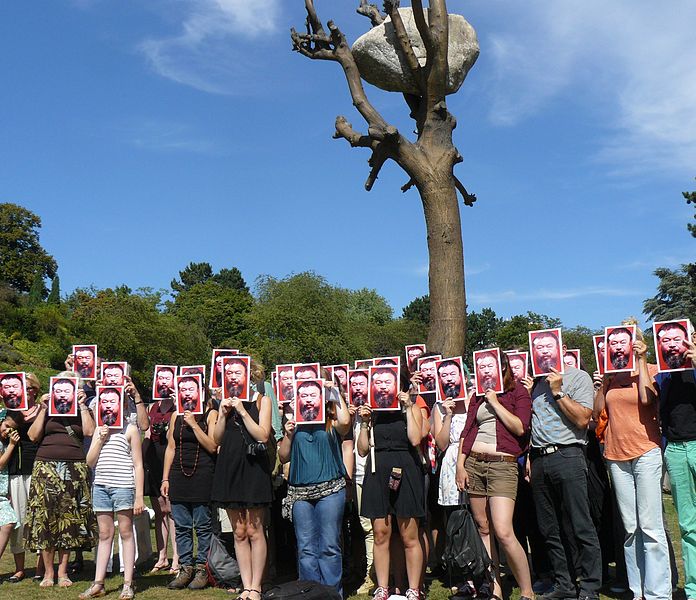
Ai Weiwei protest in Germany Kritiker9 from
The artist comes from a long line of free-thinkers and writers, marginalized both by the right and left.
Mao’s murderous purge of intellectuals, sent Ai Qing (his father) into exile where he spent his childhood years.
A young Ai remembers countless denunciation meetings of which Ai Qing was a primary target, the author bore intimate witness to his father’s ritualized humiliation.
His father, the poet Ai Qing, was his single greatest influence.
The family was sent to a labour camp, then to a rural village where Ai Qing was forced to clean communal toilets that included scraping faeces that had frozen “into icy pillars.
Ai said his father “as a poet, as an artist, [he] worked so hard at first, and it was very impressive…and I think that the only rewarding feeling he could get was to make the toilets so completely clean. That act influenced me a lot…So, you know, I was born radical, I did not become radical.”
Despite being a Communist party member, the influential poet was nevertheless exiled for twenty years after being denounced as a rightist, but has since been celebrated for his significant contribution to ‘modern poetry’.
2. His Father, Ai Qing was a Dissident in his own Right

Image by Catherine Cheng from
Ai was the eldest son of prosperous landowners who often abandoned him to the care of his nursemaid, a loving peasant woman named Big-Leaf Lotus.
The collapse of the Qing dynasty in 1911 mired the country in turmoil, but it also stirred in its youths new possibilities for the future.
At 19 Ai Qing travelled to France, where exposure to Apollinaire and Breton reshaped his aesthetic sensibility and honed an appreciation for the relationship between art and politics.
Upon his return to China in 1932, he was arrested in Shanghai’s French Concession for “causing a public disturbance through Communist Party activities,� an offence for which he served almost three years in prison.
It was from behind bars that Ai Qing composed his first masterpiece, “Dayanhe, My Wet Nurse,� a tender tribute to Big-Leaf Lotus and her countless Chinese countrywomen who toil and perish in obscurity.
Despite being a Communist party member, the influential poet was nevertheless exiled for twenty years after being denounced a rightist, but has since been celebrated for his significant contribution to ‘modern poetry’.
3. Ai Weiwei is a Western Trained Artist

Ai Weiwei “Template” Installation, swept down by a thunderstorm by David Gómez Fontanills from
He lived in New York City for 12 years, where he studied at Parsons School of Design and the Art Students League of New York.
Ai came of age as an art student in 1990s New York. A time and place where the more outrageously anti-authoritarian and oppositional the statement, the better.
He then returned to China, an environment far less open to such views. In Ai’s words, “China and the U.S. are two societies with very different attitudes towards opinion and criticism.”
Trained in the West, Ai is intimately familiar with Conceptual and Minimalist traditions and combines them. In his refusal to pleasure the eye, he is the opposite of Jeff Koons, his equally famous contemporary.
David Hammons, Robert Gober and Doris Salcedo works are aligned to that of ai Weiwei.
They aim to break free from the confines of the gallery and the museum and bridge the gap between the visual and the social
A suppressed dissident in China but admired artist in Europe: Ai Weiwei is celebrated in Europe for the same works that create problems for him at home.
4. Ai Weiwei’s Wife is also an Artist

Image by Andy Miah from
Ai Weiwei’s wife, Lu Qing, is also an artist. Her husband’s work is a form of activism while hers is a form of reflection.
Lu Qing is a Chinese Asian modern and contemporary art. Both of her parents had a background in the arts.
She ignored warnings not to follow in their footsteps for fear of the persecution and imprisonment of the artists that occurred during the cultural revolution.
Lu Qing is quoted saying, “I became an artist to focus on my own interests”.
She graduated, from the printmaking department, Central Academy of Fine Arts, Beijing, China, in 1989.
Lu Qing, produces a single work annually, filling an 82ft long bolt of silk with painted grid patterns.
5. Ai Wei is a Recorded Musician
Ai Weiwei released a 6 track album titled “The Divine Comedy� and he has published two singles on his YouTube Channel.
The video for the first single, â€Æà³Ü³¾²ú²¹²õ²õâ€� is a dramatization of the artist’s arbitrary 81-day detention in 2011.
His second, “Laoma Tihua� is filmed in the style of a hidden camera and documents several instances of dubious police behaviour.
While the idea of 55-year old Ai recording a heavy metal record might seem like a stunt, the source material for his first single, â€Æà³Ü³¾²ú²¹²õ²õâ€� is anything but funny.
The furiously angry, expletive-filled song is inspired by Ai’s harsh treatment during his 81-day imprisonment in 2011.
6. Ai Wei Wei is a Professional Blackjack Player

Image by from
He’s an amazing blackjack player.
It was during his time as an art student in New York that he also developed an interest in blackjack, making frequent trips to Atlantic City.
The artist was considered a top tier professional blackjack player in gambling circles after making frequent trips to Atlantic City during his 12-year stay in New York.
Perhaps he was a good professional blackjack player because his work is about risk (personal, professional, and political).
It is also about testing the limits of freedom. His work is designed to remind us that risk-taking is an essential form of exercise in a free society.
Today, he is still regarded as a top tier professional blackjack player amongst gamblers.
7. Ai has Mastered the use of Social Media as a Tool for his Art

Image by from
Ai’s online practice is central to his artistic and aesthetic activity.
Ai Weiwei is not afraid to shock and confront people with his artworks. His artworks are mostly related to political issues and events.
He is also one of the earliest conceptual artists to use social media – Instagram and Twitter, in particular – as one of his primary media.
Ai has been a major contributor to Chinese social media and a key figure in its censorship too.
Not only has he advocated democratic change within the highly authoritarian state, but he has authored a meme on the Chinese Internet telling the Communist Party precisely where to go.
Consequently, the Chinese Government has legislated to ban online puns due to Ai’s social media activity.
You can find him on Twitter at . As the majority of his posts are in native Mandarin, a group of industrious artists have created a Twitter account that translates Ai Weiwei’s tweets into English (), which are then posted on a Tumblr account.
However, in 2021 Ai warned that owners of social media’s put commercial interests before freedom of speech.
8. Ai Weiwei has been Under China Government Surveillance for over a Decade

Image by from
Under government surveillance for almost a decade, he has produced some of the most thoughtful work on this contemporary topic that is just as important in current popular culture as the hippies were in the 1960s or the feminists in the 1970s.
Openly critical of the Chinese government, artist-activist Ai Weiwei knows what it’s like to be under surveillance.
The artist was arrested in 2011 for being an outspoken critic of the communist regime and has had countless run-ins with censorship through much of his art practice.
In a subversive nod to his constant surveillance Ai Weiwei has several webcams at his own home, live streaming his every move from his website.
Government spying, a hot topic in contemporary art lately, is not some futuristic idea but a fact of life for Ai.
9. Ai Helped Design the Bird’s Nest Stadium

Image by from
Chinese artist Ai Weiwei helped design the stadium. He intimated that it was conceived in the spirit of democracy and freedom.
The National Stadium, known as the Bird’s Nest, was the centrepiece of the Olympic venues built for the 2008 Summer Games in Beijing.
The saddle-shaped structure got its nickname from the latticework of twisting steel that wraps around it, lights glowing from inside at night.
Despite being nicknamed the Bird’s Nest, he has claimed a toilet seat inspired his design for the Beijing Olympic Stadium.
The Chinese dissident artist stated in a Japanese newspaper that he regrets his contribution to building the radical stadium which became a centrepiece for the promotion of a new modern China.
10. Ai Weiwei had Never used a Computer Before 2005

Image by from
Ai came late to technology but adopted it with gusto.
Ai Weiwei never used a computer never really knew how to type before 2005 and was invited by Sina.com, which is a big Internet company in China, to have a celebrity blog.
He was a well-known architect and artist, and he decided to take that on.
So from 2006 to 2009, he maintained a blog in which he heavily criticized the Chinese government.
Although the blog has been taken down by Chinese authorities, its contents have been collected in a book, “Ai Weiwei’s Blog: Writings, Interviews, and Digital Rants, 2006-2009.�
He immediately was drawn to the medium. He’s always been looking for ways to communicate and he saw the Internet as the solution.
Art is a way to express feelings without the need for violence. Ai Weiwei is one of the artists who have perfected protest art and has created projects to speak against China’s communist government injustices.
No violence is necessary because they are just simply pieces of art that speak for themselves.
Through art Ai Weiwei is able to bring awareness and get people to support his causes around the world.
Planning a trip to Â鶹APP ? Get ready !
These are ´¡³¾²¹³ú´Ç²Ô’²õÌý²ú±ð²õ³Ù-²õ±ð±ô±ô¾±²Ô²µÂ travel products that you may need for coming to Â鶹APP.
Bookstore
- The best travel book : Rick Steves – Â鶹APP 2023 –Ìý
- Fodor’s Â鶹APP 2024 –Ìý
Travel Gear
- Venture Pal Lightweight Backpack –Ìý
- Samsonite Winfield 2 28″ Luggage –Ìý
- Swig Savvy’s Stainless Steel Insulated Water Bottle –Ìý
We sometimes read this list just to find out what new travel products people are buying.


