
 English


Arrival at Schiphol; Her Majesty and President Ziaur Rahman. Photo by Croes, Rob C.
Top 10 Facts about Ziaur Rahman
Ziaur Rahman also known as Komol, was a Bangladesh Army officer who later became a politician and served as Bangladesh’s President from 1977 to 1981. On 30 May 1981, he was assassinated in Chittagong during an army coup.
During the country’s independence war from Pakistan in 1971, Rahman was a Bangladesh Forces Commander of BDF Sector 1 initially, and from June as BDF Commander of BDF Sector 11 of the Bangladesh Forces and the Brigade Commander of Z Force from mid-July. On March 27. He broadcasted the Bangladesh Declaration of Independence from Chittagong’s Kalurghat radio station. Rahman rose through the ranks of the Bangladesh Army, serving as a brigade commander, deputy chief of staff, and chief of staff.
His rise to power was the result of a conspiracy that began with the assassination of Bangladesh’s founding president, Sheikh Mujibur Rahman, in a military coup d’état, followed by a coup and counter-revolt within the military to seize control of the country. Under the Mushtaq government’s martial law, Ziaur Rahman gained de facto power as the head of the government. In 1977, he was elected President.
1. Rahman enrolled Rahman in a Calcutta boys school, Hare School

Calcutta Boys’ School Main Campus. Photo by Subhrajyoti07.
He studied until the dissolution of the British Empire in India and the partition of India and Pakistan in 1947. Mansur Rahman exercised his right to become a citizen of a Muslim-majority Pakistan and relocated to Karachi, Pakistan’s first capital, in Sindh, West Pakistan, in August 1947.
In 1947, Zia was 11 years old and enrolled in class six at Karachi’s Academy School. Rahman spent his adolescent years in Karachi, where he graduated from secondary school at the age of 16.
2. He joined Pakistan Military Academy
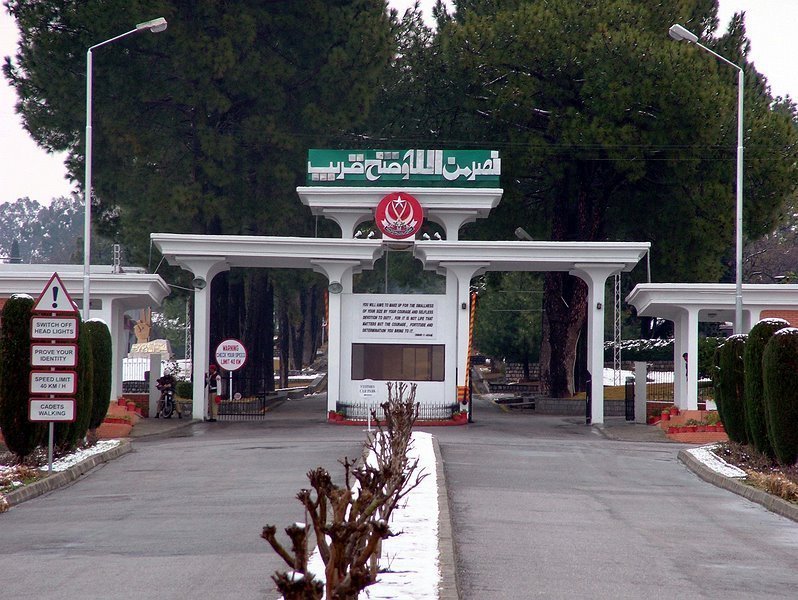
The main gate of the Pakistan Military Academy. Photo by Hassanpak30.
Rahman was admitted to the D. J. Sindh Government Science College in 1953. In the same year, he enrolled as a cadet at the Pakistan Military Academy in Kakul.
3. Rahman graduated from PMA in top 10% of his class

PMA passing out parade. Photo by Muhammadoweis.
Rahman was commissioned as a second lieutenant in the Pakistan Army after graduating from the Pakistan Military Academy’s 12th PMA long course on 18 September 1955 in the top 10% of his class. He received commando training, became a paratrooper, and completed a special intelligence course while in the army.
4. He married at 24 years

Man and wife holding hands at a wedding. Photo Jubair Ahmed Himu.
In August 1960, he married Khaleda Khanam Putul, the 15-year-old daughter of Iskandar Majumder and Taiyaba Majumder of Feni District (part of then Noakhali District). Khaleda Khanam Putul, later known as Khaleda Zia, became Bangladesh’s Prime Minister twice.
Rahman, a captain in the then-Pakistan Army who was assigned as an Officer of the Defense Forces at the time. His father, Mansur Rahman, was unable to attend the wedding because he was in Karachi. Zia’s mother had passed away earlier.
5. Rahman was transferred to East Bengal Regiment

East Bengal Regiment Insignia. Photo by Dr. Editorial.
Rahman paid a brief visit to East Pakistan and was struck by the Bengali middle class’s hostility toward the military, which consumed a large portion of the country’s resources. The low representation of Bengalis in the military was largely due to discrimination, but Rahman believed that Bengali attitudes toward the military discouraged promising young Bengalis from pursuing military careers.
As a Bengali army officer, he advocated for Bengali youth to pursue military careers. He was transferred to the East Bengal Regiment in 1957 after serving for two years in Karachi. He attended British Army military training schools. From 1959 to 1964, he also worked in the military intelligence department.
6. He was awarded the Hial-e-Jurat, Pakistan’s second-highest military award
Ayub Khan’s highly successful military rule from 1958 to 1968 convinced Rahman that a fundamental shift in Bengali attitudes toward the military was required. During the Indo-Pakistani War of 1965, Rahman commanded a company (military unit) of 100-150 soldiers in the Khemkaran sector of Punjab.
The Pakistan government awarded Rahman the Hilal-i-Jur’at for gallantry medal, Pakistan’s second-highest military award, and the first Battalion of the East Bengal Regiment (EBR) under which he fought won three Sitara-e-Jurat (Star of Courage) medals and eight Tamgha-i-Jurat (Medal of Courage) medals for their role in the 1965 War with India.
7. Rahman was appointed military instructor at the Pakistan Military Academy
The main gate of the Pakistan Military Academy. Photo by Hassanpak30.
He was appointed military instructor at PMA in 1966, and later attended the Command and Staff College in Quetta, Pakistan, where he completed a course in command and tactical warfare. During his time as an instructor, Rahman assisted in the formation of two Bengali battalions known as the 8th and 9th Bengals.
On 20 November 1966, his wife Khaleda Zia, now 24, gave birth to their first child, Tarique Rahman. Rahman joined the 2nd East Bengal regiment as its second-in-command in Joydebpur, Gazipur district, near Dhaka, in 1969, and later traveled to West Germany to receive advanced military and command training from the British Army of the Rhine.
8. Rahman was promoted to major

Ziaur Rahman. Photo by Croes, Rob C. / Anefo.
In October 1970, he was assigned as second-in-command of the 8th East Bengal Regiment in Chittagong. East Pakistan had been devastated by the 1970 Bhola cyclone. The population was irritated by the central government’s slow response and the political conflict between Pakistan’s two major parties, Sheikh Mujibur Rahman’s Awami League and Zulfiqar Ali Bhutto’s PPP.
The Awami League won a majority in the 1970 Pakistan Parliamentary elections, and its leader Sheikh Mujib laid claim to form a government, but Pakistan President Yahya Khan postponed the legislature’s convening under pressure from Zulfikar Ali Bhutto’s PPP party.
9. Zia publicly declared Bangladesh’s newly formed independence from Pakistan
After last-ditch talks failed, Yahya Khan declared martial law and directed the army to crack down on Bengali political activities. Sheikh Mujibur Rahman was apprehended before midnight on March 26, 1971, and flown to West Pakistan from Tejgaon International Airport.
Zia, who was already planning a revolt against the Pakistani government, revolted and later arrested and executed his commanding officer, Lt. Col. Janjua. Before his (Ziaur Rahman) arrest on 27 March 1971 from Kalurghat, Chittagong, he was requested by local Awami League supporters and leaders to announce the Declaration of Independence that was earlier (in the early hours of 26 March 1971) proclaimed by the undisputed Bengali leader Bangabandhu Sheikh Mujibur Rahman, as an Army officer’s words would carry weight in restoring people’s trust in the ‘Declaration of Independence.’
10. He was on house arrest in 1975
After Shafiullah resigned, Major General Ziaur Rahman (then deputy chief of army staff) was appointed as army chief of staff. However, the 15 August coup resulted in a period of instability and unrest in Bangladesh, as well as among the ranks and files of the armed forces. On 3 November 1975, Brigadier Khaled Mosharraf and the 46th Brigade of Dhaka Cantonment, led by Colonel Shafaat Jamil, revolted against Khandaker Mushtaq Ahmed’s administering, forcing Ziaur Rahman to resign and be placed under house arrest.
Planning a trip to Â鶹APP ? Get ready !
These are ´¡³¾²¹³ú´Ç²Ô’²õÌý²ú±ð²õ³Ù-²õ±ð±ô±ô¾±²Ô²µÂ travel products that you may need for coming to Â鶹APP.
Bookstore
- The best travel book : Rick Steves – Â鶹APP 2023 –Ìý
- Fodor’s Â鶹APP 2024 –Ìý
Travel Gear
- Venture Pal Lightweight Backpack –Ìý
- Samsonite Winfield 2 28″ Luggage –Ìý
- Swig Savvy’s Stainless Steel Insulated Water Bottle –Ìý
We sometimes read this list just to find out what new travel products people are buying.


